
Introduction
Summary: 2026 ADU Building Costs. Building an ADU in 2026 requires navigating new Title 24 energy mandates and aggressive zoning overrides. Costs range from $150,000 for garage conversions to $400,000+ for detached units. This guide provides the exact math, tax logic, and structural engineering data needed for a successful build. Note: Local labor rates for ADU construction changed in Jan 2026. See our full regional cost table below.
Video Guide Overview
Affiliate Disclosure
I believe in transparency: both in construction and in business. This article contains affiliate links to tools and services I personally use or have vetted for my own flips. If you click and buy, I might get a small commission at no extra cost to you. It keeps the lights on at HousingAfter60.com so I can keep telling you the truth about your money.
The Short Answer
2026 ADU Building Costs. Building an ADU (Accessory Dwelling Unit) is no longer a “hobby project” for the sentimental. In 2026, it is a high-stakes real estate maneuver that can increase property value by 30%, provided you survive the $250+ per square foot construction costs and the IRS’s evolving stance on separate-unit sales.
Introduction: The Death of the Backyard Shed
I have flipped over 100 properties in my 23 years in this game, and I have seen it all. I’ve seen homeowners “build” a granny flat that was essentially a glorified garden shed with a space heater and a prayer. In 2026, those days are dead. If you try that now, the building department will eat you alive, and your insurance company will laugh you out of the office when the unpermitted wiring inevitably sparks.
We are currently in a housing crunch that makes the 2008 crash look like a minor hiccup. If you are over 60, you aren’t just looking for a place for Mom to stay; you are looking for a way to hedge against inflation, protect your equity, and maybe even secure a secondary income stream that doesn’t involve the volatility of the stock market. But let’s be blunt: if you don’t understand the first-principles logic of structural engineering and tax code, you are just writing a blank check to a contractor who is probably already planning his next vacation on your dime.
I’m Charles O’Dell. I don’t care about the “cozy vibes” of your backyard. I care about your bottom line. Let’s get into the math.
Technical Deep Dive: Structural Engineering and the 2026 Title 24 Shift
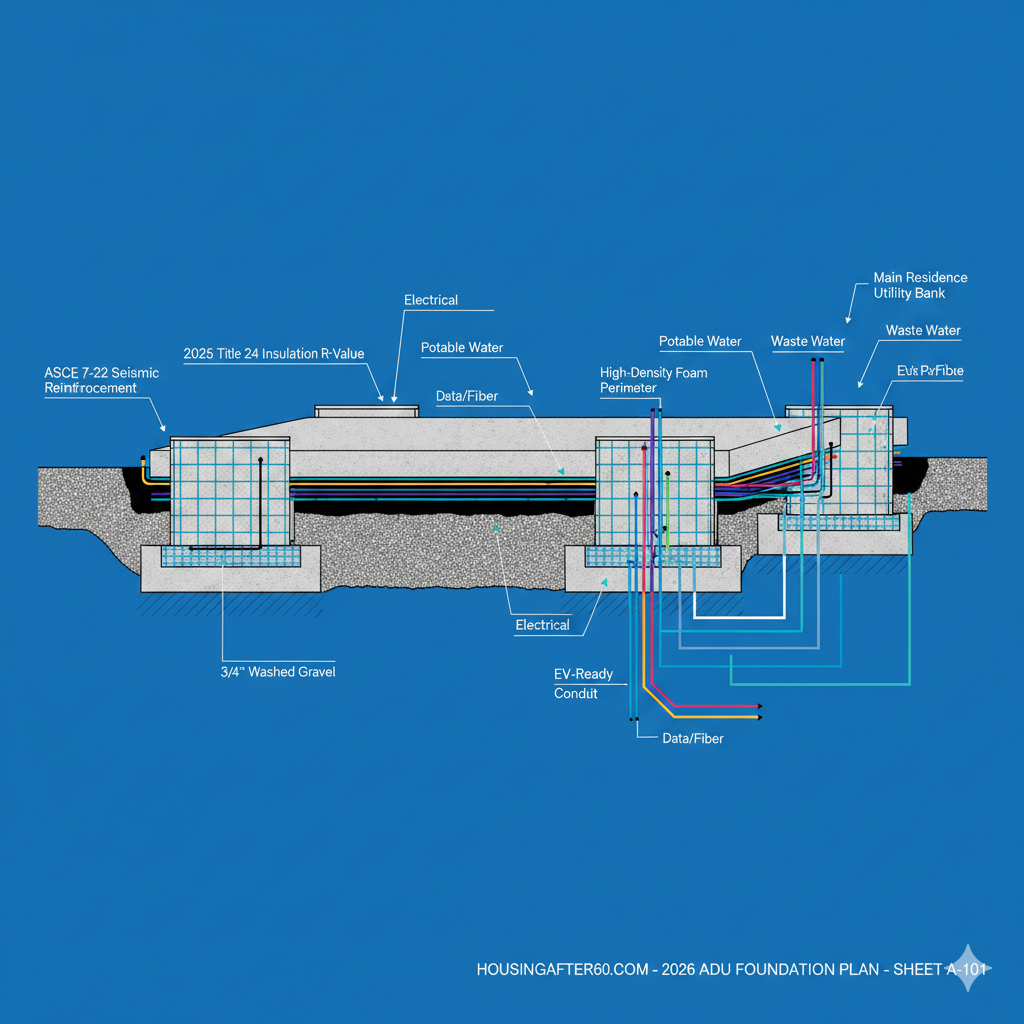
2026 ADU Building Costs.. When we talk about building in 2026, we are talking about the “2025 California Building Standards Code” (Title 24), which took full effect this January. This isn’t just a list of suggestions. For any ADU submitted for permits today, the structural requirements have shifted toward ASCE 7-22 standards. This means we are seeing revised seismic hazard maps and stricter wind design procedures.
If you are building a detached ADU, your foundation physics have changed. We are no longer just pouring a slab and calling it a day. In many seismic zones, you now need deeper footings and increased rebar reinforcement to handle the updated lateral-system demands. This adds roughly 12% to your concrete and masonry costs compared to 2024. Furthermore, the CER (Clean Energy for New Federal Buildings) influence has trickled down to residential mandates. You are now required to have electric-ready infrastructure, meaning your ADU’s electrical panel must be sized for high-efficiency heat pumps and EV charging, even if you don’t install the charger today. This requires a 200-amp service upgrade for most older primary residences, a “hidden” $5,000 cost that most DIY blogs won’t tell you about.
| Cost Category | Low-End (DIY/Basic) | High-End (Pro/Premium) |
|---|---|---|
| Foundation & Site Prep | $18,000 | $45,000 |
| Framing & Structural | $35,000 | $85,000 |
| Plumbing/Elec/HVAC | $22,000 | $55,000 |
| Total Estimated Cost | $75,000 (Conversion) | $415,000 (Custom Detached) |
Multigenerational Math: More Than Just Four Walls
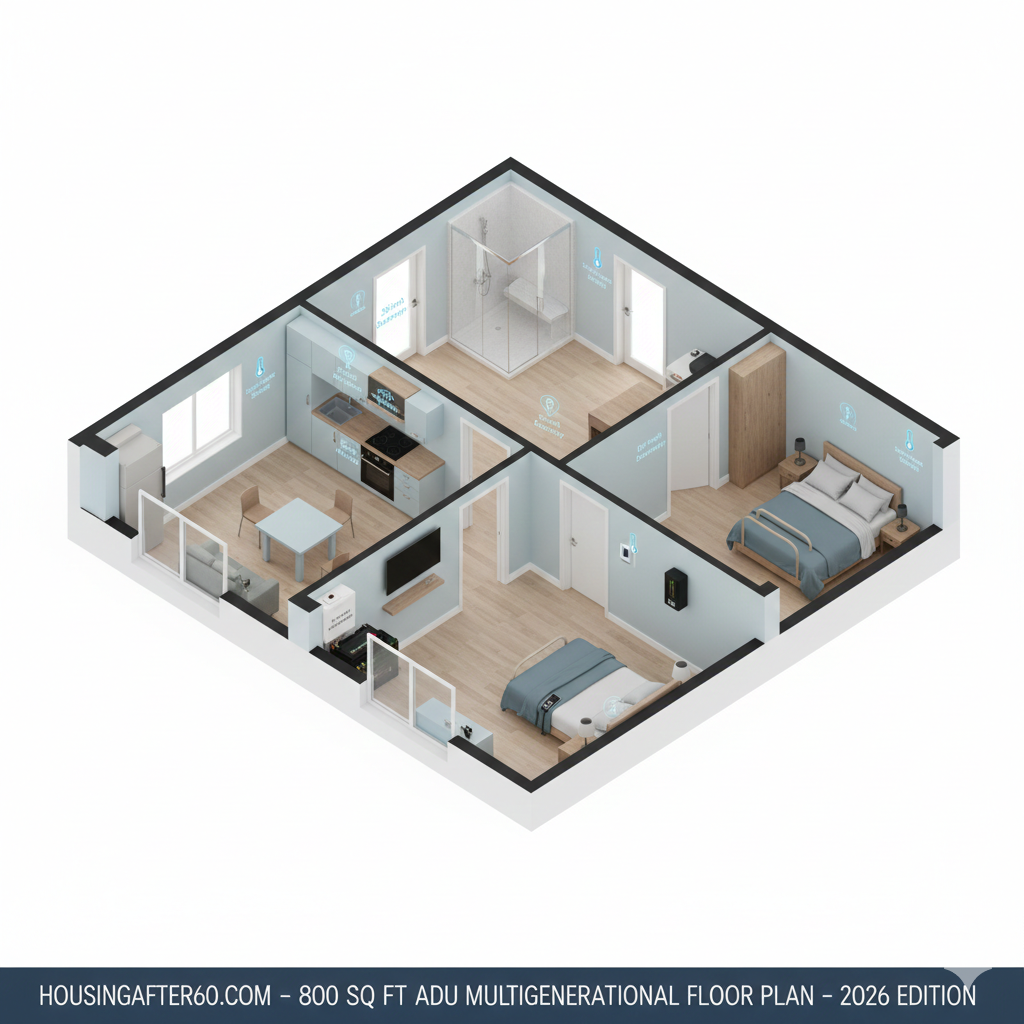
If you’re building this for “Aunt Sarah” or your aging parents, you need to stop thinking about it as a guest house and start thinking about it as a clinical facility that looks like a home. Most people make the mistake of building an ADU with standard 30-inch doors. Guess what? A wheelchair needs 32 inches of clear space. If you don’t plan for 36-inch doors now, you’ll be ripping out drywall in five years when Sarah’s hip gives out. That’s an inefficiency I won’t tolerate in my projects.
In 2026, the real value in ADUs for the 60+ crowd is the “Caregiver Contract.” We are seeing a massive surge in families using the ADU as a way to house a full-time caregiver. This isn’t just a nice gesture; it’s a strategic move to preserve the estate. By paying a family member or a pro to live in the ADU and provide care, you are essentially transferring wealth out of the taxable estate in exchange for services, which can be a vital component of Medicaid planning. But you better have a written contract, or the IRS will call it a gift and hit you with a penalty.
Technical Deep Dive: Family Caregiver Contracts and 2026 Medicaid Logic
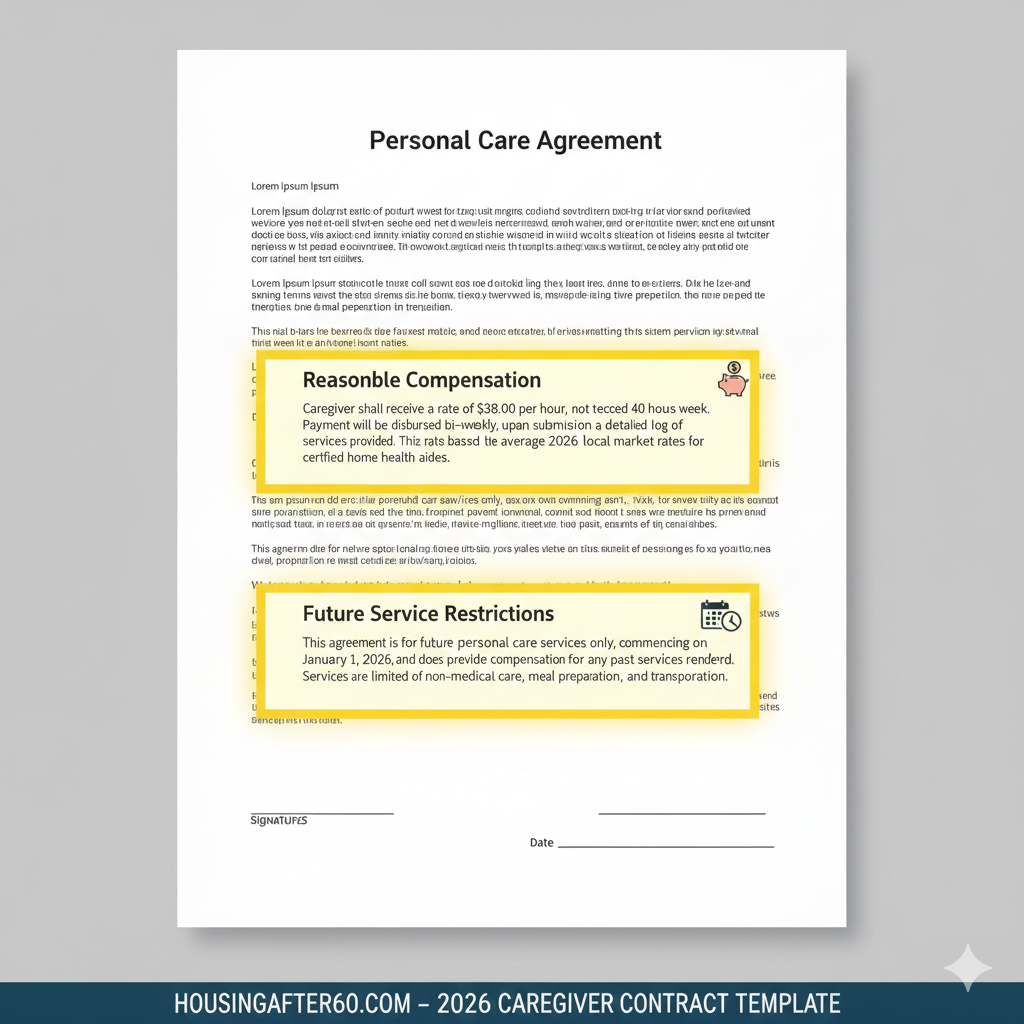
Under 2026 guidelines, a Personal Care Agreement must be an “arms-length” transaction. This means you cannot pay your grandson $5,000 a week to “keep an eye on you.” The compensation must be reasonable, based on local 2026 labor rates for home health aides (currently averaging $32-$45 per hour in most metro areas). If the payment exceeds these rates, the excess is treated as a “gift” for Medicaid’s five-year look-back period.
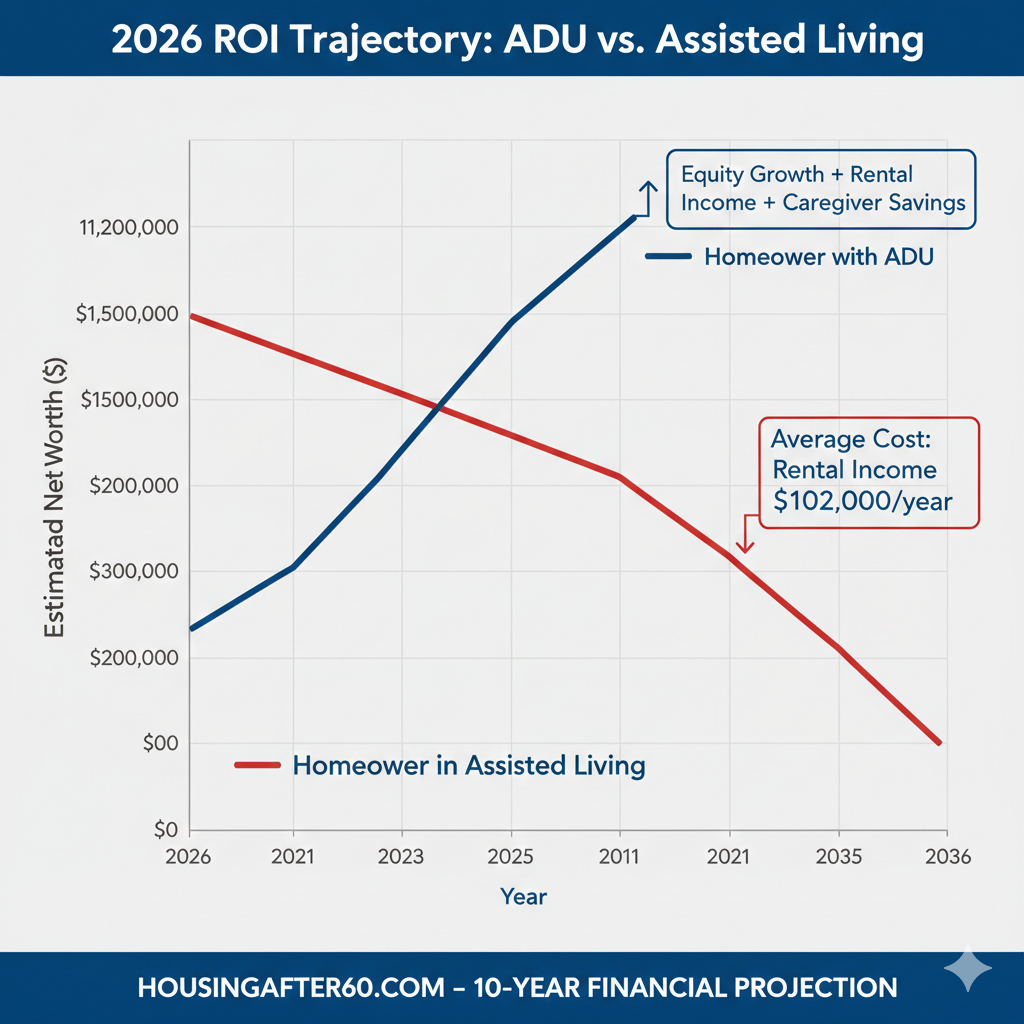
Moreover, the contract must be for future services. You cannot pay “back-pay” for the three years your daughter took care of you for free. From a first-principles perspective, this contract is an employment agreement. You, as the homeowner, are the employer. This means you are responsible for FICA, FUTA, and potentially workers’ comp. Failing to account for these “soft costs” in your ADU budget is a rookie mistake. If the ADU costs $200,000 to build, but it allows you to avoid $12,000 a month in assisted living costs, your “break-even” point is roughly 17 months. That is a 70% annual return on investment. Show me a REIT that does that. [Image of Multigenerational Floor Plan]
| Affiliate Product | 2026 Tech Feature | Price Point |
|---|---|---|
| Sentri-Flow Leak Detector | AI-driven auto-shutoff for ADU plumbing lines. | $349.00 |
| Lutron Caséta ADU Hub | Smart lighting with “occupancy logic” for safety. | $189.99 |
| Eco-Flow Delta Pro 3 | 2026-compliant battery backup for ADU life-support systems. | $3,200.00 |
Zoning and Regulatory Hurdles: The 2026 Sledgehammer
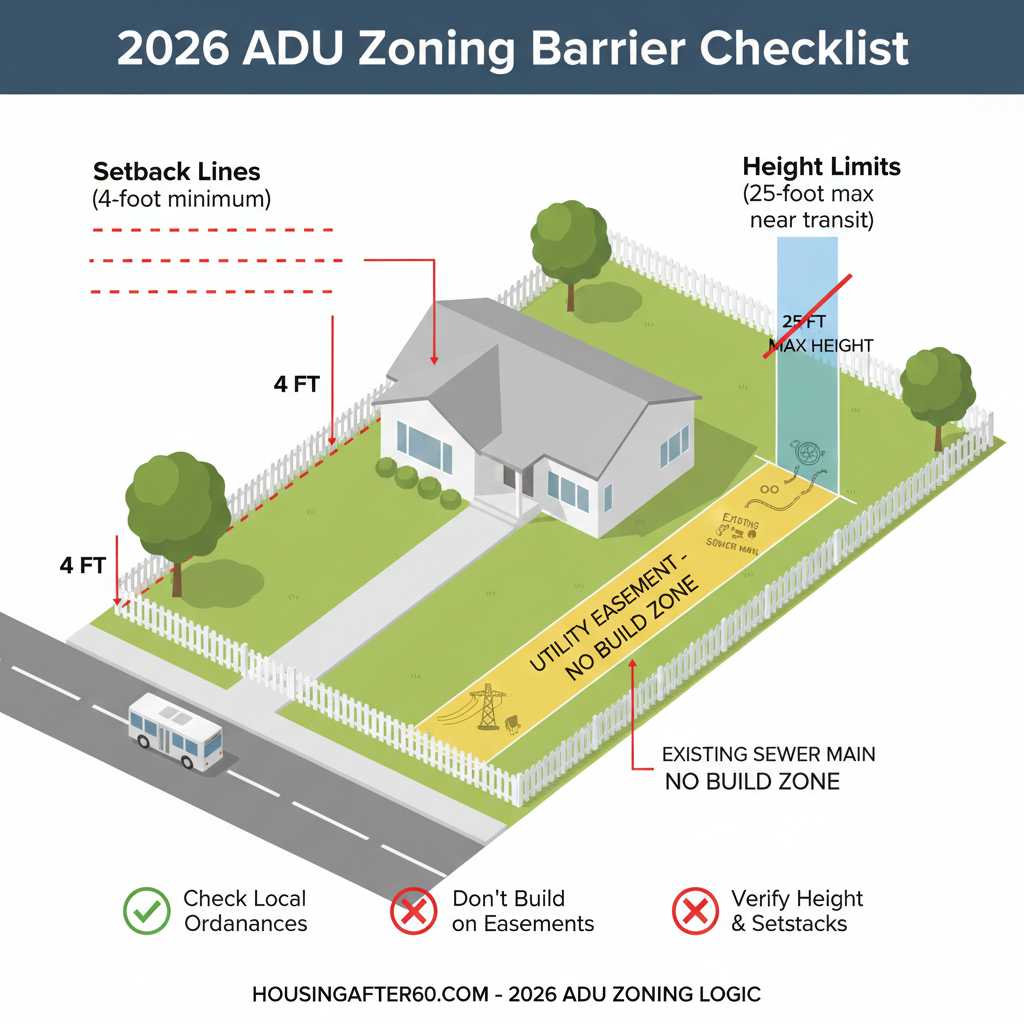
If you live in a state like California, the 2026 laws (including AB 1154 and SB 543) have effectively stripped local cities of their power to block your ADU. I love this. It’s logic winning over NIMBY-ism. Cities can no longer require “owner occupancy” for ADUs permitted after Jan 1, 2026. This means you can rent out both your main house AND the ADU. You’ve effectively turned your single-family home into a duplex overnight.
2026 ADU Building Costs. However, don’t think this is a free-for-all. The “shot-clock” rules are your best friend. Cities now have 60 days to approve or deny your plans. If they don’t act, the permit is “deemed approved.” But here is the risk: if your plans are technically flawed—say, you didn’t account for the 2026 fire-sprinkler mandate (now required if the primary residence has them)—that “deemed approved” status won’t save you from a “stop-work” order later. I’ve seen guys lose $50,000 in carrying costs because they didn’t hire a licensed structural engineer to stamp their plans. Don’t be that guy.
Technical Deep Dive: Zoning Variance and MEP Cycles
Mechanical, Electrical, and Plumbing (MEP) cycles in 2026 ADUs are dominated by the “Electric-Only” push. Many jurisdictions are banning new natural gas hookups for ADUs. This forces you into Heat Pump Technology for both HVAC and water heating. From a structural load-path perspective, an 80-gallon hybrid heat pump water heater weighs significantly more than a traditional gas unit. If you are placing this in an attic or a raised floor, your joist spans must be calculated for this “dead load.”
Additionally, the 2026 WUI (Wildland-Urban Interface) codes have expanded. Even if you aren’t in a “forest,” if your local map has been updated, you now need ember-resistant vents and non-combustible siding (like James Hardie or stone veneer). This isn’t for “looks”; it’s a structural requirement to ensure your ADU doesn’t become a torch that takes out your primary home. We calculate the R-value of your assembly not just for comfort, but to meet the strict “High-Performance Attic” requirements of the 2025 code cycle. This usually means R-38 or higher, requiring 12+ inches of insulation. If your ADU has a vaulted ceiling, you better be using spray foam or your rafters will need to be 14 inches deep. More wood equals more money.
Tax Logic: IRC Section 121 and the 2026 Shift
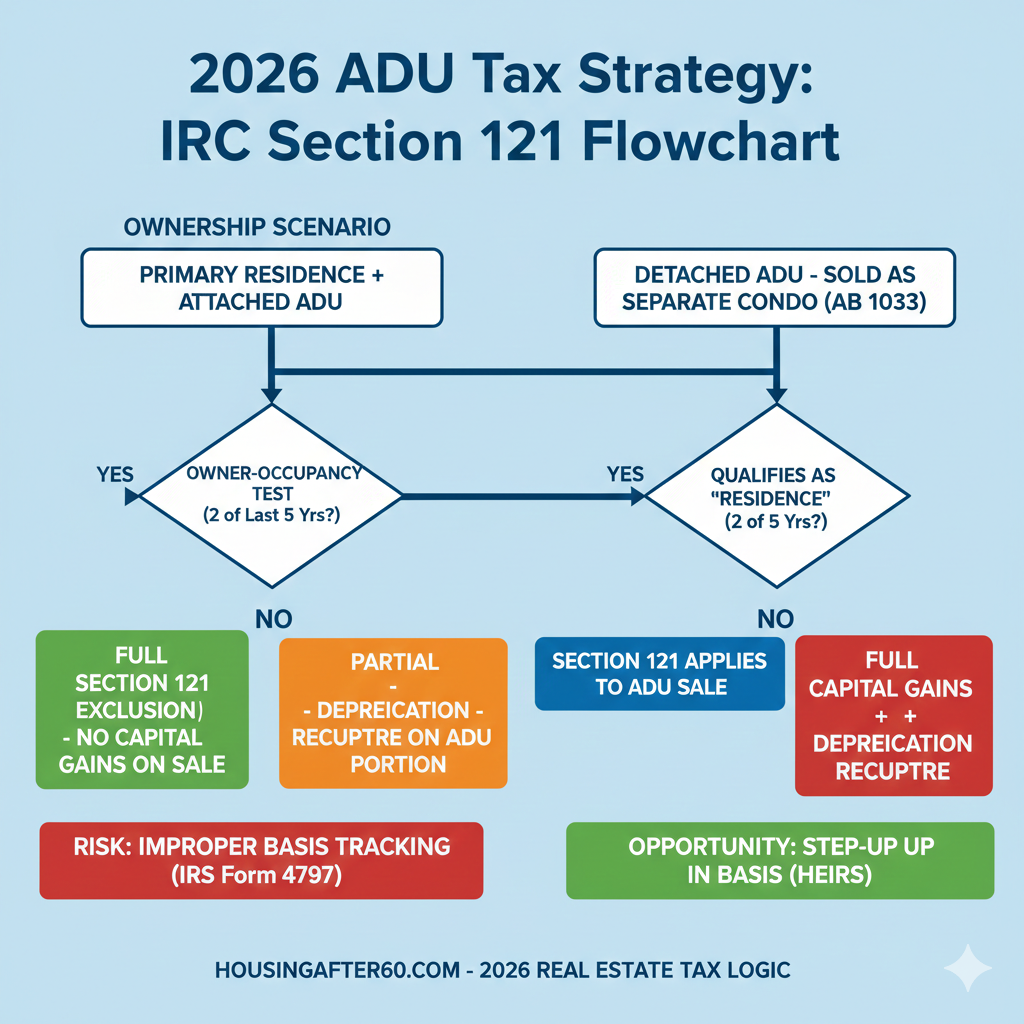
Let’s talk about the IRS. They aren’t your friend, but they are predictable. One of the biggest mistakes I see homeowners make is not understanding IRC Section 121. Normally, you can exclude up to $250,000 ($500,000 for couples) of gain from the sale of your primary residence. But what happens when you build an ADU and then sell it separately as a condo (allowed under AB 1033 in some cities)?
In 2026, the IRS is looking closer at “dual-use” property. If you’ve been renting out the ADU for three years and then sell the whole property, you cannot apply the Section 121 exclusion to the portion of the gain attributable to the rental ADU. You will owe Capital Gains Tax and Depreciation Recapture on that unit. I’ve seen people hit with $40,000 tax bills they didn’t see coming because they didn’t track their “basis” correctly from day one of construction. You need to read our guide on real estate tax strategies for seniors before you break ground.
Technical Deep Dive: 2026 Step-Up in Basis and Capital Gains
The “Step-Up in Basis” is the holy grail of real estate for those over 60. Under 2026 rules (which survived the last legislative session despite threats of reform), when you pass away, your heirs inherit the property at its current market value, not what you paid for it. If you build an ADU today for $200,000 and it adds $350,000 in value, and then you pass away in ten years when it’s worth $600,000, that $400,000 gain is effectively wiped out for your heirs. It’s a Tax-Free Wealth Transfer machine.
However, if you sell the property while you are alive to “downsize,” you are playing a different game. You must allocate the sales price between the primary home and the ADU. If the ADU was used for business (rental), you must use IRS Form 4797. The logic here is simple: the government wants their cut of the depreciation you claimed while you were a landlord. If you haven’t been keeping a “Depreciation Schedule” for the ADU, your CPA is going to have a very expensive headache come April. First-principles rule: never build without an exit strategy that accounts for the tax man.
| Project Type | Est. Labor (2026 Rates) | Est. Materials | Total All-In |
|---|---|---|---|
| Garage Conversion (400sf) | $45,000 | $50,000 | $95,000 |
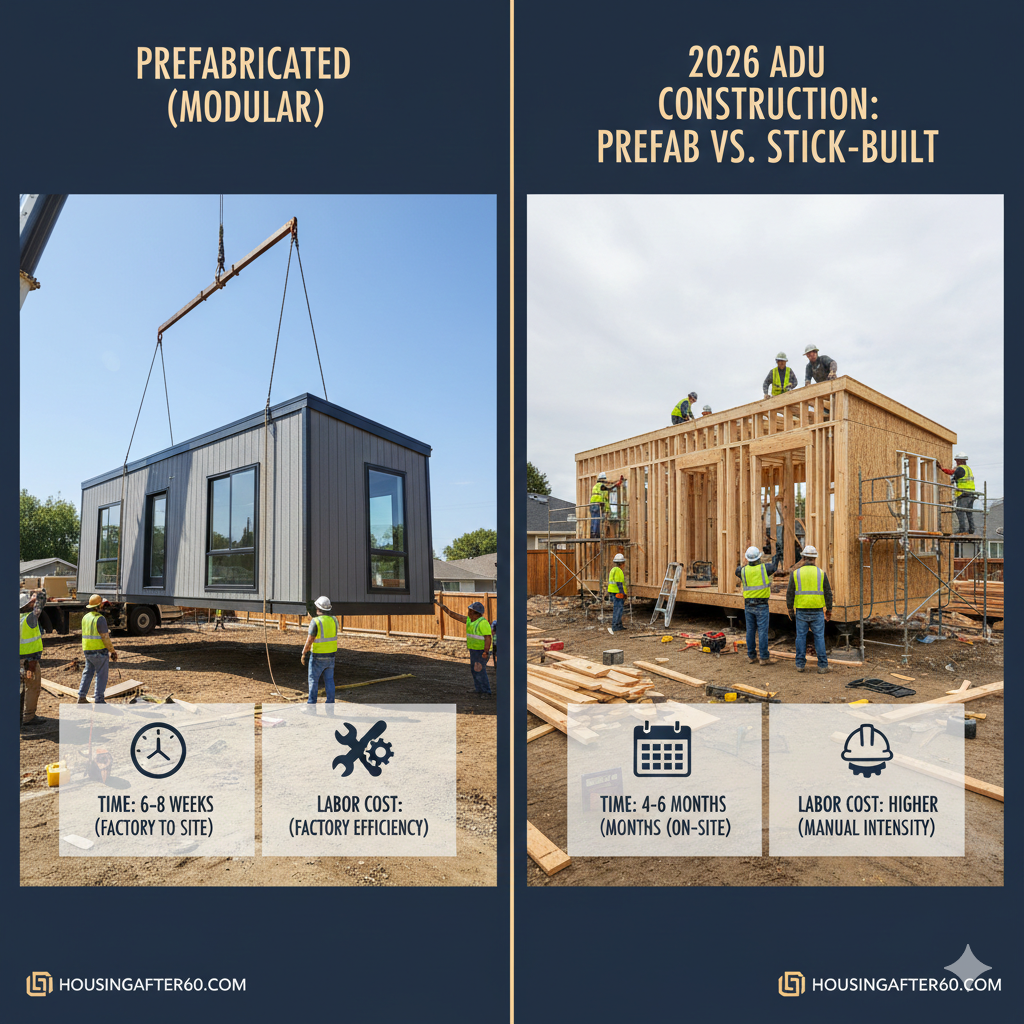
| Detached Prefab (800sf) | $80,000* | $160,000 | $240,000 |
| Custom Stick-Built (1200sf) | $180,000 | $220,000 | $400,000+ |
*Prefab labor includes site prep, utility hookups, and crane rental.
ROI Calculations: The 10-Year Trajectory
Why do people over 60 do this? It isn’t because they love construction dust. It’s because the Opportunity Cost of doing nothing is too high. If you have $300,000 sitting in a high-yield savings account earning 4%, you’re making $12,000 a year (and paying income tax on it). If you put that $300,000 into a 2-bedroom ADU in a high-demand market, you could easily pull in $2,500 a month in rent. That’s $30,000 a year, or a 10% cash-on-cash return.
But the real ROI is in the “Assisted Living Avoidance.” The average cost of a private room in an assisted living facility in 2026 is crossing $8,500 a month. That’s $102,000 a year of after-tax dollars going up in smoke. If an ADU keeps you or your spouse at home for even three years, it has paid for itself entirely. That is the logic I use for every flip and every client. You are buying freedom, not just floor space.
Technical Deep Dive: Net Worth and 2026 Market Valuations
In a 2026 real estate market, properties with ADUs are commanding a “utility premium.” This is different from a simple “square footage” appraisal. Appraisers are now using the Income Approach more frequently for residential properties with ADUs. If your ADU generates $24,000 in net operating income (NOI), and the local cap rate is 6%, that ADU just added $400,000 to your property’s value—even if it only cost you $250,000 to build.
We also have to look at Debt Service Coverage Ratio (DSCR) loans. In 2026, many homeowners are using the projected rent of the ADU to qualify for the very loan they use to build it. This is sophisticated financing that was unavailable to the average senior ten years ago. If your “debt-to-income” (DTI) is too high for a traditional refi, a DSCR loan on the ADU “unit” itself might be your path forward. This allows you to leverage the project with minimal personal income verification, assuming the math on the rent holds up. And in 2026, with the housing shortage, the rent always holds up.
2026 ADU Execution Checklist
If you’re serious about this, stop dreaming and start auditing. Follow these steps in order. No shortcuts.
- Conduct a Feasibility Audit: Hire a surveyor to identify your property lines and utility easements. You cannot build over a sewer main, no matter how much you want to.
- Check the “Shot-Clock”: Confirm your local building department is complying with the 60-day state approval mandate. If they aren’t, have your attorney ready to send a “Intent to Deem Approved” letter.
- Select Your Construction Method: Decide between Prefab (faster, fixed cost) or Stick-Built (more custom, higher labor risk). Review our prefab comparison guide for 2026 brands.
- Verify Electrical Capacity: Call an electrician to see if your current panel can handle a 200-amp upgrade for the ADU’s 2026 electric-only mandates.
- Draft the Caregiver Agreement: If a family member is moving in, get a written contract that specifies hours, duties, and “reasonable compensation” to satisfy Medicaid look-back rules.
- Review the 2026 Fire Code: Ensure your plans include fire sprinklers if your primary home has them, or if the ADU is more than 150 feet from the street curb.
- Set Your Tax Basis: Open a dedicated bank account for the project. Every nail, every permit fee, and every labor hour must be tracked to establish your “Cost Basis” for future IRS filings.
Internal Resources
- Using a Reverse Mortgage to Fund Your ADU in 2026
- How to Sell Your ADU as a Separate Condo under AB 1033
- Top 10 Smart Home Technologies for Senior Safety in 2026
- ALL COMING SOON
Summary: The Logic of the Build
2026 ADU Building Costs. Building an ADU is a brutal, technical, and expensive process. It is also the smartest financial move most people over 60 will ever make. By focusing on structural integrity, tax efficiency, and first-principles ROI, you can turn your backyard into a wealth-generating fortress. Don’t let the nostalgia for your old garden get in the way of a $400,000 equity boost. Get the permits, hire the engineers, and build it right the first time.
Bio: Charles O’Dell
Charles O’Dell is the founder of HousingAfter60.com and a veteran real estate investor with 23+ years of experience. He has flipped over 100 properties and facilitated hundreds of transactions for homeowners navigating the complexities of the 60+ market. Charles rejects “emotional fluff” in favor of first-principles logic and technical accuracy, helping seniors maximize their net worth through strategic real estate maneuvers. When he isn’t auditing floor plans, he’s teaching homeowners how to outmaneuver the IRS.
Built on 23 years of real estate experience and 100+ flips, Charles O’Dell breaks down ADU logic with first-principles precision.