
2026 Executive Summary: Contractor fraud risks. Hiring a contractor after age 60 is a high-stakes financial maneuver, not a social call. In 2026, labor shortages have spiked prices by 15%, leading to an influx of “storm chasers” and unlicensed workers. To protect your equity, you must use a first-principles approach: verify liquid assets, check 2026 insurance endorsements, and use milestone-based payments. Never pay more than 10% upfront. This guide provides the exact technical framework I use to vet crews for my own flips.
Note: Local labor rates for Contractor Services change constantly. See our full regional cost table below.

Introduction: Why I Don’t Trust “Nice” Guys
In my 23 years of flipping over 100 houses, I have heard every excuse in the book. “The truck broke down.” “My lead carpenter has the flu.” “I need more money for materials because prices went up at Home Depot this morning.” I don’t care about excuses. I care about the bottom line. When you are over 60, your home is likely your largest asset. You cannot afford to lose $50,000 to a contractor who spends your deposit at a casino or on a new truck wrap instead of buying your windows.
Most homeowners hire based on “vibes.” They like the guy because he was polite or showed up on time for the estimate. That is a logical fallacy. Politeness does not hammer nails. I look for technical competence, verifiable insurance, and a balance sheet that shows the contractor isn’t living hand-to-mouth. In 2026, the risk is higher than ever. Scams are becoming more sophisticated, using AI-generated portfolios to trick you. We are going to strip away the fluff and look at the cold, hard numbers. I’ve seen enough “tailgate” contractors disappear into the sunset with a retiree’s savings to know that a smile is not a substitute for a performance bond.
Video Guide Overview
Affiliate Disclosure
I believe in transparency. Some links in this article are affiliate links. If you buy a tool I recommend, I might get a small commission. This doesn’t cost you a penny extra, and I only recommend gear I actually use on my job sites to ensure my crews aren’t cutting corners or fudging measurements.
The “Short” Answer Contractor Fraud Risks
To hire an honest contractor in 2026, you must verify their license via state portals, demand a 2026-dated COI (Certificate of Insurance) sent directly from their agent, and sign a contract that ties payments to specific, inspected milestones. If a contractor asks for more than 10% or $1,000 down (whichever is less in most states), they are likely undercapitalized and represent a high default risk. True professionals have the credit lines to carry material costs until the first draw.
Technical Deep Dive: Structural Engineering and Foundation Physics
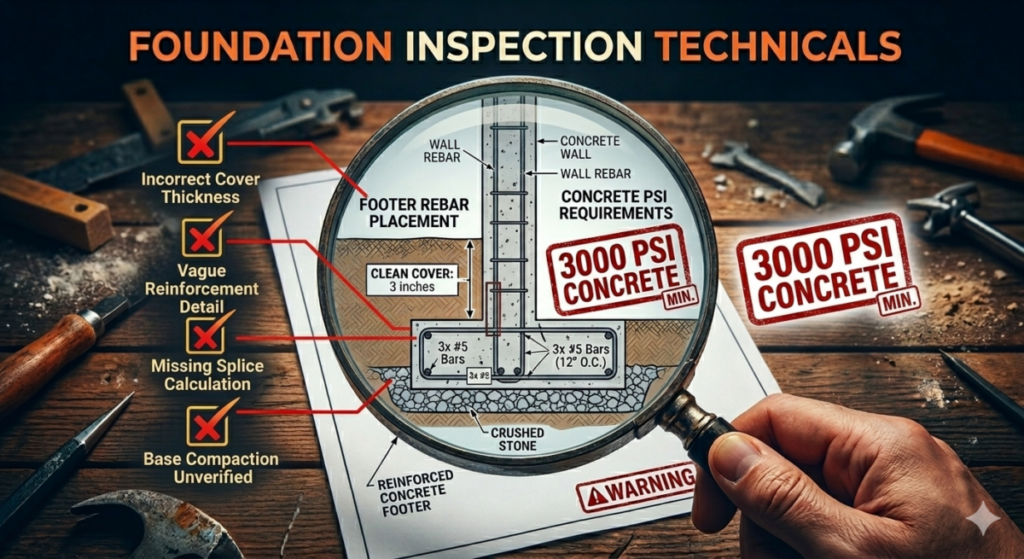
When you hire a contractor for an addition or a major remodel, you aren’t just buying “space.” You are altering the load-bearing integrity of a structure. In 2026, building codes have updated the requirements for concrete compression strength. Most residential footers now require a minimum of 3,000 PSI concrete, but for high-load areas, we look for 4,000 PSI with Grade 60 rebar reinforcement.
An “honest” contractor will talk to you about soil compaction and R-values. If they don’t mention the frost line or the specific load-bearing capacity of your soil (usually measured in pounds per square foot or PSF), they are guessing. A professional knows that a standard 1,500 PSF soil requires a wider footer to prevent settling. If your contractor suggests “just pouring a slab” without a site-specific engineering plan, they are a liability risk. Settling leads to cracked drywall and jammed doors, which kills your resale value. We prioritize foundation physics over aesthetics every single time.
Furthermore, the physics of lateral loads cannot be ignored. In 2026, wind-load requirements have been revised for many coastal and inland “high-wind” zones. Your contractor should be discussing hurricane ties (H-clips) and shear wall schedules. If they tell you “the weight of the roof holds it down,” they are living in 1980. Modern engineering requires a continuous load path from the roof rafters down to the foundation anchors. If they aren’t checking the torque on your J-bolts, they aren’t doing their job. I once saw a “pro” forget to wet-set his anchors in a fresh pour; I made him jackhammer the whole slab out on his own dime. That’s the level of scrutiny you need.
Technical Deep Dive: MEP (Mechanical, Electrical, Plumbing) Cycles
Your home’s internal organs—the MEP systems—have a specific lifespan. In 2026, the transition to high-efficiency heat pumps and induction cooking has changed electrical load requirements. A dishonest or lazy contractor will try to “piggyback” off your existing 100-amp service. This is a fire hazard and a code violation.
First-principles logic dictates that if you are adding modern appliances, you likely need a 200-amp panel upgrade. This involves calculating the “demand load” of the house. We use the NEC (National Electrical Code) Article 220 calculations. If your contractor isn’t performing a load calculation before installing that new HVAC system, they are setting you up for a main breaker trip in the middle of a heatwave. Likewise, plumbing “honesty” means using copper or high-grade PEX-A with expansion fittings, not the cheap PEX-B crimp rings that are prone to failure in 15 years. We build for the next 30 years, not the next 30 days.

In 2026, we also see the rise of “Smart MEP.” This includes leak detection valves that automatically shut off the main water line if a pipe bursts. If your contractor isn’t suggesting these 2026-standard preventative measures, they aren’t looking out for your long-term equity. They are just trying to get in and out. I’ve replaced enough rotted subfloors to know that a $500 sensor is cheaper than a $20,000 mold remediation. I demand my plumbers use manifold systems for PEX distribution, which reduces the number of “hidden” joints behind walls. Fewer joints mean fewer points of failure. If your plumber complains that it’s “too much work,” find a plumber who isn’t allergic to quality.
2026 Cost Transparency: Labor vs. Materials
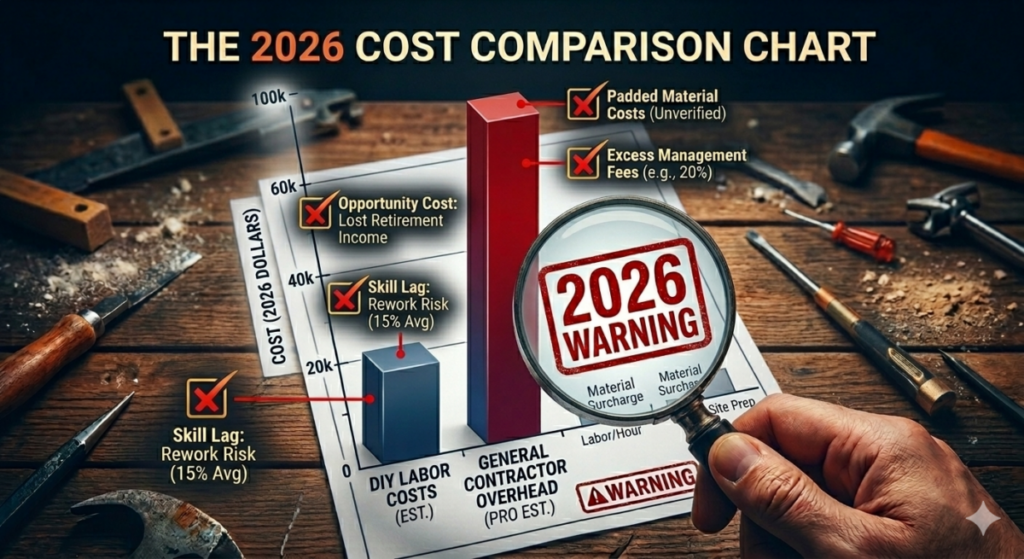
Understanding where your money goes is the best way to spot a “padded” invoice. Below is the 2026 breakdown for a standard 500-square-foot renovation project.
| Task Item | Material Cost (Mid-Range) | Labor Cost (Pro) | Total 2026 Estimate |
|---|---|---|---|
| Demolition & Haul-off | $400 (Dumpster) | $1,800 | $2,200 |
| Electrical (Panel + Circuits) | $2,200 | $3,500 | $5,700 |
| Plumbing Rough-In | $1,100 | $2,900 | $4,000 |
| Drywall & Paint | $900 | $4,200 | $5,100 |
Technical Deep Dive: Zoning and Regulatory Hurdles
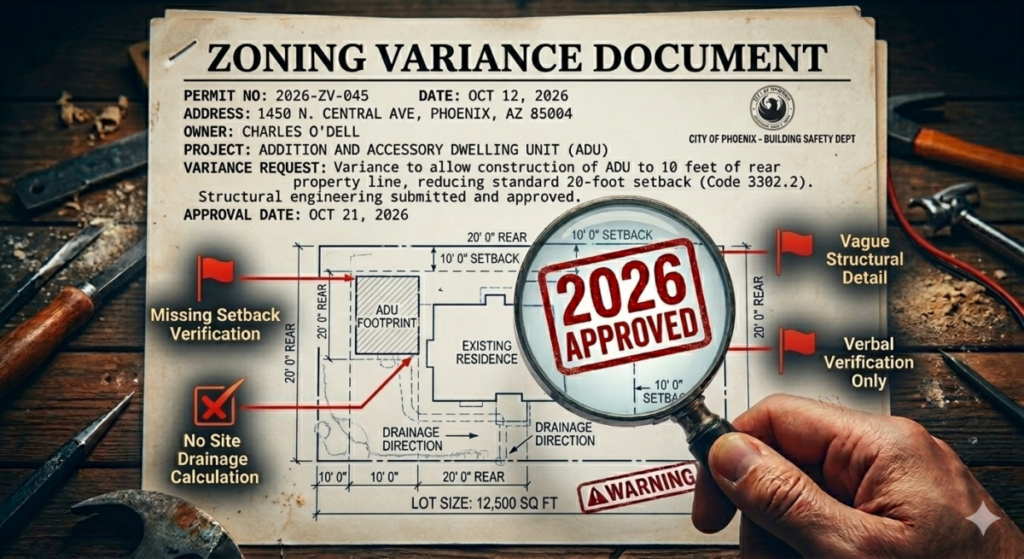
Honesty in contracting often reveals itself in the “boring” paperwork. In 2026, many municipalities have implemented stricter ADU (Accessory Dwelling Unit) and “Age-in-Place” zoning laws. If a contractor tells you “we don’t need a permit for this,” they are either ignorant or lying. Both are dangerous.
Working without a permit is a breach of your homeowner’s insurance policy. If a fire occurs due to unpermitted electrical work, your 2026 policy will likely deny the claim. Furthermore, when you go to sell the house, an eagle-eyed buyer’s inspector will flag the unpermitted work, forcing you to pay “double” to have it opened up, inspected, and closed back up. A technical pro will provide a “Permit Tracking Number” before the first sledgehammer swings.
In 2026, we are also dealing with “Impermeable Surface” ratios. If you are adding a deck or patio, your local zoning may limit how much of your lot can be covered by non-draining surfaces. A dishonest contractor will ignore this, leading to city fines and drainage issues for your neighbors. I always demand a “Zoning Compliance Memo” for any project that changes the footprint of the home. If the contractor says, “The city doesn’t care,” it usually means the contractor doesn’t want to wait the three weeks for the permit approval because they have a boat payment due. Don’t let their financial urgency become your legal nightmare.
Affiliate Product Comparison: The Pro’s Toolkit
If you are going to manage your contractor effectively, you need to speak their language and occasionally check their work. Here are three tools I keep in my truck to ensure quality control on every flip.
| Product Name | Primary Use | Why it Matters in 2026 |
|---|---|---|
| Fluke 117 Electrician’s Multimeter | Testing voltage and continuity. | Prevents contractors from “ghosting” wires that are still live and dangerous. |
| Bosch GLM 50-27 Laser Measure | Precise distance and area math. | Contractors often round up square footage by 10% to pad material costs. Catch them. |
| Zircon Leak Alert WiFi | Smart water leak detection. | Drop these near new plumbing rough-ins to detect slow drips before the drywall goes up. |
Technical Deep Dive: Tax Logic and IRC Section 121
Every dollar you spend on a contractor should be viewed through the lens of the IRS. In 2026, capital improvements—not repairs—increase your “basis” in the home. This is critical for homeowners over 60 who may be looking to downsize within the next decade. Under IRC Section 121, you can exclude up to $250,000 (single) or $500,000 (married) of capital gains from the sale of your primary residence.
An honest contractor will provide detailed, line-item invoices that distinguish between a “repair” (fixing a leaky faucet) and a “capital improvement” (replacing the entire plumbing stack). Repairs are not tax-deductible; improvements are. If your contractor gives you a “lump sum” receipt for $80,000, the IRS may disqualify the entire amount during an audit of your 2026 tax return. I insist on a “Schedule of Values” (SOV) that breaks down labor and materials by room and system.
Additionally, we must consider the 2026 “Step-up in Basis” rules. If you plan to leave your home to your heirs, the cost basis “steps up” to the fair market value at the time of your passing. However, keeping meticulous records of your 2026 renovations ensures that if you sell *before* that happens, you aren’t paying capital gains taxes on money you already spent on the house. I keep a digital vault of every contractor invoice, building permit, and canceled check. If your contractor wants to be paid in cash “under the table,” they are stealing your future tax deduction. No receipt, no payment. It is that simple. I’ve had contractors get mad at me for this; I usually point them toward the nearest exit.
Technical Deep Dive: ROI Calculations and Opportunity Cost
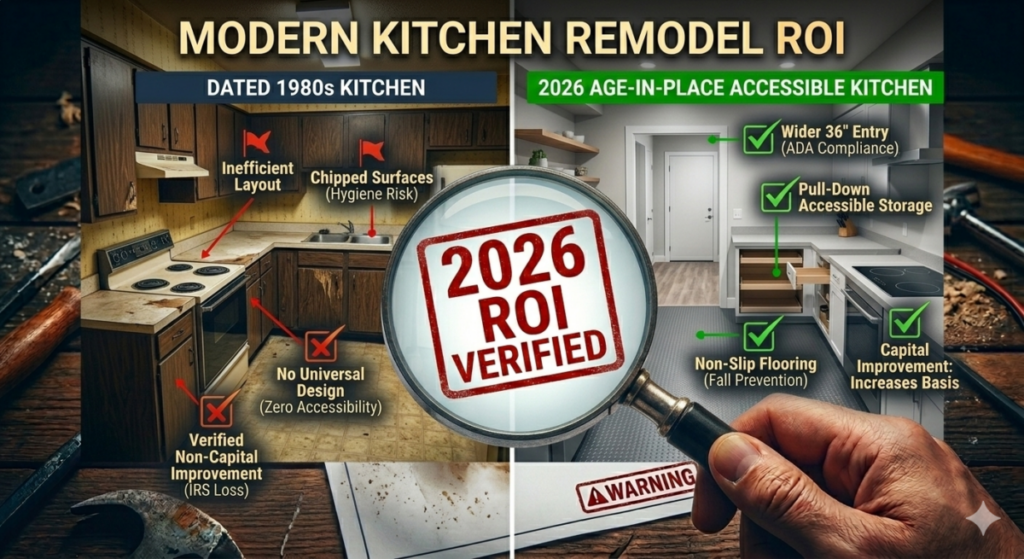
Let’s talk about the math of “The Deal.” If you spend $100,000 on a kitchen remodel in 2026, you must calculate the 10-year net-worth trajectory. At age 65, your “time horizon” for recovering that investment is shorter than a 30-year-old’s.
Standard ROI for a major kitchen remodel in 2026 is roughly 62%. That means you “lose” $38,000 the moment the project finishes. However, if that remodel includes universal design (wider doors, pull-down shelves, non-slip flooring), the “Utility ROI” increases because it allows you to stay in your home longer, avoiding the $8,000-per-month cost of assisted living. An honest contractor will be blunt: “This $20,000 backsplash won’t add a dime to your home value, but this $5,000 walk-in shower will save you $100,000 in future care costs.” That is the kind of logic I look for. We prioritize wealth preservation over vanity projects.
We also need to analyze “Opportunity Cost.” If you pull $100,000 out of a brokerage account earning 7% to pay a contractor, that renovation actually costs you the principal plus the $7,000 in lost annual gains. Over five years, that’s over $135,000 in total economic impact. An “honest” contractor understands these stakes. They won’t suggest “upsells” that don’t provide either functional utility or verifiable equity gain. I once had a contractor try to sell me on a $15,000 “smart lighting” system for a flip. I showed him the neighborhood comps and the local cap rates; he realized I wasn’t a mark. You should do the same. If the renovation doesn’t move the needle on the appraisal or your quality of life, the answer is “no.”
Technical Deep Dive: Contractual Protections and Performance Bonds
The biggest risk in 2026 isn’t bad work; it’s “abandonment.” This happens when a contractor takes your 30% deposit to finish the “previous” client’s job. This is the “Ponzi Scheme” of the construction world. To stop this, I use a “Performance and Payment Bond” on jobs over $50,000. This is a three-party agreement where a surety company guarantees the project will be finished. If the contractor disappears, the surety pays to finish the job.
If your project is smaller, you can use “Restrictive Endorsement” checks. You write the check to both the contractor AND the material supplier (like ABC Supply or Ferguson). This ensures the contractor can’t spend the lumber money on a new truck. Honest contractors shouldn’t have an issue with this because it proves the materials are paid for and no liens will be filed against your home. In 2026, lien laws have become even more aggressive in favor of suppliers. If a contractor doesn’t pay for your shingles, the supplier can legally foreclose on your house to get their money, even if you already paid the contractor. This is why a “Lien Waiver” must be signed for every single draw. No waiver, no check. No exceptions.
Step-by-Step Actionable Checklist for Hiring
- Verify the License: Go to your state’s Contractor Licensing Board website. Ensure the license is “Active” and check for “Final Judgments” or “Open Complaints.” If they use a “borrowed” license, fire them immediately.
- Request the 2026 COI: Do not accept a photocopy of their insurance. Call their insurance agent and ask for a Certificate of Insurance listing YOU as the “Certificate Holder.” This ensures you are notified if the policy cancels.
- Check the 2026 Step-Up Basis Rules: Consult your CPA to ensure the work qualifies as a capital improvement under current 2026 tax law.
- The 3-Bid Rule: Get three detailed bids. If one bid is 30% lower than the others, that contractor is likely missing something or planning to hit you with “Change Orders” later.
- Mechanical Lien Waiver: Before making the final payment, require a signed Lien Waiver from the contractor and all major subcontractors. This prevents a lumber yard from suing YOU if the contractor didn’t pay his bills.
- The Milestone Payment Schedule: Set a schedule. For example: 10% at signing, 30% after rough-in inspections, 30% after drywall, 20% after final inspection, and 10% “punch list” holdback.
- Site Cleanliness Clause: Put it in the contract. A messy site is a dangerous site. Demand a daily cleanup of nails and debris.
- Verify Liquid Assets: Ask for a bank reference. An honest contractor should have at least 20% of the project value in liquid cash to handle surprises.
- Check “Tailgate” References: Don’t just call the numbers they give you. Ask for the address of a job they finished two years ago and knock on the door. Ask the homeowner if the grout is cracking or if the contractor returned for warranty work.
Internal Resources
To further protect your investment, check out our other deep dives:
- The 2026 Guide to Accessory Dwelling Units (ADUs)
- Age-in-Place Renovations: What Actually Increases Resale Value?
- How to Handle Contractor Disputes Without a Lawyer
Summary: Control the Chaos
Hiring a contractor is like entering a temporary business partnership. You are the CEO, and they are the vendor. In 2026, with labor shortages and shifting building codes, you cannot afford to be a passive observer. By using the technical tables and vetting logic provided here, you are removing the emotion from the equation. Follow the math, verify the engineering, and keep your money in your pocket until the work is done to your satisfaction. Don’t be afraid to be the “difficult” client. In this business, “difficult” usually just means “someone who doesn’t get cheated.” Success in real estate isn’t about luck; it’s about systems. And this system is designed to keep you from becoming a headline in a fraud investigation. Stick to the logic, ignore the “nice guy” routine, and get it in writing.
Bio: Charles O’Dell
Charles O’Dell is the owner of HousingAfter60.com and a veteran real estate investor with over 23 years of experience in the trenches. He has successfully flipped more than 100 single-family and multi-family properties, navigating three major market cycles. Charles specializes in first-principles real estate logic, focusing on helping the 60+ demographic protect their home equity and maximize their net worth through data-driven renovation and divestment strategies. He doesn’t like fluff, he doesn’t like waste, and he definitely doesn’t like dishonest contractors. When he isn’t vetting crews, he’s analyzing 2026 tax codes to find new ways for retirees to win.
Written by Charles O’Dell, 23+ year real estate investor with 100+ successful property flips.