
Summary: Building an Accessory Dwelling Unit (ADU) in 2026 is the ultimate “First-Principles” move for homeowners over 60. With inflation lingering and the stock market showing its usual mood swings, your backyard represents underutilized capital. However, this is not a weekend shed project. To turn a profit, you must navigate 2026 labor shortages, complex utility hookups, and specific IRS rules that could jeopardize your primary residence tax exclusion. This guide provides the hard data on cost per square foot, structural requirements, and the 10-year ROI outlook. Note: Local labor rates for ADU Construction change constantly. See our full regional cost table below.
Introduction
I have spent 23 years in the trenches of real estate. I have flipped over 100 properties, and if there is one thing I have learned, it is this: sentimentality is a luxury you cannot afford in retirement. Many people my age look at their backyard and see memories of kickball games or a spot for a gazebo. I look at it and see $3,000 a month in untapped rental income. In 2026, the “ADU Revolution” is no longer a trend; it is a financial necessity for those looking to hedge against the rising costs of healthcare and property taxes.
I remember a fellow investor, Mike. Mike had a half-acre lot in a prime zip code. He spent years “thinking” about building a cottage for his mother-in-law. By the time he pulled the trigger, construction costs had jumped 18 percent. He didn’t account for the soil composition or the city’s new electrical requirements. He ended up over-leveraged because he didn’t follow a logical, data-driven plan. We are going to avoid Mike’s mistakes. We are going to treat your backyard like a professional job site where every square inch must justify its existence on your balance sheet.
Video Guide Overview
Affiliate Disclosure
I am a straight shooter. This article contains affiliate links to products and tools that I personally authorize for use on my job sites. If you purchase through these links, I receive a small commission at no extra cost to you. This helps fund the deep-dive research we do here at HousingAfter60.com to keep you from making six-figure mistakes.
The “Short” Answer
In 2026, a professionally built, 600-square-foot ADU costs between $195,000 and $340,000. While the upfront cost is significant, the combination of rental yield and property value appreciation typically results in a full return of capital within seven to nine years.
Technical Deep Dive: Structural Engineering and Foundation Physics
The Load-Bearing Reality of Secondary Structures
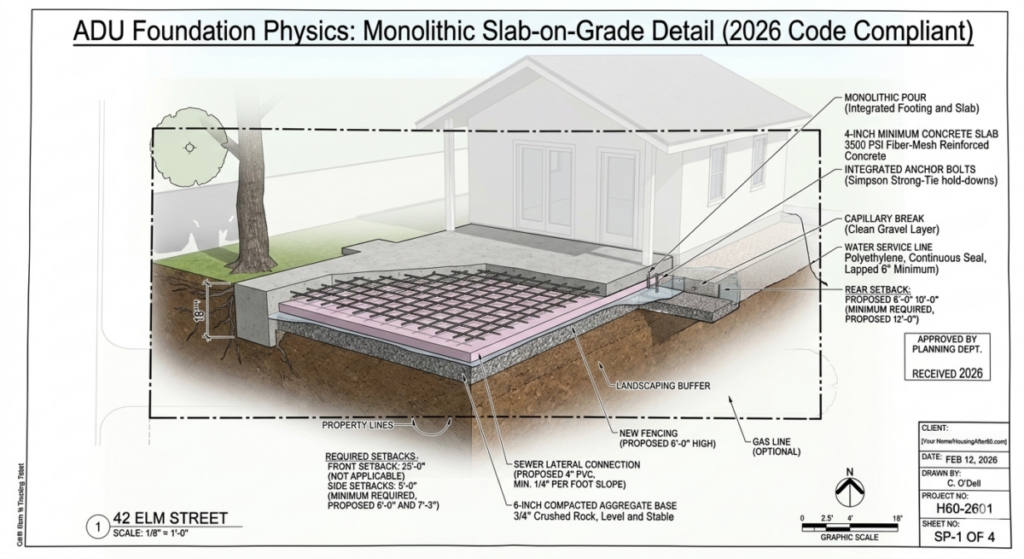
When you are building an ADU, you are essentially building a jewelry box: everything is smaller, so the precision must be higher. In 2026, we are seeing a significant move toward “Floating Slab” or Monolithic Slab foundations for ADUs. Unlike a traditional crawlspace, a monolithic pour integrates the footer and the floor into one single piece of reinforced concrete. Why does this matter for someone over 60? It is about moisture control and maintenance cycles. A slab foundation eliminates the risk of rot in floor joists and keeps pests out of the building’s belly.
Logic dictates that we look at the pounds per square inch (PSI) of your concrete mix. For a 2026 ADU build, I require a minimum of 3,500 PSI concrete with fiber-mesh reinforcement. This isn’t just “over-engineering.” We are seeing more extreme weather patterns, and a higher PSI helps prevent the micro-cracking that occurs during rapid freeze-thaw cycles. If your foundation cracks, your plumbing lines crack. If your plumbing lines crack, your ROI evaporates into a muddy mess under your tenant’s kitchen.
We also need to discuss R-value optimization in small footprints. Because an ADU has less interior volume to retain heat, your thermal envelope must be superior to the main house. I recommend “Advanced Framing” techniques where studs are placed at 24 inches on center rather than 16. This sounds counter-intuitive, but it allows for more insulation and less wood (thermal bridging) in the walls. In 2026, energy costs are a major line item on your P&L statement. If you pay the utilities for your ADU, every bit of escaped heat is money out of your pocket. If your tenant pays, a high utility bill will lead to higher turnover. Vacancy is the silent killer of real estate wealth.
Finally, let’s talk about the “Seismic Logic” of ADUs. If you are on the West Coast, 2026 building codes have become even stricter regarding lateral bracing. You cannot simply nail 2x4s together and call it a day. You need engineered shear walls and Simpson Strong-Tie hold-downs that anchor the frame directly into the concrete. This prevents the “pancake effect” during an earthquake. It is a technical necessity that adds about $4,000 to your framing budget but ensures the structure remains an asset rather than a pile of debris.
2026 ADU Cost Transparency Table
| Phase of Construction | Material Cost (Est.) | Labor Cost (Est.) |
|---|---|---|
| Permitting & Site Survey | $2,500 | $8,000 |
| Foundation & Underground Plumbing | $18,000 | $22,000 |
| Framing, Roofing & Siding | $45,000 | $55,000 |
| Electrical, HVAC & Plumbing Rough-in | $12,000 | $18,000 |
| Insulation, Drywall & Paint | $9,000 | $14,000 |
| Cabinetry, Flooring & Fixtures | $22,000 | $15,000 |
| PROJECT TOTALS | $110,500 | $132,000 |
Affiliate Products Comparison Table
| Product Category | Top Choice (2026 Model) | Technical Edge |
|---|---|---|
| Ductless Mini-Split | Mitsubishi Hyper-Heat | Maintains 100% capacity at -5°F; ultra-quiet for close-proximity living. |
| Tankless Water Heater | Rinnai Sensei RX | Fits in a small closet; eliminates the 50-gallon flood risk of traditional tanks. |
| Smart Main Water Valve | Phyn Plus 2nd Gen | Uses ultrasonic waves to detect pinhole leaks before they ruin the ADU flooring. |
Technical Deep Dive: MEP Cycles and Mechanical Logic
The Complexity of Split-System Utilities
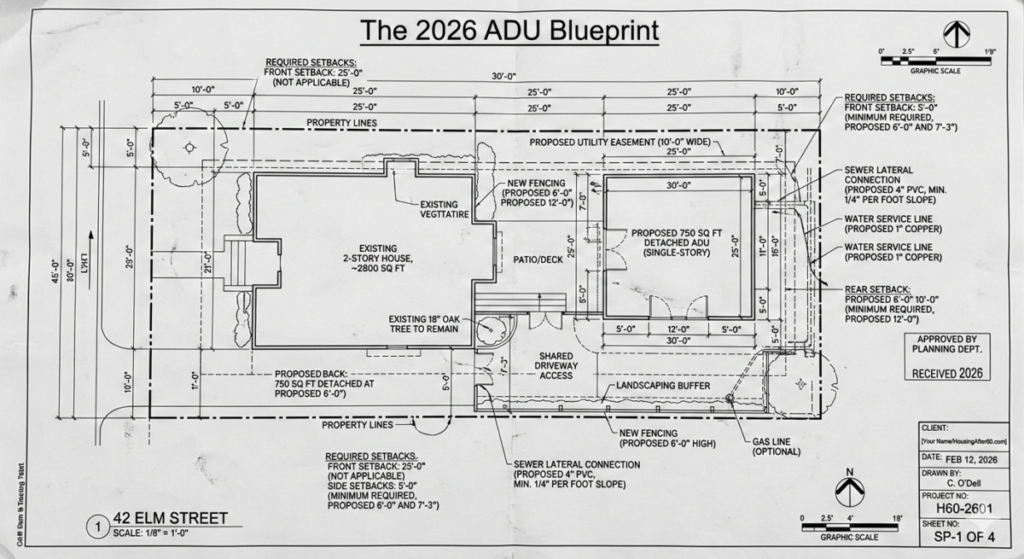
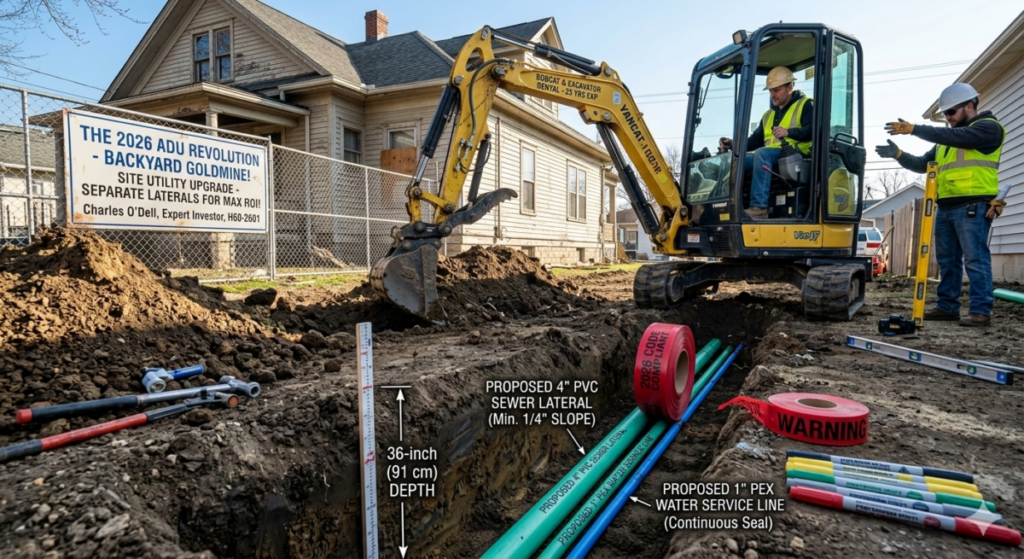
Mechanical, Electrical, and Plumbing (MEP) systems are where most ADU budgets go to die. First-principles logic suggests that you should never “share” a sewer line if you can avoid it. Why? Because if your tenant flushes something they shouldn’t, and it backs up into your master bathroom, you have more than just a plumbing problem; you have a lifestyle crisis. In 2026, I insist on separate laterals for sewer and water whenever the municipal code allows. This ensures that the ADU is a “stand-alone” asset for future resale.
Let’s talk about the “Electrical Service Logic.” Most homes built before 2000 have a 100-amp or 150-amp main panel. Adding an ADU with an electric range, a mini-split HVAC, and a water heater will push you over your load limit. You have two choices: a service upgrade to 400-amps (expensive and requires utility company involvement) or a Smart Load Controller. In 2026, we use digital energy managers that automatically shed non-essential loads (like an EV charger) when the oven is on. This saves you about $8,000 in transformer upgrade fees. It is the kind of technical pivot that separates an expert investor from a hobbyist.
Plumbing in an ADU requires a mastery of “Wet Wall” design. To keep costs down, you must align the kitchen, bathroom, and laundry along a single plumbing wall. This minimizes the amount of copper and PVC piping required and reduces the number of penetrations through your roof. Every roof penetration is a potential leak point in 15 years. By consolidating your vents, you increase the longevity of the structure. Also, for the 60+ demographic, we must discuss the “Recirculation Loop.” No one wants to wait three minutes for hot water to reach the shower in a small unit. A dedicated recirculation pump adds $600 to the cost but increases the “Premium” feel of the unit, allowing you to charge higher rent.
Finally, we have the “HVAC Lifecycle.” Traditional central air is a waste of money in a 600-square-foot space. In 2026, the ductless mini-split is king. However, you must size it correctly. An over-sized unit will short-cycle, meaning it turns on and off too quickly to dehumidify the air. This leads to mold growth. I use a Manual J calculation for every single ADU build. If your contractor tells you they “just know” what size you need by looking at it, fire them. We use math, not intuition.
Technical Deep Dive: Tax Implications and 2026 Legal Logic
Zoning Variances and the IRC Section 121 Shield
The most dangerous part of an ADU build isn’t the construction; it’s the IRS. Under IRC Section 121, you can sell your primary residence and keep up to $500,000 of the profit tax-free (if married). But here is the 2026 trap: if you have used the ADU as a rental for five years, the IRS may classify that portion of your property as an investment asset rather than part of your “principal residence.” This means you could owe depreciation recapture and capital gains taxes on the ADU portion when you sell. First-principles logic requires you to consult with a CPA to structure the ADU as an “accessory use” rather than a separate business entity to protect that $500,000 shield.
Zoning laws in 2026 have become more favorable due to state-wide mandates, but local “Impact Fees” are the new hidden tax. Cities that can no longer say “no” to ADUs are now saying “yes, for a $20,000 fee.” This is where you must apply “Regulatory Arbitrage.” In many jurisdictions, an ADU under 750 square feet is exempt from these impact fees. This is why you see so many 749-square-foot units. Building that extra 2 square feet could cost you $20,000. That is $10,000 per square foot—the worst investment you’ll ever make. Always check the “Fee Threshold” before finalizing your architectural footprints.
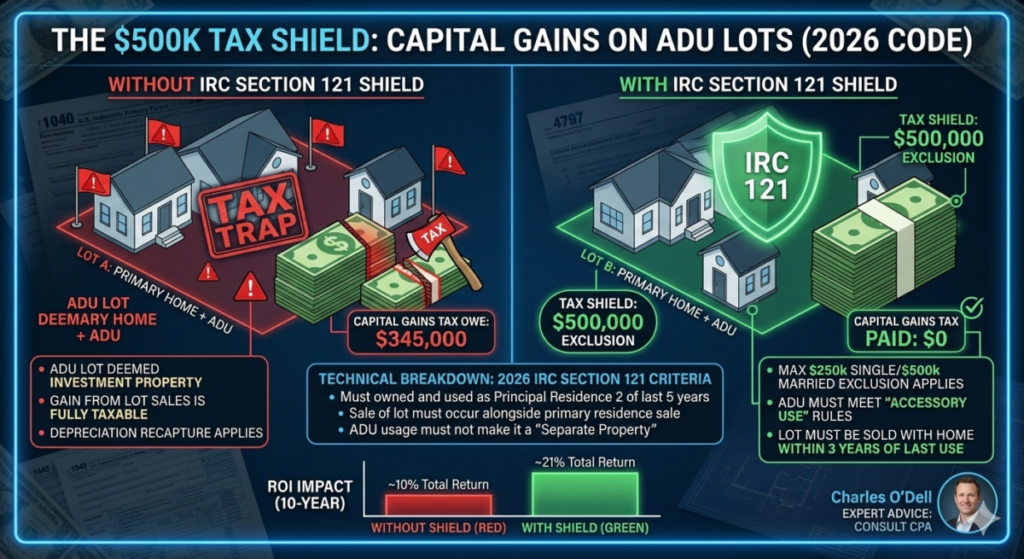
Furthermore, we must address the “Step-Up in Basis” logic for estate planning. If you are over 60, you are likely thinking about what you leave behind. An ADU is a “Value-Add” that gets stepped up to current market value upon your passing. If you spend $200,000 to build an ADU that adds $350,000 in value, and you pass the property to your kids, that $150,000 in “built-in equity” is never taxed. It is one of the last great tax loopholes for the middle class. However, this only works if the ADU is legally permitted. A “bootleg” garage conversion has zero value to an appraiser and creates a massive legal liability for your heirs. Do it right, or don’t do it at all.
Technical Deep Dive: ROI Calculations and Opportunity Cost
The 10-Year Net Worth Projection
Let’s run a “First-Principles” ROI analysis on a $250,000 ADU investment in 2026. If you left that money in a 5% CD, you would earn $12,500 a year with zero effort. That is our benchmark. To beat the CD, the ADU must provide more than just rent; it must provide “Total Return.”
Suppose your ADU rents for $2,500 per month. After a 10% maintenance/management reserve and $200 a month in extra property taxes/insurance, you are netting $2,050 a month, or $24,600 a year. That is a 9.8% cash return. Already, you are nearly doubling the CD’s performance. But wait—we also have “Equity Growth.” If the ADU causes the property value to jump by $300,000, you have an immediate $50,000 “paper profit.” Over 10 years, if the property appreciates at a modest 3%, that ADU is worth $400,000. Your total 10-year profit (Rent + Appreciation) exceeds $440,000 on a $250,000 investment. This represents a Compounded Annual Growth Rate (CAGR) of approximately 14%.
The “Opportunity Cost” of not building is even higher when you consider the “Caregiver Hedge.” If you eventually need in-home care, providing a free place to live for a nurse or family member can save you $5,000 to $8,000 a month in facility costs. That “avoided cost” is effectively tax-free income. When you look at the numbers through this lens, the ADU isn’t just a construction project; it is a specialized insurance policy that pays you dividends while you’re healthy and saves your life when you’re not. This is why I tell every client over 60: your backyard is not a lawn; it is a life-raft.
How to Build Your ADU: A Step-by-Step Technical Guide
- Verify Zoning “As-of-Right” Status: Go to your city’s planning portal and confirm that your lot allows for a “Detached Accessory Dwelling Unit” (DADU) without a public hearing.
- Commission a Topographical Survey: You need to know exactly where the water flows on your lot. Building an ADU that creates a pond in your neighbor’s yard will lead to a 2026 lawsuit.
- Conduct a “Sewer Scope” of the Main Line: Use a camera to inspect your existing sewer line. If it’s old orangeburg or cracked clay, you must replace it before connecting the ADU.
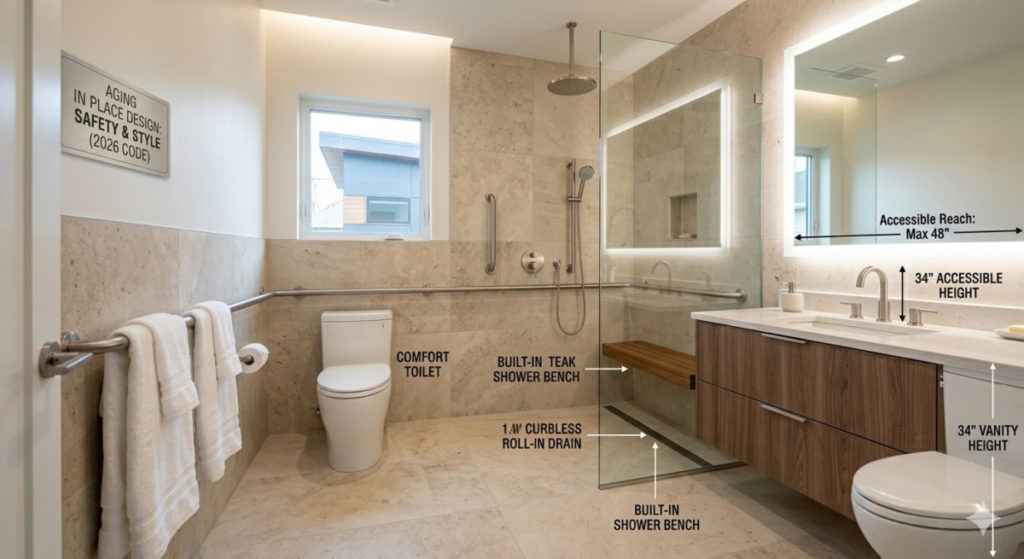
- Design for “Universal Access”: Ensure the entrance has a “zero-step” threshold. This is critical for 2026 resale value as the population continues to age.
- Submit for “Expedited Review”: Many cities in 2026 offer fast-track permitting for ADUs that use “Pre-Approved” plans. This can save you four months of waiting.
- Execute the “Service Drop”: Coordinate with the electric utility to bring in a new service line if your current transformer cannot handle the additional load.
- Pour the Monolithic Slab: Ensure the vapor barrier is at least 15-mil thick to prevent soil gases and moisture from migrating into the living space.
- Frame with “Header Logic”: Use engineered LSL (Laminated Strand Lumber) headers over all windows and doors to prevent sagging, which is common in small structures.
- Install the “Energy Recovery Ventilator” (ERV): Modern 2026 codes make ADUs so airtight that they can trap stale air. An ERV swaps old air for fresh air without losing heat.
- Rough-in Smart Home Infrastructure: Run CAT-6e cable to all corners. Relying on Wi-Fi from the main house is a recipe for tenant complaints.
- Apply “Sound Mitigation” Layers: Use “QuietRock” drywall on the wall facing the main house to ensure privacy for both you and your tenant.
- Final Inspection and “Notice of Completion”: Do not pay your contractor the final 10% until the city has signed off on the Certificate of Occupancy.
Internal Resources
If you’re serious about your 2026 property strategy, don’t stop here. Read these deep-dives next:
* Downsizing Logic: Why Selling the Family Mansion is a Math Problem, Not an Emotional One
* 2026 Reverse Mortgage Risks: How to Use Equity Without Losing Your Soul
* Aging in Place Renovations: The High-ROI Guide to Zero-Threshold Living
Summary
Building an ADU is a high-stakes chess match against inflation, regulation, and physics. For the 60+ homeowner, it is the most logical path to increasing net worth while maintaining lifestyle control. However, the technical details—from the PSI of your concrete to the “Basis” of your tax return—will determine whether this is a “Goldmine” or a “Money Pit.” Trust the data, ignore the “handyman” advice, and build for the long-term MEP cycle. Your retirement depends on the quality of your infrastructure, not the color of your paint.
Bio: Charles O’Dell
Charles O’Dell is the owner of HousingAfter60.com and a recognized expert in residential redevelopment. With 23+ years of experience and over 100 successful property flips, Charles focuses on “First-Principles” investing. He has facilitated hundreds of transactions, helping homeowners over 60 convert stagnant equity into cash-flowing assets. He lives by one rule: “If the math doesn’t work, the house doesn’t get built.”
Written by Charles O’Dell: 23+ years of experience and 100+ property flips.