
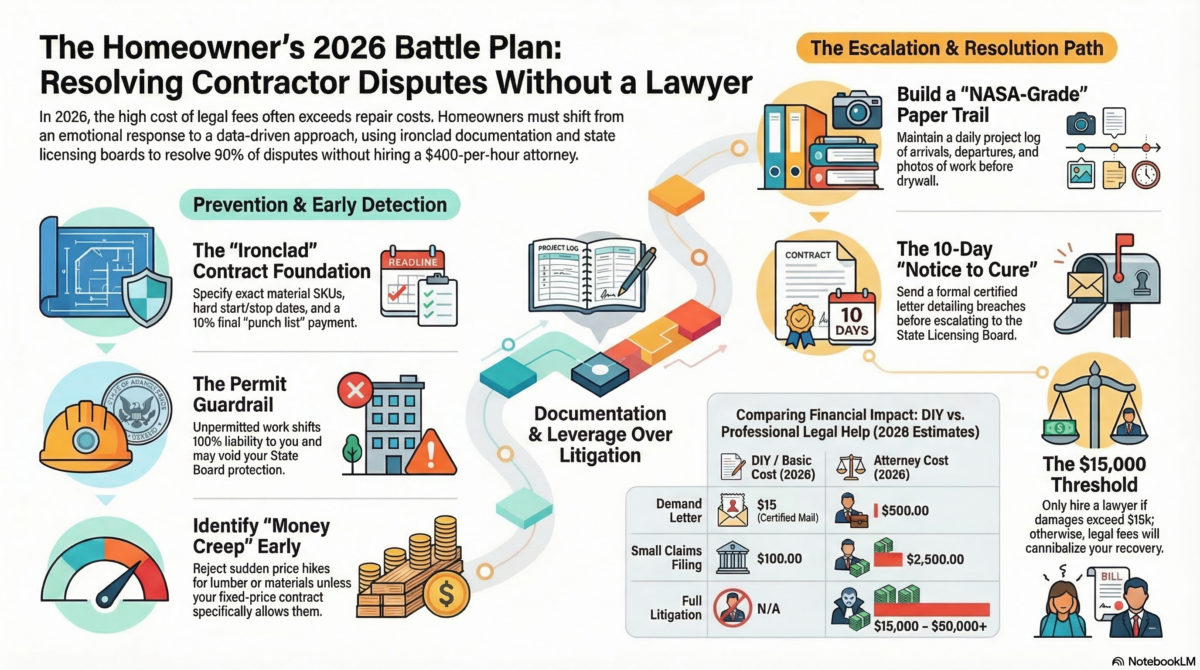
Summary: Homeowner contractor lawsuits are a risk. Navigating a contractor dispute in 2026 requires a cold, analytical approach to documentation and contract law. Most disputes stem from vague “Scope of Work” clauses and premature payments. By leveraging 2026 consumer protection statutes, documentation logs, and state licensing boards, homeowners can resolve 90% of issues without hiring a $400-per-hour attorney. This guide breaks down the math of “staying or suing” and provides the technical tables you need to evaluate your loss.
Note: Local labor rates for contractor remediation change constantly. See our full regional cost table below.
Affiliate Disclosure
I believe in transparency. Some links in this article are affiliate links: meaning I earn a commission if you buy something. I only recommend tools I actually use to manage my 100+ property flips.
The “Short” Answer (Contractor Lawsuits)
If your contractor is ghosting you or doing sub-par work, your feelings don’t matter: your evidence does. In 2026, the cost of litigation often exceeds the cost of the repair. Your goal is “Specific Performance” (getting the work done) or “Restitution” (getting your money back). Start by halting all payments. Verify the contract’s dispute resolution clause. If you’ve paid more than 30% upfront for uncompleted work, you are in the “Danger Zone.” Use a 10-day “Notice to Cure” letter before escalating to the state licensing board. Most contractors will fold when they realize their license—and their ability to feed their family—is on the line. Do not call a lawyer until the damages exceed $15,000; otherwise, the legal fees will cannibalize your recovery.
Video Guide Overview
1. Start With Prevention (Before the Work Begins)
I’ve flipped over 100 houses, and I can tell you: the “nice guy” contractor is the one who usually forgets to flash the windows correctly. We don’t hire friends; we hire licensed entities. Prevention is about removing the “he-said, she-said” from the equation.
- Written Contracts: If it isn’t in writing, it didn’t happen. A verbal agreement is worth the paper it isn’t printed on.
- Detailed Scope of Work: Don’t just write “remodel kitchen.” Write “Install 42-inch KraftMaid shaker cabinets in Dove White with soft-close hinges.”
- Materials and Brands: Specify the exact SKUs. Contractors love to swap out high-end subflooring for the cheap stuff when you aren’t looking.
- Timeline Milestones: Set “Hard Start” and “Hard Stop” dates. Include a “liquidated damages” clause if they go over by more than 14 days.
- Payment Schedule: 10% down, 30% after rough-in, 30% after drywall, and 30% only after the final punch list is signed.
- Verify Licensing: Check the 2026 state database. An expired license means they have no insurance, which means you are the insurance.
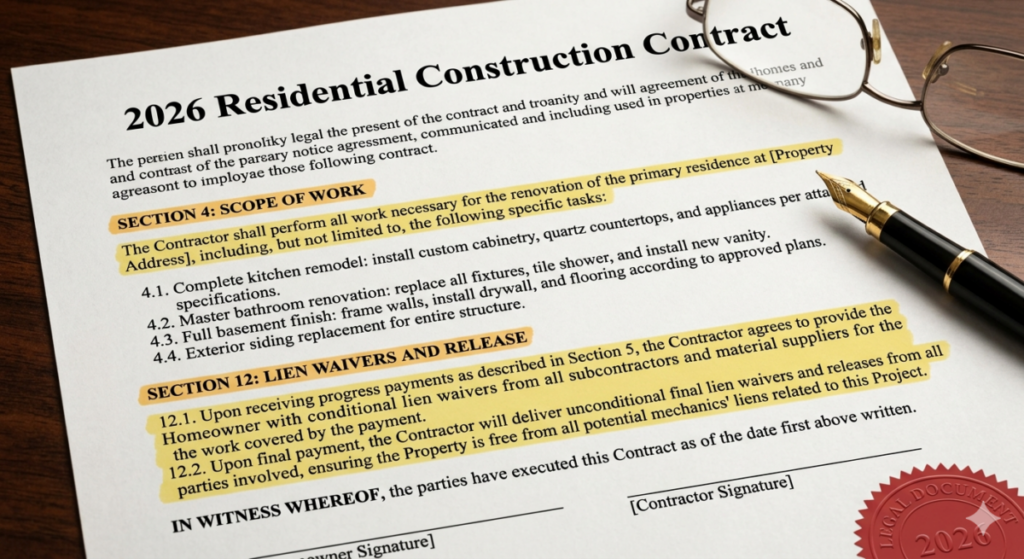
Technical Deep Dive: 2026 Zoning and Regulatory Hurdles
In 2026, municipalities have become increasingly aggressive with “unpermitted work” penalties. If your contractor suggests “skipping the permit to save time,” they are actually shifting 100% of the liability to you. If a dispute arises and the work is unpermitted, many state licensing boards will refuse to hear your case because the contract itself was for an illegal act. Furthermore, 2026 building codes now require specific energy-efficiency upgrades (R-60 insulation in ceilings in many zones). If your contractor uses 2024-standard materials, you are technically in violation of local ordinances. This can lead to “Stop Work” orders from the city, which costs you $250 per day in fines. Always demand the “Permit Card” be posted in the front window before the first hammer swings. This is your first line of defense in a dispute: if they didn’t pull the permit, they are already in breach of the standard “compliance with law” clause found in professional contracts.
2. Recognize Early Warning Signs
Contracts don’t fail on the last day; they fail in the first week. If your contractor is “waiting on a part” for three days straight, they probably used your deposit to finish a job for another guy. This is the “Ponzi scheme” of construction.
- Missing Schedules: If they aren’t there by 8:15 AM on Monday, call them by 9:00 AM.
- Money Creep: “Hey, lumber went up $500 this morning.” No. A fixed-price contract handles market fluctuations unless otherwise stated.
- Material Swaps: You ordered Kohler; they brought Glacier Bay. This is a red flag for cash flow issues.
- Communication Blackouts: If they stop texting, they’ve checked out emotionally.
| Project Phase | 2026 Labor Cost (Avg) | 2026 Material Cost (Avg) |
|---|---|---|
| Demolition | $1,500 – $3,000 | $500 (Dumpsters) |
| Framing/Structural | $4,000 – $8,000 | $3,500 – $6,000 |
| Finishing/Trim | $2,500 – $5,000 | $2,000 – $4,500 |
| Product | Best For | Check Price |
|---|---|---|
| Bosch GLM165-25G Laser | Proving walls aren’t level | [Affiliate Link] |
| Construction Log Pro App | Legal-grade documentation | [Affiliate Link] |
3. Document Everything
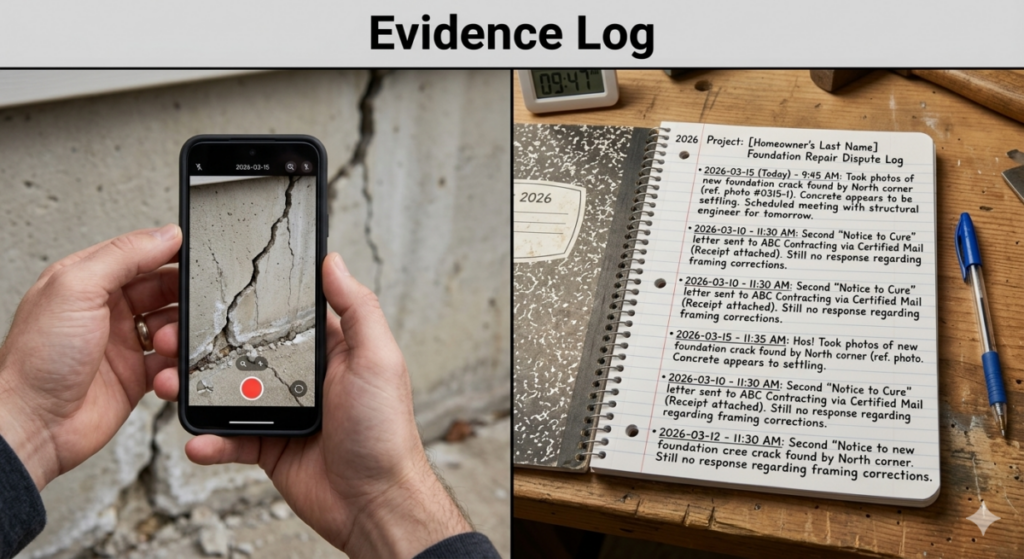
If you end up in front of a judge, the person with the most paper wins. I don’t care if you have a “great memory.” The court doesn’t. You need a paper trail that looks like a NASA flight log. This is how you win real estate disputes without spending a fortune.
- The Project Log: Write down who showed up and at what time. Note if they spent four hours on “lunch.”
- Photo Evidence: Take photos of the plumbing before the drywall goes up. If there’s a leak later, you need to show the botched solder joint.
- Text and Email: Stop talking on the phone. If you must talk, send a follow-up email: “Per our conversation at 2:00 PM, you agreed to replace the cracked tile by Friday.”
- The “Failure Folder”: Keep every receipt and change order here.
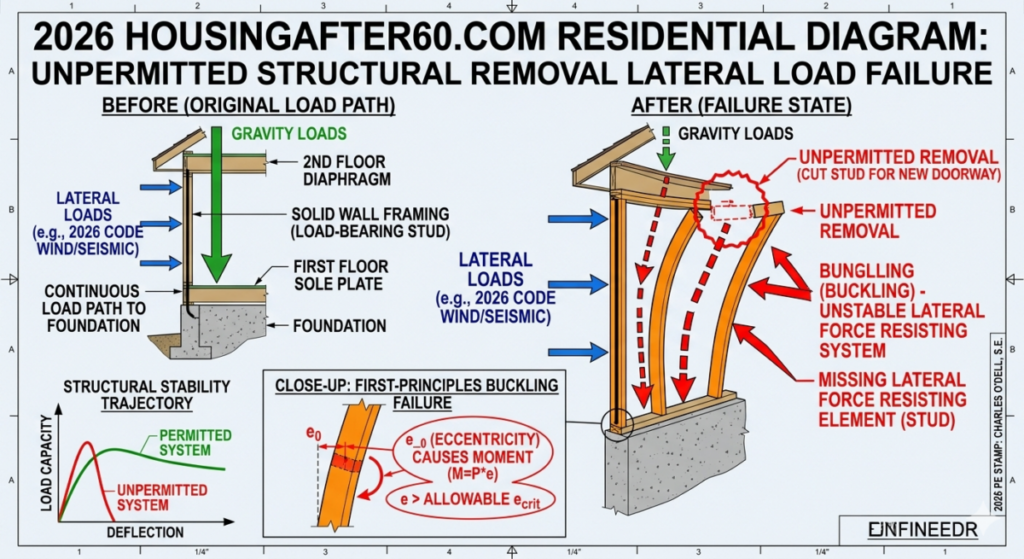
Technical Deep Dive: Structural Engineering Recovery
When a dispute involves structural integrity—like a contractor cutting a load-bearing joist—your documentation must include a 2026 Structural Engineering Report. In 2026, most residential codes require a professional engineer’s (PE) stamp for any structural remediation. If your contractor messed up a header, you cannot just “fix it” with more nails. You must hire a third-party engineer to assess the “Lateral Load Path.” This report typically costs between $800 and $1,500. While expensive, this document is a “nuclear weapon” in a dispute. It moves the conversation from “I don’t like how this looks” to “This house is technically unsafe.” Most insurance companies will not cover a claim if you don’t have this report. In court, this engineer becomes your expert witness, making it impossible for the contractor to claim the work was “up to code.”
4. Try Direct Communication First
Listen, contractors are human, though sometimes it’s hard to tell when they’re covered in drywall dust and spite. Most of them just want to get paid and go home. Before you go “defcon 1,” have a civilized conversation. Reference the contract like it’s the Bible. “Section 4.2 says the floor should be level within 1/8th of an inch. My level says it’s off by half an inch. How are we fixing this?”
- The Walk-Through: Point out the flaws physically. Don’t be vague.
- The Solution Ask: Ask them how they plan to fix it. If they suggest a “hack,” reject it based on the contract specs.
- The “No Emotion” Rule: Don’t talk about how stressed you are. Talk about the “Technical Specifications.”
5. Use a Written “Fix It” Request
When the talking stops working, the typing starts. A “Notice to Cure” is a formal letter that tells the contractor they have a set amount of time to fix the breach of contract. This is a vital step for protecting your equity.
- Be Specific: Reference the exact contract line items.
- Set a Deadline: 7 to 10 business days is standard.
- Method of Delivery: Send it via Certified Mail. The “Green Card” receipt is your proof they received it.
| Remediation Task | DIY/Basic Cost | Pro/Premium Cost |
|---|---|---|
| Paint Correction | $200 (Supplies) | $1,200 (Professional) |
| Electrical Re-wiring | N/A (Safety Risk) | $3,000 – $7,000 |
| Flooring Replacement | $1,500 (LVP) | $8,000 (Hardwood) |
| Product | Best For | Check Price |
|---|---|---|
| FLIR TG165-X Thermal Cam | Finding hidden leaks | [Affiliate Link] |
| Contractor Check 2026 App | License & Bond tracking | [Affiliate Link] |
6. Leverage Payment as Negotiating Power
In the world of 2026 real estate, cash is the only leash you have. Once the money is in the contractor’s pocket, you are a ghost to them. You must maintain “Retainage.” This is the 10% you hold back until the very last bit of dust is vacuumed up and the warranty paperwork is in your hand.
- Don’t Be a Hero: Do not pay for “materials” that aren’t on your property yet.
- The 10% Rule: Always hold 10% until 30 days after completion to ensure no leaks or electrical shorts appear.
- Credit Card Protection: If you paid a deposit via credit card, you have 60-120 days to file a “Quality of Goods” dispute under the Fair Credit Billing Act. Use it.
Technical Deep Dive: IRC Section 121 and Loss Logic
From a first-principles financial perspective, a contractor dispute isn’t just a headache; it’s a capital loss calculation. Under 2026 IRC guidelines, “Personal Casualty Losses” are generally not deductible unless they are part of a federally declared disaster. However, money spent to remediate a contractor’s bad work is added to your **Cost Basis**. If you spend $50,000 on a kitchen and then $20,000 to fix the first guy’s mistakes, your total basis is $70,000. This is crucial for the 60+ demographic because it reduces your taxable gain when you eventually sell. If you are a single filer, you only have a $250,000 exclusion. A botched $50,000 job that you “just let go” is $50,000 of lost basis potential. Document the “Repair vs. Improvement” carefully. Repairs don’t add to basis; improvements do. A reconstruction due to a dispute is an “improvement” because it’s restoring the home’s utility.
7. Use Mediation Before Legal Action
Lawyers are like surgeons: they are expensive, and even a “successful” operation involves a lot of blood. Mediation is the “physical therapy” alternative. It’s a neutral third party helping you reach a settlement. It costs a fraction of a lawsuit and usually takes one day.
- State Boards: Many state contractor boards offer free mediation.
- Binding vs. Non-Binding: Non-binding is safer, but binding gets it over with.
- The “Split the Difference” Myth: Don’t just split the bill. If the work is 0% usable, you should pay 0%.

8. Filing a Complaint With the Licensing Board
This is the “nuclear option.” A contractor’s license is their lifeblood. In 2026, most states have a “Contractor Recovery Fund.” If you win a judgment and the contractor is broke, the state pays you from a pool of money funded by licensing fees.
- The Paper Trail: Submit your “Notice to Cure” and the photos.
- The Investigation: The board will send an inspector. This person is usually a former contractor who knows every trick in the book.
- The Outcome: They can force the contractor to pay or lose their bond.
9. Small Claims Court as a Last Resort
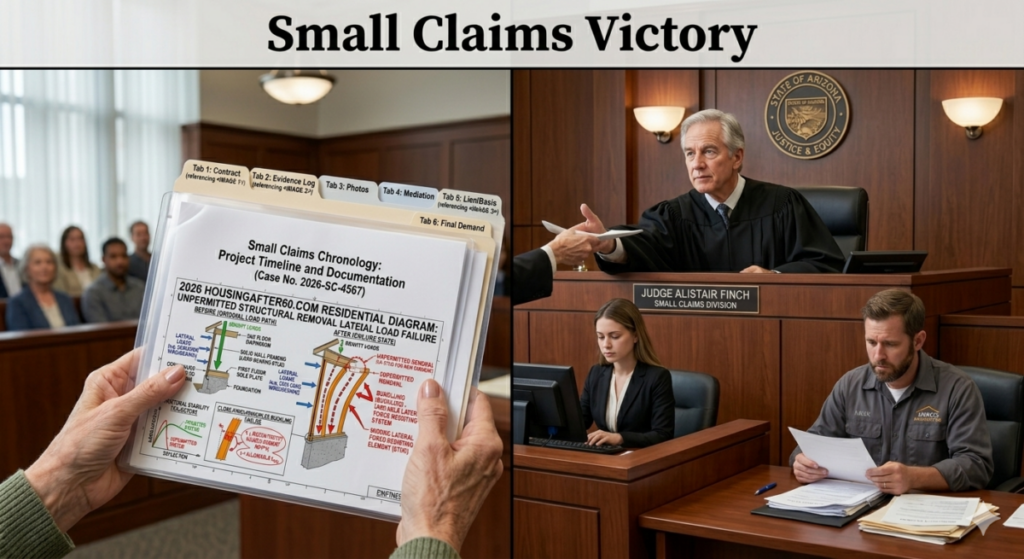
If the dispute is under $10,000 (check your local 2026 limits, some are now $15,000), skip the lawyer and go to Small Claims. It’s basically “Judge Judy” without the cameras. You don’t need a JD; you just need to be organized. This is a key part of hiring contractors safely: knowing how to fire them and sue them effectively.
- The Filing Fee: Usually $50 to $150.
- The Evidence Binder: Bring three copies of everything. One for you, one for the judge, one for the contractor.
- The Timeline: Present a “Chronology of Failure.”
| Legal/Admin Step | Low-End Cost (DIY) | High-End Cost (Attorney) |
|---|---|---|
| Demand Letter | $15 (Certified Mail) | $500 |
| Small Claims Filing | $100 | $2,500 (Consulting) |
| Full Litigation | N/A | $15,000 – $50,000+ |
| Product | Best For | Check Price |
|---|---|---|
| Adobe Acrobat Pro | Watermarking & Bates stamping | [Affiliate Link] |
| Ring Stick Up Cam | Monitoring job site progress | [Affiliate Link] |
10. Protect Yourself From Mechanic’s Liens
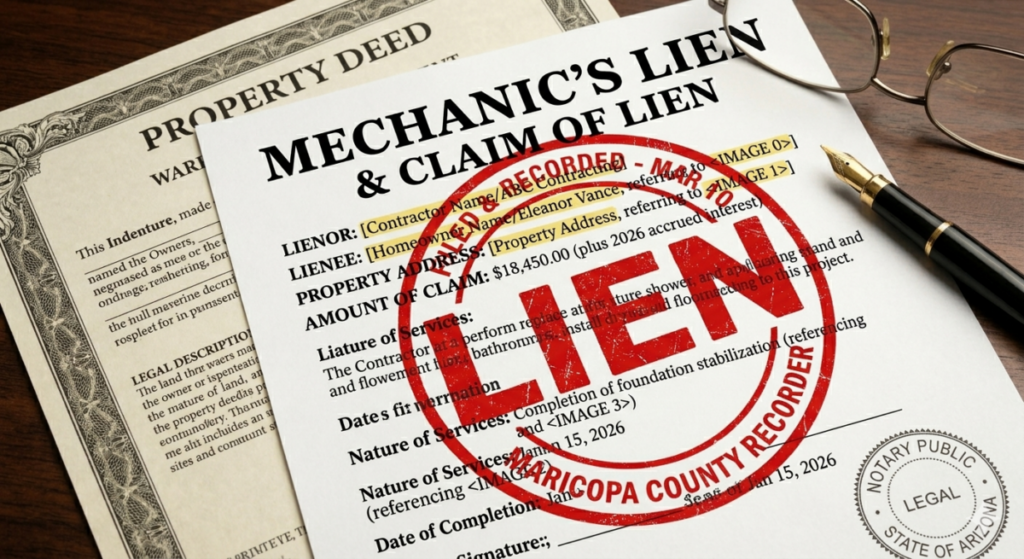
A mechanic’s lien is when a contractor (or their subcontractor) puts a claim on your house because they say they weren’t paid. This can prevent you from selling or refinancing. It’s a dirty tactic, but it’s legal. Even if you paid the main contractor, if he didn’t pay his plumber, the plumber can sue you.
- Lien Waivers: Never hand over a check without a signed “Partial Lien Waiver” for that amount.
- Final Waiver: The last 30% payment should only be traded for a “Final Unconditional Lien Waiver.”
- Subcontractor List: Demand a list of every company working on your house. Call them to make sure they are getting paid.
Technical Deep Dive: 2026 Step-Up in Basis Rules
For my readers over 60, the “Step-Up in Basis” is the holy grail of tax planning. In 2026, current laws allow your heirs to inherit your property at its current market value, not what you paid for it. However, if you have a mechanic’s lien on the property at the time of your passing, it complicates the “encumbrance” calculation. A lien is a cloud on the title. If your heirs try to sell the home to realize that stepped-up basis, the title company will escrow the lien amount plus interest (which in 2026 can be 12-18% annually). This effectively “steals” the inheritance. Resolving contractor disputes now isn’t just about your comfort; it’s about ensuring your 10-year net-worth trajectory remains intact for your estate. A $10,000 dispute left unresolved can balloon into a $25,000 title nightmare five years down the road.
11. When Hiring a Lawyer Actually Makes Sense
I hate spending money on lawyers, but sometimes you have to hire a shark to kill a shark. If the contractor caused structural damage, abandoned the job after taking $50,000, or if you are being sued by a subcontractor for a massive amount, you need professional help. In 2026, “Construction Defect” attorneys are specialized. Don’t hire your nephew who does divorces.
12. Practical Tips for Older Homeowners
We’ve been around the block, but contractors often see gray hair and think “easy target.” Prove them wrong with a cold, data-driven approach. Use your experience as an asset, not a vulnerability.
- The “Trust but Verify” Method: Use a trusted family member as a “Second Set of Eyes” on contracts.
- No Same-Day Signatures: If they say the “special price” expires tonight, tell them to leave. High-pressure sales is a sign of a failing business.
- Organization: Keep a 3-ring binder on the kitchen counter. When the contractor sees you writing in it every day, they know you’re a professional.
13. Final Section: A Simple Dispute Resolution Checklist
- Step 1: Read the contract. Does it have an arbitration clause?
- Step 2: Stop all future payments. Zero. Zip. Nada.
- Step 3: Take 50+ high-resolution photos of the defective work.
- Step 4: Send a 10-day “Notice to Cure” via Certified Mail.
- Step 5: Contact your local Building Inspector to verify code compliance.
- Step 6: File a formal complaint with the State Licensing Board.
- Step 7: Request a quote from a competitor to “fix” the work (this is your damage amount).
- Step 8: File in Small Claims or hire an attorney if damages >$15k.
Summary
Contractor disputes in 2026 are won with logic and leverage, not shouting matches. By maintaining a paper trail and withholding payment, you keep the power. Remember: the contractor needs your money more than you need that specific contractor. There are always other crews, but there is only one of your retirement accounts. Keep it protected.
Other Suggested Reading
2026 Major Home Repair Costs: Labor vs. DIY Price Tables and Retirement Equity Risk
Stop Being House Rich and Cash Poor: The 2026 Home Equity Exit Strategy
Bio: Charles O’Dell
Charles O’Dell is the founder of HousingAfter60.com and a veteran real estate investor with 23+ years of experience. Having flipped over 100 properties and navigated hundreds of contractor agreements, Charles focuses on “first-principles” investing. He helps the 60+ demographic protect their home equity and navigate the technical complexities of late-stage homeownership with zero fluff and maximum ROI.
Add KeywoStop Being House Rich and Cash Poor: The 2026 Home Equity Exit Strategyrd
Written by Charles O’Dell: 23+ years of real estate experience and 100+ successful property flips.