
Summary: Major home repair costs. High inflation in skilled trades has pushed 2026 repair costs 12% higher than last year. Retiring homeowners must prioritize structural and MEP (Mechanical, Electrical, Plumbing) integrity over cosmetic upgrades to avoid 30% equity erosion. Failure to budget for $25,000+ “critical failures” is a primary risk to 60+ net worth.
Note: Local labor rates for Major Home Repairs changed in Jan 2026. See our full regional cost table below.
Introduction
I have spent 23 years in the trenches of the real estate market. I have flipped over 100 houses and seen every imaginable way a “charming” home can turn into a financial black hole. If you are over 60, you do not have the luxury of time to recover from a $50,000 surprise foundation repair. Your home is not just a shelter; it is a massive, illiquid asset on your balance sheet. In 2026, the cost of “waiting and seeing” has become prohibitively expensive. We are seeing a shortage of master electricians and plumbers that has driven labor rates through the roof. If you do not apply first-principles logic to your home maintenance, you are essentially gambling with your retirement fund.
Most “lifestyle” blogs will tell you to pick a pretty paint color. I am here to tell you how to prevent your main sewer line from collapsing and taking your vacation budget with it. We are going to look at the hard numbers, the structural physics of your aging property, and the 2026 tax laws that dictate how you should track these expenses. In this deep dive, we will strip away the fluff and look at your home as a mechanical system that requires a rigorous maintenance schedule to preserve its market value.
Video Guide Overview
Affiliate Disclosure
In the spirit of total transparency: this article contains links to specific tools and products that I personally use on my job sites. If you purchase through these links, HousingAfter60.com may receive a commission. I only recommend high-spec hardware that meets 2026 building codes and provides a measurable ROI for the homeowner.
The Short Answer – Major Home Repair Costs
Budgeting for home repairs after 60 requires a 1.5% to 2.5% annual reserve of the home’s current market value due to 2026 labor surges. Prioritize foundation stabilization, R-454B HVAC compliance, and main line plumbing to prevent a total loss of saleability in a high-interest environment.
Structural Engineering: The Physics of Your Foundation
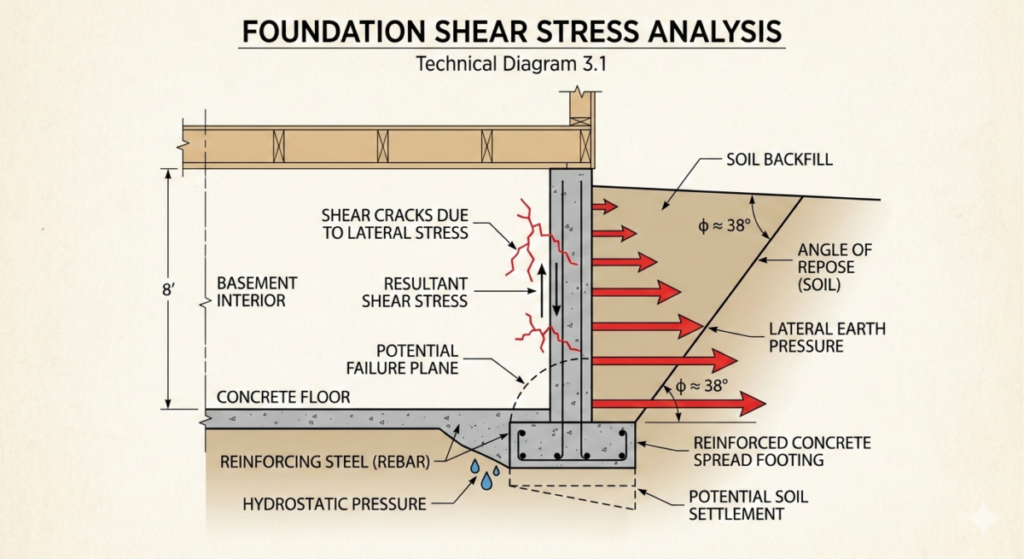
When I evaluate a flip, I start at the bottom. Your foundation is under constant attack from hydrostatic pressure and soil movement. If you are living in a home built before 1990, the concrete has likely reached its “brittle phase.” In 2026, we are seeing increased soil volatility due to shifting weather patterns, which means “settlement” is no longer a slow process; it is a sudden liability.
Technical Deep Dive: Foundation Load-Bearing Cycles and Soil Mechanics
From a structural engineering perspective, a residential foundation is designed to manage specific “dead loads” (the weight of the house) and “live loads” (you and your furniture). Over a 30 to 50-year cycle, the reinforced steel (rebar) inside your concrete can begin to oxidize if moisture penetrates the slab. This is known as “concrete carbonation.” In 2026, the cost to excavate and underpin a failing foundation has surged because of the price of high-tensile steel and specialized hydraulic piers. If you notice a crack wider than 1/8th of an inch, you are looking at a potential shear failure. This is not a “patch it with caulk” situation. You need to understand the physics of expansive clay soils. When clay absorbs water, it exerts lateral pressure against your foundation walls. If the wall cannot resist this “moment of force,” it begins to bow. In my experience, a wall that has bowed more than 2 inches is a candidate for carbon fiber reinforcement or steel I-beams. In 2026, the labor for this specialized work averages $1,200 per linear foot. If you ignore it, the upper-level framing of your house will begin to rack, leading to jammed doors and windows. This is a progressive failure: the longer you wait, the higher the structural entropy. Your goal is to intercept the failure before it requires a total replacement of the stem wall or footer.
MEP Cycles: The Mechanical Heart of the Asset
MEP stands for Mechanical, Electrical, and Plumbing. These are the systems that make a house habitable. As an investor, I treat these as depreciating machinery. Your HVAC system has a 15-year lifecycle. Your water heater has a 10-year lifecycle. If you bought your “forever home” in 2010 and haven’t touched the mechanicals, you are currently living in a ticking time bomb of 2026 expenses.
| Repair Category | Labor Cost (2026) | Material Cost (2026) |
|---|---|---|
| HVAC Replacement (3-Ton) | $5,500 – $7,000 | $8,000 – $12,000 (R-454B Units) |
| Main Sewer Line (50ft) | $9,000 – $14,000 | $1,500 – $3,000 (SDR 35/PVC) |
| Roofing (25 Squares) | $8,500 – $12,000 | $7,000 – $15,000 (Impact Rated) |
| Affiliate Product | Use Case | 2026 Efficiency Rating |
|---|---|---|
| Rheem Hybrid Water Heater | Heat pump water heating for 400% efficiency. | UEF 4.07 (Top Tier) |
| Leviton Smart Load Center | Remote circuit monitoring and safety. | 2026 NEC Compliant |
Technical Deep Dive: HVAC Refrigerant Shifts and SEER2 Standards
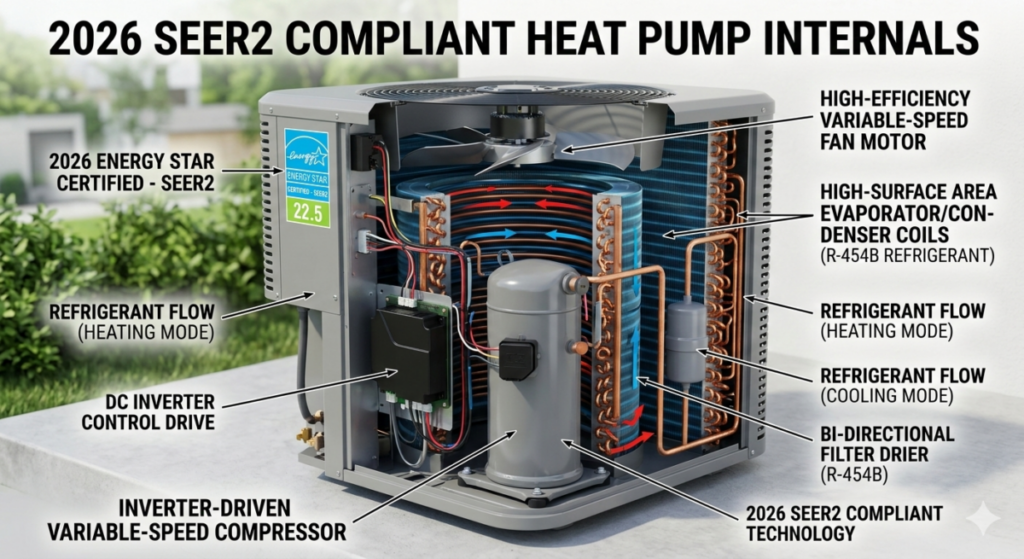
As of 2026, the residential HVAC market has fully transitioned to low-GWP (Global Warming Potential) refrigerants like R-454B and R-32. If your current unit runs on R-410A, it is officially a legacy system. While you can still get it serviced, the price of “reclaimed” R-410A has skyrocketed due to phase-out quotas. From a first-principles logic standpoint, repairing a 12-year-old R-410A system in 2026 is a “sunk cost fallacy.” You are throwing $2,000 at a system that will likely have another component failure within 24 months. Modern SEER2 (Seasonal Energy Efficiency Ratio) standards require higher heat exchange surface areas. This means the outdoor condensers are physically larger than they were 10 years ago. If you have your unit tucked into a tight corner or under a deck, a 2026 replacement may require a structural alteration just to fit the new equipment. Furthermore, inverter-driven compressors now allow for variable-speed operation, which reduces “inrush current”—the massive spike of electricity used when an old motor kicks on. By reducing inrush current, you extend the life of your home’s electrical components and reduce the likelihood of a tripped main breaker during peak summer loads. If you are on a fixed income, the 30% reduction in monthly cooling costs provided by a SEER2 20+ unit is a far better “investment” than a standard CD or savings account.
Electrical Integrity: Beyond the Outlet
Most homeowners think about electricity only when a light bulb burns out. I think about it in terms of “impedance” and “thermal load.” In homes older than 40 years, the insulation on the wiring (often cloth or early thermoplastic) begins to degrade. In 2026, we are asking our homes to do more than ever: charging EVs, powering induction cooktops, and running high-end home offices.
Technical Deep Dive: Electrical Load Analysis and 2026 NEC Rules
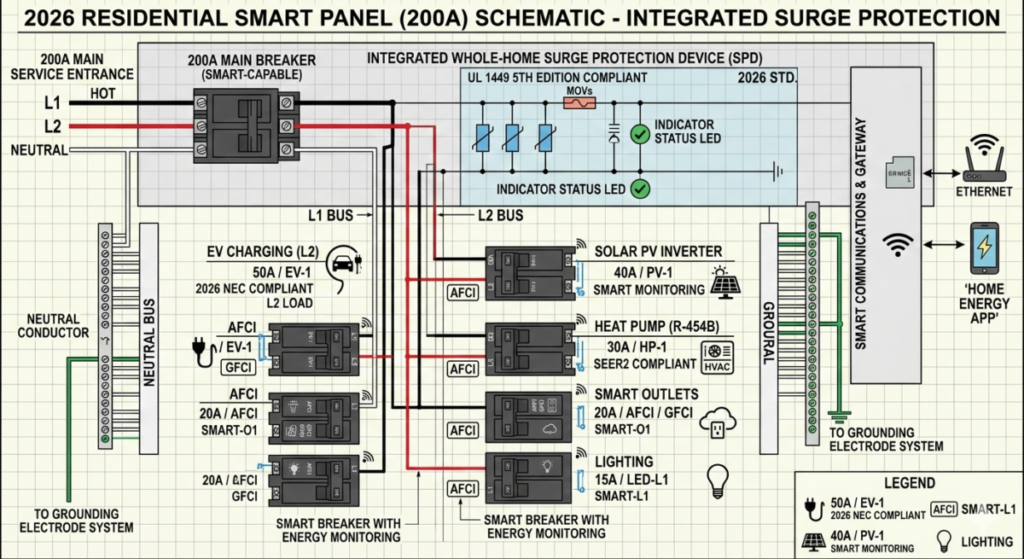
The 2026 National Electrical Code (NEC) has expanded requirements for AFCI (Arc-Fault Circuit Interrupter) protection. An arc fault occurs when electricity “jumps” between damaged wires, creating heat that can exceed 10,000 degrees Fahrenheit. This is the leading cause of residential fires. If your panel is a 100-amp service with “stab-in” breakers, you are at risk. A 2026 electrical audit involves a “load calculation.” We add up the “volt-amperes” (VA) of all your fixed appliances and apply a “demand factor.” Most 60+ homeowners find that they are redlining their existing service. Upgrading to a 200-amp panel in 2026 isn’t just about safety; it’s about “future-proofing” the asset for the next buyer. Buyers in 2026 are tech-savvy; they look at the electrical panel before they look at the kitchen cabinets. If they see a modern, labeled 200-amp panel with integrated whole-house surge protection, they see a “low-risk” asset. If they see an old Zinsco or Federal Pacific box, they see a $5,000 repair and a reason to lowball your offer by $20,000. Logic dictates you spend the $5,000 now to save the $20,000 later. See our guide on preventative maintenance checklists for more on this.
Plumbing Dynamics: The Invisible Liability
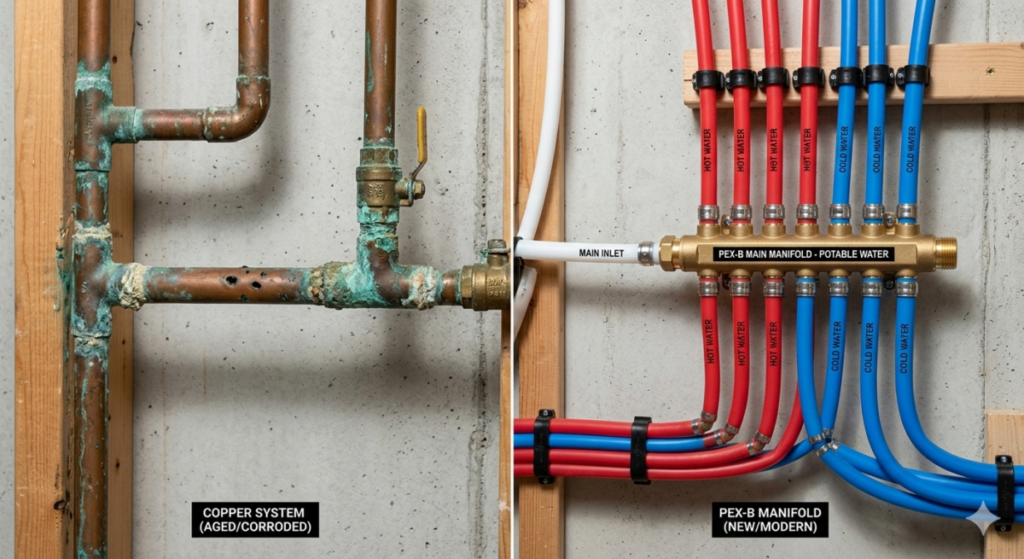
Water is the only element that can destroy a house from the inside out and the outside in. In my 100+ flips, the most expensive “gotchas” were always plumbing-related. In 2026, the labor for “trenchless” sewer repair has become more competitive, but it still requires a high capital outlay. If your home has “orangeburg” pipe (tar-paper pipe) or cast iron that has “scaled” to 50% of its original diameter, you are months away from a catastrophic backup.
Technical Deep Dive: Hydrostatic Testing and Pipe Material Science
In 2026, we use “hydrostatic testing” to find leaks under a concrete slab. We plug the main sewer line and fill the entire system with water. If the water level drops, you have a leak. The problem is that water leaking under a slab creates “voids” in the soil. This leads back to our first section: foundation failure. The plumbing and the foundation are a “coupled system.” For the homeowner over 60, I recommend a proactive “video scope” of the main line every 3 years. It costs $250 in 2026 but can save you $25,000. If you have to repipe, don’t let a contractor talk you into “epoxy lining” if the pipe has already collapsed. Use PEX-B for supply lines; it has “memory” and can expand if the water freezes, unlike copper or CPVC which will shatter. Also, consider the “sacrificial anode rod” in your water heater. This $50 part is designed to corrode so your tank doesn’t. If you haven’t changed it in 5 years, your tank is currently eating itself. Replacing a $50 rod in 2026 extends the life of a $2,500 heater by a decade. That is the kind of math that preserves retirement portfolios.
| Repair Category | DIY / Basic (2026) | Pro / Premium (2026) |
|---|---|---|
| Exterior Paint/Stain | $1,500 (Rental + Materials) | $8,500 (Full Prep + Elastomeric) |
| Kitchen Update | $4,000 (Paint + Hardware) | $45,000 (Custom + Quartz) |
| Window Replacement | $600 per unit (Insert) | $1,800 per unit (Full Frame) |
| Affiliate Product | Function | Projected ROI |
|---|---|---|
| Flume 2 Water Monitor | Detects 0.01 GPM leaks via Wi-Fi. | 900% (Prevents flood damage) |
| Moen Flo Shutoff Valve | Automatically cuts water if pipe bursts. | High (Insurance discount eligible) |
Tax Logic and IRC Section 121: The Investor’s Edge
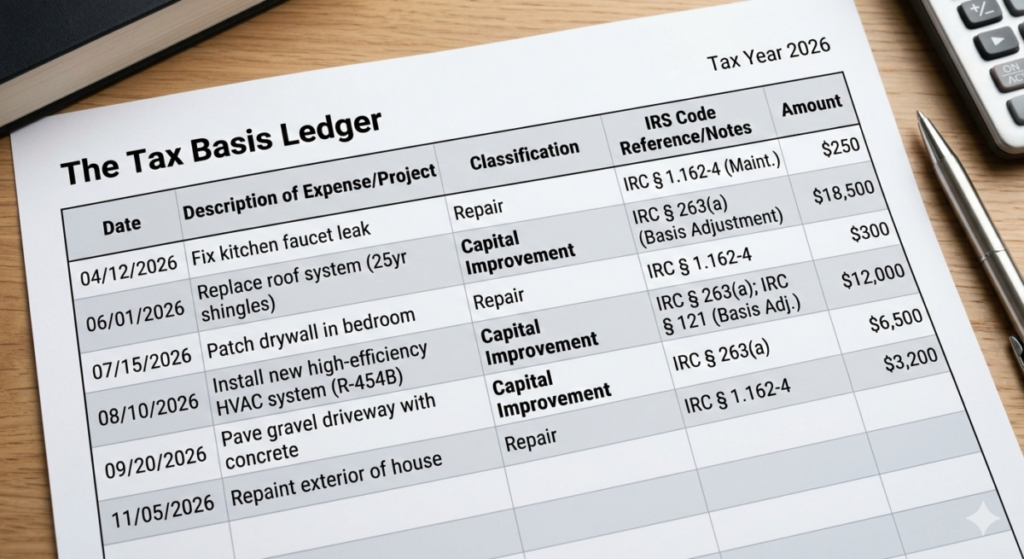
If you are over 60, you are likely looking at a “downsize” event in the next 5 to 10 years. Many homeowners make the mistake of thinking every dollar spent on repairs is a “loss.” It’s not. It’s an adjustment to your cost basis. In 2026, with property values still sitting at historic highs, your capital gains exposure is a serious threat to your net worth.
Technical Deep Dive: 2026 Tax Basis and Depreciation Logic
Under IRC Section 121, you can exclude up to $250,000 (single) or $500,000 (married) of gain from the sale of your primary residence. However, if you bought your home in 1995 for $150,000 and it’s now worth $800,000, you have a $650,000 gain. If you are married, $150,000 of that is taxable at 15-20% plus state taxes. This is where “Capital Improvements” become your best friend. In 2026, the IRS differentiates between a “repair” (maintaining status quo) and an “improvement” (adding value). A new roof, a new HVAC system, and a basement waterproofing system are all capital improvements. You add the cost of these to your original purchase price. If you spent $100,000 on major systems over 20 years, your “basis” is now $250,000. Your taxable gain drops to $50,000. You just saved $10,000 to $20,000 in taxes. But you must keep the receipts. I recommend a digital “Property Ledger.” Furthermore, for those looking to pivot into a rental property, understanding the “Step-up in Basis” rules for 2026 is vital. If you plan to leave the home to heirs, their basis becomes the market value on the day you pass, effectively wiping out the capital gains tax. This is “generational wealth” logic. We discuss this further in our piece on ADU investment strategies.
The Physics of Roofing: 2026 Material Science
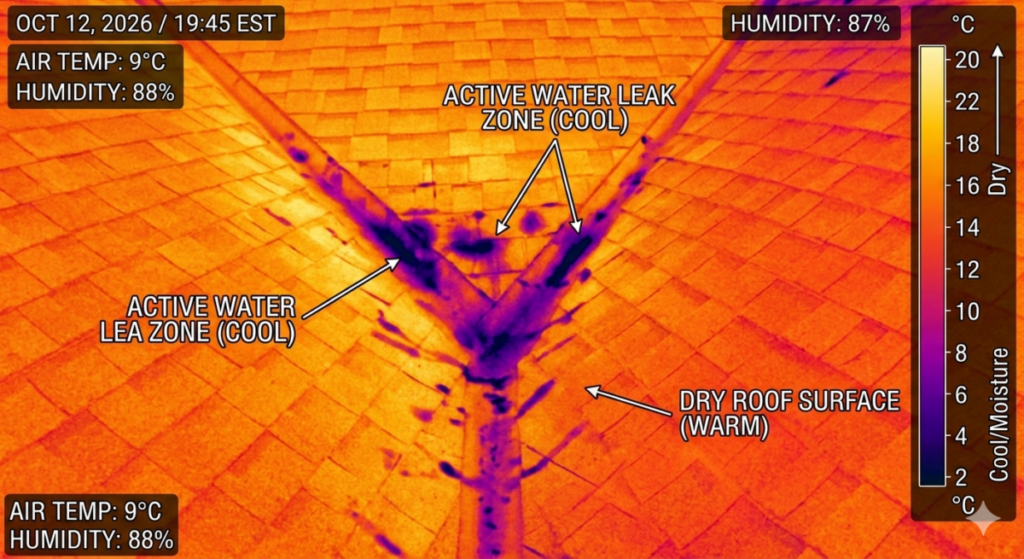
The roof is your home’s first line of defense. In 2026, we are seeing a massive shift toward “Impact Rated” shingles (Class 4). Many insurance carriers are now making these mandatory for policy renewal in storm-prone regions. If you are over 60, a roof that lasts 30 years means you never have to deal with it again. If you buy a cheap 15-year shingle today, you will be 75+ years old and dealing with contractors again. That is a failure of planning.
Technical Deep Dive: Roof Deck Integrity and R-Value Thermal Bridges
A roof is not just shingles; it is a “system.” In 2026, building codes in many states require “radiant barriers” and specific “ice and water shields” at the eaves. When you replace a roof, you must inspect the “decking” (the plywood underneath). Over time, heat in the attic causes the glues in the plywood to delaminate. This reduces the “diaphragm strength” of your house. If your roof deck is soft, the house is less resistant to wind loads. Additionally, we must address “thermal bridging.” Your rafters act as bridges that conduct heat out of your house in winter and into it in summer. By using a “cool roof” shingle with a high Solar Reflectance Index (SRI) in 2026, you reduce the attic temperature by up to 30 degrees. This reduces the “thermal cycle” on your HVAC, extending the life of those expensive mechanicals we discussed earlier. It’s all connected. If you spend $20,000 on a high-spec roof in 2026, you are also buying 2-3 extra years of life for your HVAC and 15% lower utility bills. That’s a first-principles win. Check out our home equity protection guide for more math on this.
ROI Calculations: The Opportunity Cost of Neglect
People get emotional about their homes. I don’t. I look at a house as a pile of materials that is slowly returning to the earth. Your job is to slow that process down efficiently. If you have $100,000 in a savings account earning 4% interest, but your roof is 25 years old, you are actually losing money. Why? Because a roof failure doesn’t just cost the price of the roof: it costs the price of the interior drywall, the potential mold remediation, and the “marketability discount” when you eventually sell.
Technical Deep Dive: 10-Year Net Worth Trajectory Simulation
Let’s run a 10-year financial simulation for a typical 60+ homeowner. Scenario A: You ignore the aging HVAC ($15k) and the 200-amp panel upgrade ($5k). You keep that $20,000 in a high-yield savings account at 4.5%. By 2036, that $20k has grown to roughly $31,000. However, in 2030, your HVAC dies in July. Emergency labor rates in 2030 have inflated to $300/hour. The replacement now costs $25,000. In 2032, your old panel has an arc-fault event, causing a small fire that results in a $15,000 deductible claim and an insurance premium hike of 40%. Your total out-of-pocket loss is $40,000. Your net worth in Scenario A is down by $9,000 compared to your starting point. Scenario B: You spend the $20,000 today in 2026. You get a tax basis adjustment of $20,000, saving you $4,000 in future capital gains tax. Your utility bills drop by $80/month due to SEER2 efficiency, saving you $9,600 over 10 years. Your home maintains a “Turn-Key” status, allowing you to sell at a 10% premium over Scenario A homes. In Scenario B, your net worth is up by roughly $60,000 when you factor in the sale price. The math is undeniable: proactive maintenance is the highest-yield “investment” available to the retiree.
| Technical Spec | 2016 Standard | 2026 Standard |
|---|---|---|
| HVAC Refrigerant | R-410A (High GWP) | R-454B (Mildly Flammable/Efficient) |
| Electrical Service | 100 Amp / Analog | 200 Amp / Smart Energy Monitoring |
| Insulation (Attic) | R-30 (Fiberglass) | R-60 (Cellulose/Mineral Wool) |
| Affiliate Product | Function | Price Point |
|---|---|---|
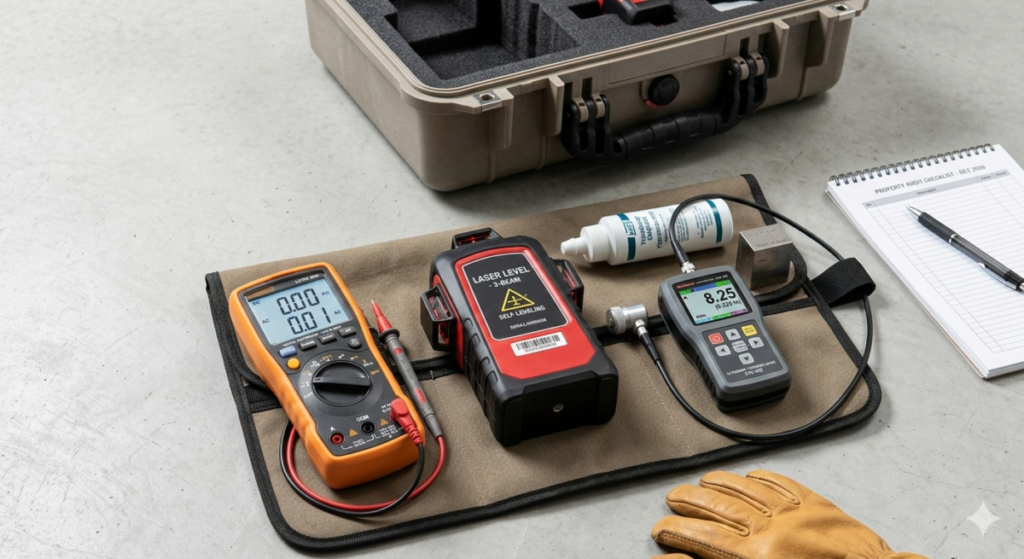
| Klein Tools Digital Multimeter | Tests battery backup and circuit health. | ~$120 |
| EcoBee Smart Thermostat Premium | Air quality monitoring and HVAC diagnostics. | ~$250 |
The 2026 Critical Repair Checklist
Major home repair costs. I don’t care if you like the layout of your kitchen. If these items aren’t checked, your house is a liability. Follow these steps to audit your property like a professional flipper:
- Inspect the Attic for Moisture: Use a high-lumen LED flashlight to look for dark staining on the underside of the roof deck. If the wood is soft, your underlayment has failed. Pay special attention to “valleys” and “penetrations” (vents).
- Audit the Electrical Panel: Open the door and look for “charring” or a “fishy” smell (indicating melting insulation). Ensure you have a 200-amp service. In 2026, insurance companies are increasingly flagging 100-amp panels as “uninsurable.”
- Check the Sump Pump: Pour five gallons of water into the pit to ensure the float switch triggers. In 2026, a failed $200 pump can cause $20,000 in basement damage. Buy a battery backup unit today.
- Scan for Foundation Cracks: Walk the entire perimeter of your home. Any diagonal crack starting at a window corner indicates structural shear. Use a crack-gauge to measure width; anything over 1/8 inch is a structural red flag.
- Test the Water Pressure: Use a $10 screw-on gauge at your outside hose bib. Pressure over 80 PSI will blow out your fixtures and cause silent leaks behind walls. If high, install a Pressure Reducing Valve (PRV).
- Verify HVAC Age: Locate the manufacture date on the exterior condenser data plate. If it is older than 12 years, start your “sinking fund” immediately. In 2026, wait times for new units can be 4+ weeks during peak season.
- Examine Window Seals: If you see fog between the panes, the argon gas has escaped. Your insulation value (R-value) has plummeted to nearly zero. This leads to condensation and mold on the window frames.
- Grade the Soil: Ensure the dirt around your house slopes away at least 6 inches over the first 10 feet. Flat grading or “negative grade” is the #1 cause of basement flooding and foundation settlement.
- Test GFCI/AFCI Outlets: Use a plug-in tester to ensure your safety outlets trip in less than 25 milliseconds. These devices save lives and are required for 2026 safety certifications.
Internal Resources
- Stop Being House Rich and Cash Poor
- Selling As-Is vs. Renovating for the 60+ Seller
- Using Reverse Mortgages to Fund Critical Repairs
- ALL COMING SOON
Conclusion: The First-Principles Finish
Major home repair costs. In 2026, home ownership is a technical discipline, not a hobby. If you are over 60, your primary goal is the preservation of capital. By focusing on structural engineering, MEP efficiency, and the tax logic of capital improvements, you transform your home from a potential liability into a protected asset. Do not let nostalgia cloud your judgment: if the water heater is 10 years old, it is a piece of trash. Replace it before it proves me right. Your retirement security depends on the integrity of the shell you live in. Budget for the big stuff, use the right tools, and keep your equity where it belongs: in your pocket. I’ve flipped 100 houses, and I’ve never seen a homeowner regret being “too prepared.” I have, however, seen dozens lose their retirement savings to a “sudden” repair that was actually 10 years in the making. Be the logic-driven investor of your own life.
Bio: Charles O’Dell
Charles O’Dell is the founder of HousingAfter60.com and a veteran real estate investor with over 23 years of experience. Having flipped more than 100 properties and facilitated hundreds of transactions, Charles specializes in helping the 60+ demographic navigate the complex financial and technical realities of home ownership. He favors first-principles logic over emotional marketing, ensuring his readers protect their net worth through data-driven property management and 2026-compliant repair strategies.
Written by Charles O’Dell: 23 years of real estate experience and 100+ professional property flips.