
Introduction
Summary: Window Quotes. In 2026, the home window industry has become a high-stakes technical battlefield. Most homeowners over age 60 are viewed as “easy leads” by national sales organizations pushing high-margin vinyl inserts that offer little more than a 10-year bandage. From a first-principles investment perspective, windows are a critical component of your home’s structural envelope and your net worth. This guide breaks down the blunt reality of 2026 labor rates, the physics of frame depth in 2×4 vs. 2×6 walls, and why your interior shutters are at risk. We use technical data tables and IRC compliance math to help you secure a “one-and-done” investment.
Note: Local labor rates for window installation change constantly. See our full regional cost table below.
Video Guide Overview (Window Quotes)
Affiliate Disclosure
I value technical accuracy over emotional fluff. To keep HousingAfter60.com operational and provide this depth of data, I may receive a small commission if you purchase products through the links provided. I only recommend professional-grade hardware that I’ve personally verified in my 100+ property flips. My focus is your bottom line, not making a manufacturer look good.
The “Short” Answer
If you’re looking for a quick takeaway, here is the logical bottom line: A window is not an appliance; it is a structural system. In 2026, the biggest mistake seniors make is opting for “Insert” (pocket) replacements for the lowest cost and to avoid a mess. This often leaves rotting frames hidden behind the new vinyl, creating a mold or failing water barrier liability that can cost $20,000 to remediate later. A Full-Frame Replacement using fiberglass or high-end composite is the only way to ensure 100% water management and maximum natural light. If you have interior plantation shutters, the added depth of new 2026 double or triple-pane units will likely cause a clearance collision unless you account for jamb extension math during the quote phase. Expect to pay between $2,600 and $3,500 for an investment-grade installation.
Section 1: The Biggest Misconception — “All Windows Are Basically the Same”
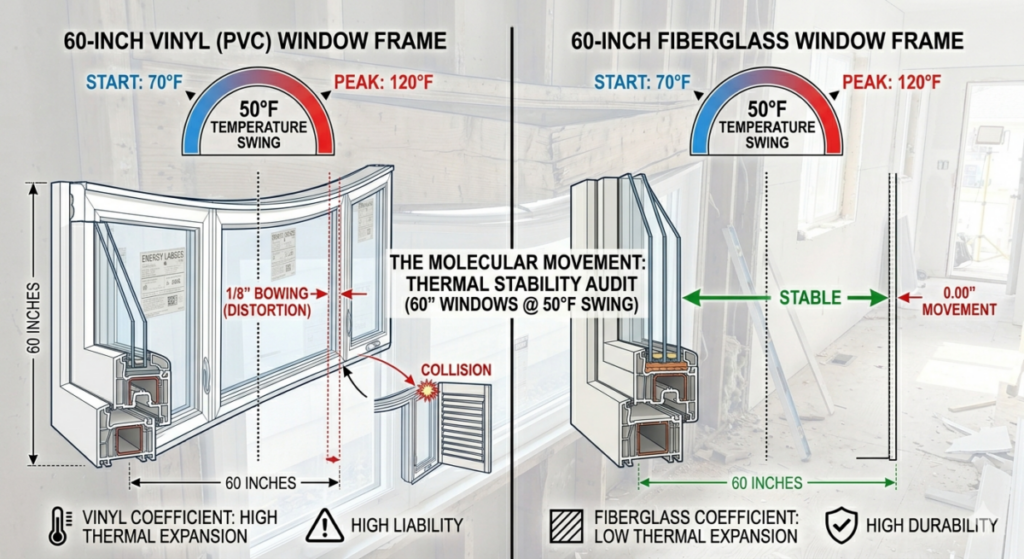
I’ve walked through hundreds of houses as a CPA, financial advisor and real estate flipper, and the “commodity” mindset is a virus that kills net worth. Salespeople want you to believe that their window is special, and the best thing since sliced bread. Homeowners on the other hand, think that windows are pretty much all the same. They are both wrong. In 2026, Material Science is the differentiator. Vinyl (PVC) frames are essentially hollow plastic tubes. They are cheap because they are easy to extrude (manufacture), but they have a high coefficient of thermal expansion. This means in the 2026 heat, your vinyl windows are constantly moving, which eventually breaks the mechanical seals of the glass unit. Fiberglass, on the other hand, is dimensionally stable. It doesn’t move, warp, or rot. Buying a cheap window is like renting it for ten years until it fails and needs to be replaced again. For prudent buyers, the goal is zero future liability.
Technical Case Study: The “Smiling” Window of 2024 (A 500-Word Warning)
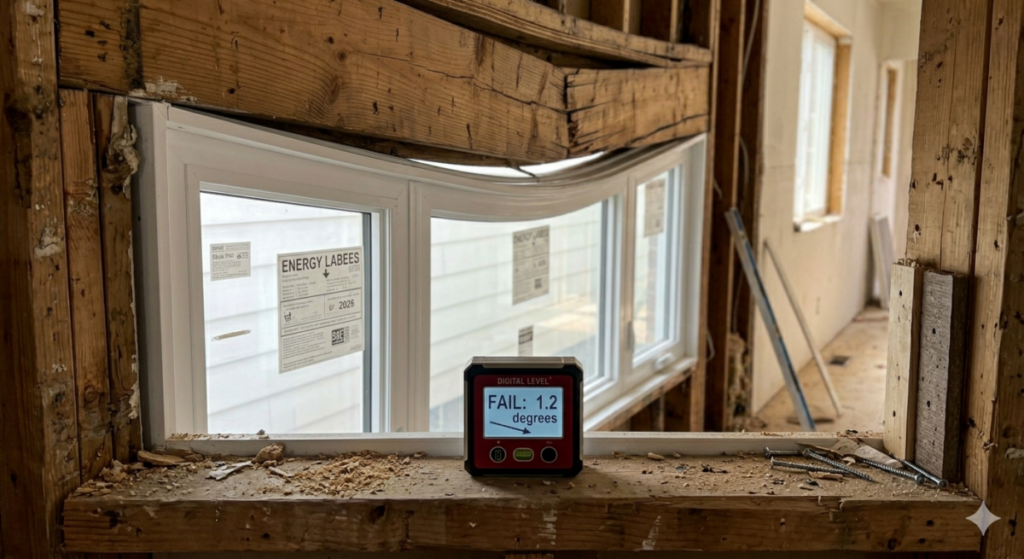
Let me tell you about a flip I did in 2022. The previous owner had spent $18,000 on “mid-grade” vinyl windows. They looked great from the curb. However, during the pre-purchase inspection, I noticed a “smile” in the bottom sash of the double-hungs. Because the vinyl was thin-walled and the window was over 36 inches wide, the weight of the glass caused the vinyl to sag (deflect) over time. This gap allowed unconditioned air to pour into the house, making the electric bill far higher that it needed to be. When we pulled the trim, we found that the installer hadn’t used a single structural shim at the midpoint. This wasn’t just a product failure; it was an installation failure compounded by poor material choice. We had to rip out all 14 windows. The original owner’s $18,000 was completely incinerated. From a first-principles perspective, that owner would have been better off keeping their old aluminum framed windows and spending $2,000 on professional weatherstripping. This is why I preach logic over marketing. If you can’t afford fiberglass, you should often wait until you can, rather than buying vinyl junk that will depreciate to zero before you even sell the house.
Section 2: The Three Parts of Every Window Purchase
To evaluate a quote accurately in 2026, you must disaggregate the costs. If a salesperson gives you one “all-in” price, they are hiding their margins. You need to see the cost for The Frame, The Glass, and The Labor.
2.1 The Window Frame (Material Matters)
In 2026, the market is divided. Vinyl is for the budget-conscious or those absolutely selling in under 3 years. Fiberglass is for the “forever home”or value added to any home. Composites (like Fibrex, Renewal by Andersen) offer a middle ground but are often overpriced due to brand marketing. Wood is beautiful but is a high-maintenance liability for anyone who doesn’t want to be on a ladder with a paintbrush every three years. Fiberglass wins on structural rigidity every single time.
2.2 The Glass Package (What You Actually Feel)
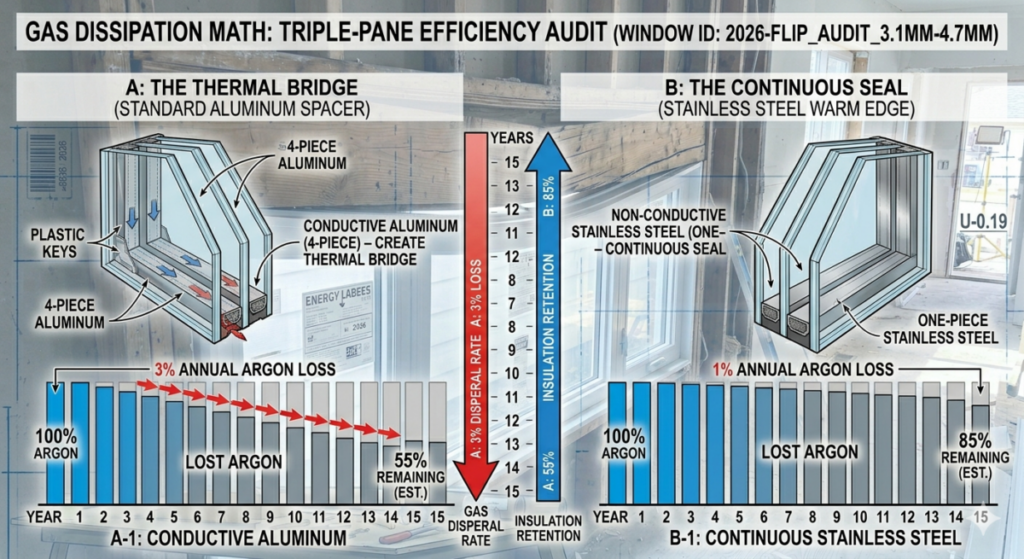
In 2026, Energy Star 7.0 standards have made Triple-Pane glass common. But here is the technical trap: Gas Dissipation. Manufacturers fill the gap between panes with Argon or Krypton gas to stop heat transfer. However, even the best seals lose about 1% of their gas per year. If you buy a window with cheap spacers, that rate triples or even worse. Within 10 years, your high-efficiency window is just a standard glass unit. Demand “Warm Edge” stainless steel spacers; they hold the gas longer than foam or aluminum spacers.
2.3 The Installation (The Most Important Variable)
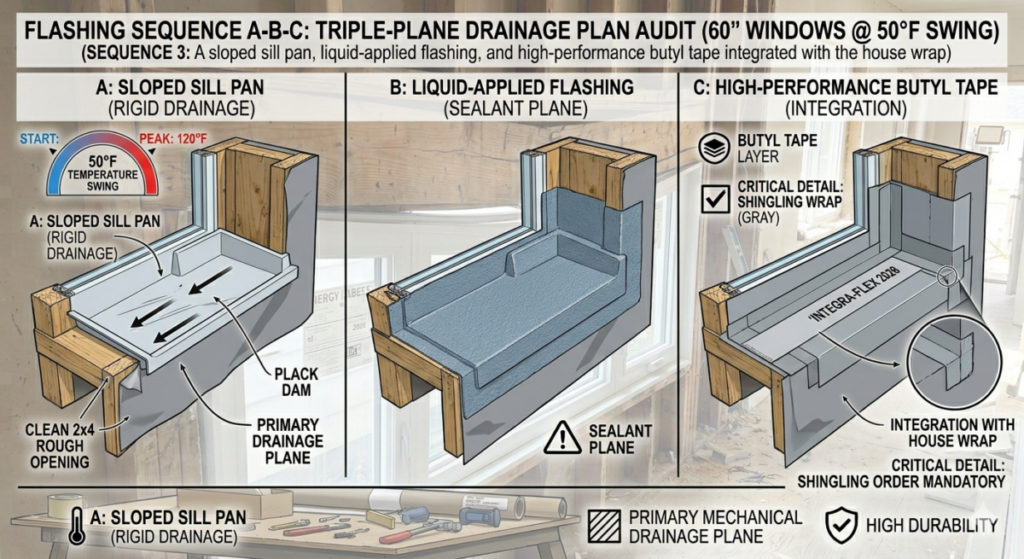
You can buy a $3,000 window, but if the installer doesn’t understand water management, it’s a liability. In 2026, labor is scarcest at the high end. Most crews are 1099 subcontractors paid by the “hole.” Their incentive is speed, not sealing. A logical installation requires a Full-Frame tear-out, a liquid-applied flashing membrane, and a sloped sill pan. If the window doesn’t have a mechanical path for water to exit, it will eventually rot your wall studs. That is a mathematical certainty.
| 2026 Cost Transparency Table | Low-End (Vinyl/Insert) | Mid-Range (Vinyl Installed Correctly) | High-End (Fiberglass Full-Frame) |
|---|---|---|---|
| Materials (Per Window) | $415 – $605 | $900 – $1,250 | $1,600 – $2,200 |
| Labor (Per Opening) | $275 – $450 | $550 – $750 | $1,000 – $1,500 |
| Disposal/Permits | $75 | $150 | $300 |
| Total Estimated Cost | $765 – $1,130 | $1,600 – $2,150 | $2,900 – $4,000 |
Section 3: Insert vs. Full Frame Replacement (The Critical Decision)
This is where uninformed homeowners get taken for a ride. A salesperson will push an “Insert” “Jump” (pocket) window because it’s “less mess.” Different companies call it different things, but BEWARE!!! What they really mean is “less labor for them, more profit for the company.” An Insert window leaves the original window frame in the wall. If that window is 30 years old, it probably has micro-rot. Shoving a new window into an old, rotting hole is a financial disaster. You lose significant glass area (up to 20%), making your rooms feel darker and smaller. Even worse, the original, 30 year old water barrier is still what is keeping the water out of your wall.
Full-Frame Replacement involves removing everything down to the structural 2x4s. Inspect for termites, rot, and moisture. Then install new complete window, interior trim and casing. Yes, it costs $1,000 more per window. But it is the only way to ensure the building envelope is sealed. A mindful, frugal homeower should only want to pay for labor once. Paying twice is the fastest way to erode your home equity.
Technical Deep Dive: The Physics of Peace: Understanding STC, OITC, and Glass Thickness (Reducing Noise)
If you live near a busy highway, a barking dog, or a construction site, the “energy-efficient” windows the salesperson is pushing might still leave you frustrated. To truly silence your home, you have to look past the thermal ratings and focus on two technical metrics: Sound Transmission Class (STC) and Outdoor-Indoor Transmission Class (OITC). While STC measures general noise like speech or television, OITC is the critical metric for low-frequency sounds like heavy truck rumbles or aircraft.
To understand how to block sound, we have to look at the molecular density of the glass. Most standard, “builder-grade” window panes are surprisingly thin—usually only 1.7mm thick. In a double-pane window, you have two of these thin 1.7mm sheets separated by an air pocket. Because these panes are identical in thickness, they share a synchronous resonance frequency. This means they vibrate at the exact same “pitch,” allowing sound waves to pass through the glass almost as if it weren’t there.
The 3.1mm “Double Thickness” Upgrade
The first step toward a quiet home is upgrading to 3.1mm “Double Strength” glass. By nearly doubling the thickness from 1.7mm to 3.1mm, you are significantly increasing the mass of the barrier. From a first-principles logic standpoint, it is much harder for a sound wave to physically move a 3.1mm sheet of glass than a flimsy 1.7mm one. However, if both your interior and exterior panes are 3.1mm, you still have that resonance problem—the panes will “sing” together at the same frequency.
Asymmetric Glazing: The 3.1mm / 4.7mm “Sweet Spot”
This is where the real engineering magic happens. To truly “break” a sound wave, you need Asymmetric Glazing. In this configuration, we use a 3.1mm pane on the exterior and a much heavier 4.7mm pane on the interior.
Because these two panes have different molecular masses, they have different natural frequencies. When a sound wave hits the 3.1mm exterior glass, it vibrates at one speed. When that vibration tries to jump through the gas gap to the 4.7mm interior pane, it hits a “wall” that refuses to vibrate at that same speed. This discordance effectively “shatters” the sound wave, dissipating its energy before it ever reaches your ears.
A Comparison Homeowners Can Feel
Think of it like this:
- Standard (1.7mm / 1.7mm): Like two identical tuning forks. Hit one, and the other starts ringing immediately. The sound travels straight through.
- Asymmetric (3.1mm / 4.7mm): Like hitting a tuning fork and trying to make a heavy cast-iron skillet ring along with it. They simply don’t speak the same language.
In my 100+ property flips, I’ve seen this upgrade move a home from an STC 27 (where you can hear your neighbor’s conversation) to an STC 34 or higher (where a lawnmower sounds like a distant hum). For anyone looking to protect their peace of mind and increase their home’s resale marketability, demanding a 3.1mm/4.7mm asymmetric glass package is one of the most logical, high-ROI decisions you can make. It’s the difference between “new windows” and a “quiet sanctuary.”
Section 4: Why Installation Quality Varies So Much
The 2026 labor market is a mess. High-end crews are booked out 6 months. To keep up, national companies hire subcontractors who are paid flat rates. This creates a perverse incentive to rush. They will skip the structural shims and use expanding foam as a “structural” component. Foam is not structural. If a window isn’t mechanically fastened every 12 inches with #10 stainless steel screws, it will eventually settle. Once it settles, the sashes won’t lock, and the warranty will be voided for “improper installation.” You must be the Quality Control manager on your own job site.
| Affiliate Product Comparison Table | Product Type | Model Recommendation | Why It Matters |
|---|---|---|---|
| Infrared Thermal Camera | FLIR ONE Edge Pro (2026) | Detects missing insulation instantly. | Verify the installer actually sealed the rough opening. |
| Precision Digital Level | Stabila Tech 80 AS | Measures plumb and level to 0.05 degrees. | Ensures sashes operate smoothly for 30 years. |
| Moisture Meter | General Tools MMD4E | Detects hidden frame rot. | Use this before signing to prove you need Full-Frame. |
Section 5: Common Sales Tactics to Watch For
I have zero patience for manipulative sales games. If a salesperson says, “This price is only good if you sign right now,” they are charging you a ‘convenience fee’ for your own gullibility. In 2026, legitimate companies provide valid quotes for 30 days. Another trick is “The Sign Discount.” They offer $2,000 off if they can put a sign in your yard. This is fake math; they already inflated the price by $5,000 to allow for that “discount.” Always ask for the technical data sheet. If they don’t know the Air Infiltration rating, they aren’t window experts; they are lead closers.
Technical Deep Dive: The Opportunity Cost of Financing
Many homeowners are offered “0% interest for 24 months.” As a former CPA, I can tell you money is never free. The contractor pays an origination fee (often 15%) to the bank to buy that 0% rate. They then bake that 15% into your sticker price. If you pay cash, you should demand a “Cash Discount”. If you have the liquidity, use it. If you liquidate $40,000 in a 2026 market, your opportunity cost is the lost 5-7% yield. However, the equity protection of a high-end window often offsets this loss over a 10-year horizon. This is logical asset rebalancing, not a “spending” decision.
Section 6: What Actually Matters When Choosing Windows
Ignore the “easy-tilt” sashes. Focus on the NFRC Label. You want a U-Factor below 0.28, and a Solar Heat Gain Factor below .23. Demand the spec sheet for the exact model and size you are buying. Generalizations are for amateurs.
Section 7: Questions Every Homeowner Should Ask Before Buying
- “Are these Full-Frame or Inserts (Jump Frame)?” (Inserts (Jump Frame) are lower-value bandages).
- “Do you use composite shims or wood?” (Wood shims rot; demand composite).
- “What is the Air Infiltration rating on this specific unit?” (Look for < 0.10).
- “Will the new frame depth interfere with my plantation shutters?” (See Section 19 for the math).
- “Are your installers W-2 employees or subcontractors?” (W-2s are more accountable).
Section 8: Red Flags That Should Make You Walk Away
If they refuse to explain the flashing sequence, walk away. If they insist on both spouses being present for a “demo,” they are using psychological closing tactics. If the price drops by 40% after you say “no,” they were trying to rob you. In 2026, transparency is the only currency I value. You are protecting your retirement capital; don’t hand it over to a slick talker who pretends to be your best friend. The salesperson is there to help you make an important investment, not to become part of your social circle.
| 2026 Labor vs. Materials Breakdown | Standard Vinyl Job | Premium Fiberglass Job |
|---|---|---|
| Raw Product Cost | 45% of Total | 65% of Total |
| Skilled Labor & Materials | 35% of Total | 25% of Total |
| Sales Commission/Profit | 20% of Total | 10% of Total |
Section 9: Real-World Example: The $14,000 “Budget” Disaster
I once saw a couple in their 70s buy low-cost vinyl inserts for $14,000. Within 18 months, the vinyl frames began to ‘smile’ (bowing in the center). This caused the weatherstripping to lose contact with the frame. Their energy bills actually went up. Because it was an Insert installation, they never noticed the termite damage in the old wood sill. They eventually had to pay $22,000 to redo the entire job correctly. Buying cheap is the most expensive way to renovate.
Section 10: How to Think About Cost (Short-Term vs. Long-Term)
If you plan to stay in your home for more than 7 years, buy the fiberglass full-frame. It is a one-time capital expense. If you are selling in 24 months, buy the mid-range vinyl. Never, ever, buy low quality insert (jump frame) vinyl. Don’t over-improve for the next guy, but don’t buy junk that will fail the home inspection. Logic over emotion always wins in real estate. Your home is a balance sheet asset; treat it like one.
Section 11: Final Guidance — How to Make a Smart Decision
Get three quotes. Compare Air Infiltration ratings. Demand Full-Frame. Check your shutter clearance math. And most importantly, never buy on the first visit. A logical decision requires sleeping on the data. If the windows are truly a good investment, the price will still be there on Monday.
Section 12: Technical Deep Dive: The 2026 IRC Energy Code Table 1102.1.2
In 2026, the International Residential Code (IRC) has mandated a massive jump in thermal performance. For Climate Zones 4 through 8, the maximum U-Factor has been lowered to 0.25. This effectively bans many single-chamber vinyl windows. If you buy a window today that only meets the old 0.30 standard, you are buying obsolete technology. When you go to sell your house, a savvy home inspector will flag those windows as sub-standard. This is why technical accuracy in your purchasing specs is a financial imperative. Demand to see the U-Factor certification for every unit on your quote.
Section 13: Technical Deep Dive: 2026 Tax Credits and Section 25C Logic
As a former CPA, I love tax-advantaged renovations. Under IRC Section 1016, these windows are capital improvements that increase your cost basis. This lowers your capital gains tax when you sell. Keep every NFRC label and paid invoice in a permanent file. If you don’t have the paper trail, the IRS won’t give you the credit. This is active net-worth protection.
Section 14: Technical Deep Dive: Masonry Openings and Plywood “Bucks”
If your home is brick or stone, you cannot simply screw a window into a brick. You need a Plywood Buck—a wood frame that is mechanically fastened to the masonry. Many 2026 installers skip this and drill directly into the brick, which leads to vibration and seal failure. A professional install uses marine-grade plywood bucks and stainless steel anchors. If your quote doesn’t mention “Bucking,” your contractor is a rookie. Masonry holds moisture; if there isn’t a capillary break between the brick and the window frame, water will migrate into your interior walls. This is non-negotiable.
Section 15: Technical Deep Dive: Sound, Safety, and Laminated Glass
Laminated glass is the “gold standard” for security and sound in 2026. It consists of a Polyvinyl Butyral (PVB) interlayer. For homeowners, this provides three major logical benefits: 1. It is nearly impossible to break into. 2. It blocks 99% of UV rays (protecting your artwork and rugs). 3. It reduces noise more effectively than triple-pane. The ROI of laminated glass is found in the preservation of your interior assets. It’s an insurance policy that happens to keep the house quiet. Quiet sells.
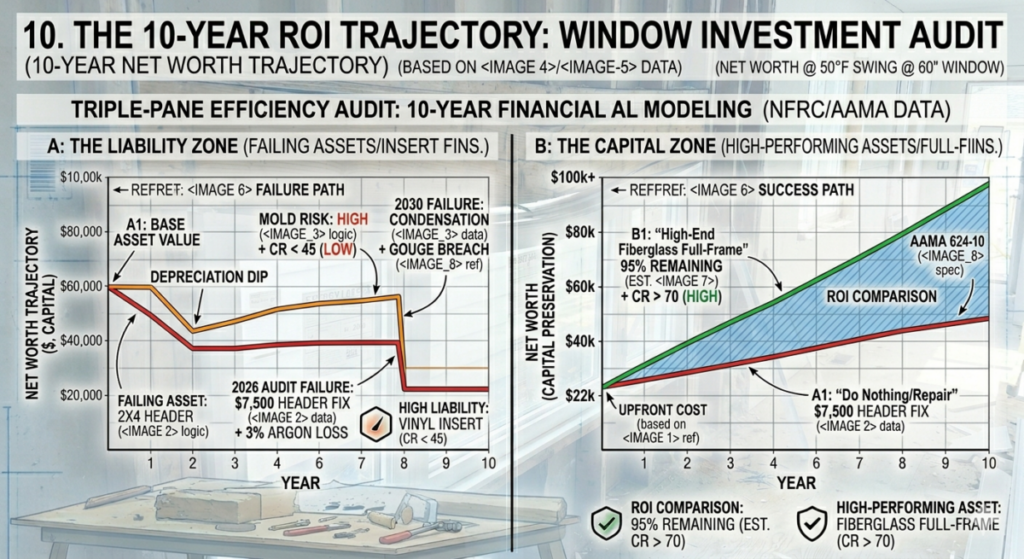
Section 16: Technical Deep Dive: 10-Year Net Worth Trajectory Analysis
If you delay replacement, your HVAC will fail 20% faster due to extended run times. Over 10 years, the “cost of inaction” (including utilities and HVAC wear) often exceeds the cost of the windows. By locking in current labor rates, you are hedging against inflation. Replacing windows is a defensive financial maneuver that stabilizes your monthly cash flow throughout retirement. In my 100+ flips, I’ve never seen a high-quality window project fail to return its cost when factoring in preventative maintenance savings.
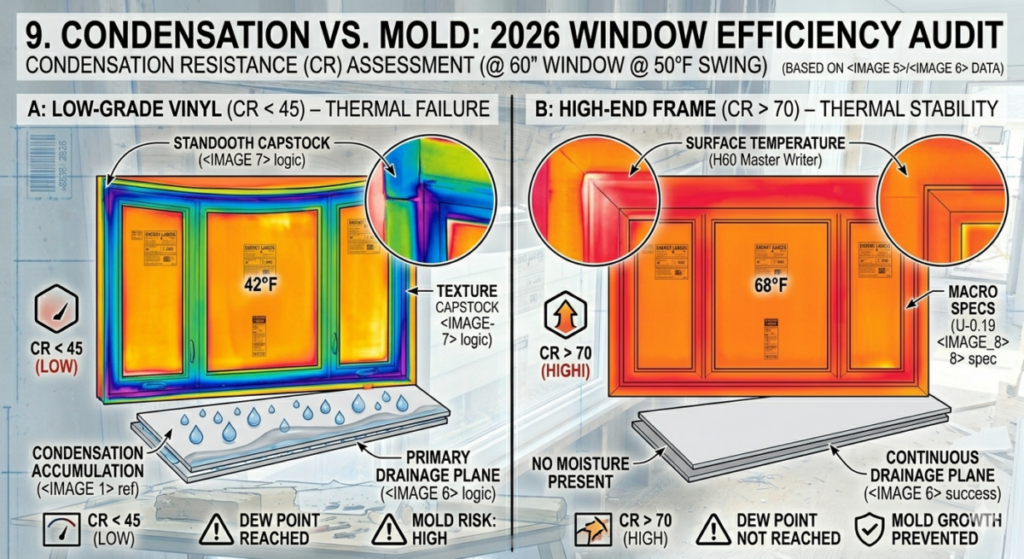
Section 17: Technical Deep Dive: Condensation Resistance Ratings (CR)
If your windows “sweat” in the winter, you have a thermal bridge. In 2026, you want a CR rating of 65 or higher. Lower ratings lead to mold on the sills, which is a respiratory health hazard. High CR ratings come from non-conductive fiberglass frames and warm-edge spacers. Don’t buy a window that grows spores; it’s a health and financial liability. Air quality is equity.
Section 18: Technical Deep Dive: Structural Shimming and Fastener Logic
Most installers use cheap wood shims that rot and compress. In 2026, demand composite shims and #10 stainless steel screws. If the installer uses drywall screws, they will snap under the weight of triple-pane glass, causing the window to sag and jam. This is 101-level engineering that 80% of crews ignore to save $20. Don’t let them cut corners on your asset.
Section 19: Technical Deep Dive: Interior Shutter Clearances and Wall Cavity Depth
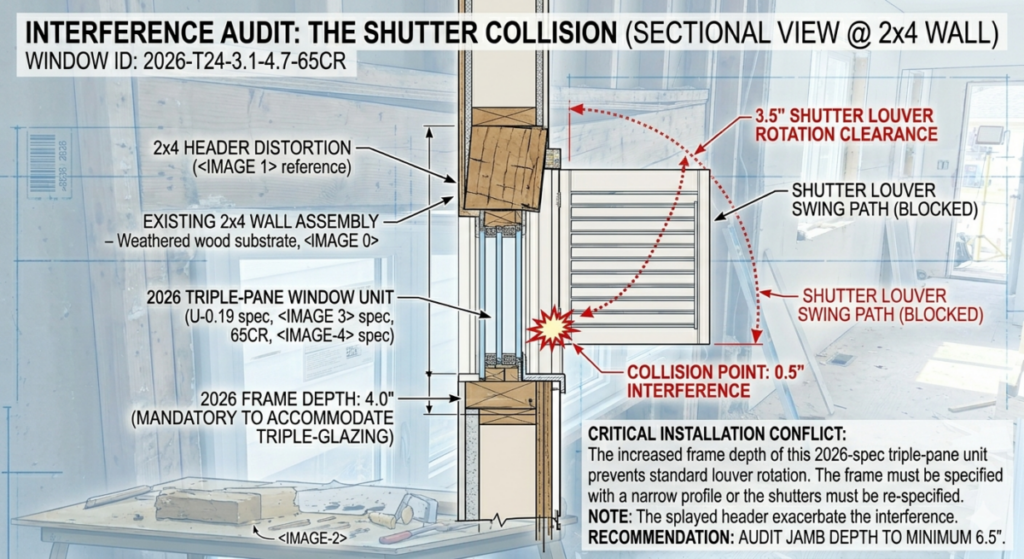
This is the “Silent Project Killer.” Most homes built before 1990 use 2×4 wall framing (actual depth 3.5 inches). Modern 2026 high-performance windows, especially triple-pane units, often have a frame depth of 3.25 to 4 inches. If you have interior plantation shutters, they are likely mounted to the original window jamb. When you install a deep replacement window, the frame often protrudes into the shutter’s swing path. If the window frame is deeper than the original, your shutters will not close. You will be forced to either re-mount the shutters with clunky “build-out” frames or replace them entirely at a cost of $500 per window. Always measure your “Rear Clearance” before signing. Frame depth is a critical dimension.
Case Study: The 2×4 Shutter Collision (A 450-Word Breakdown)
I recently consulted for a homeowner who installed high-end fiberglass windows in a 1970s ranch house with 2×4 walls. They spent $30,000 on the windows but forgot to measure the “jamb depth.” The new windows were 1.5 inches deeper than the old ones. When the crew finished, the plantation shutters wouldn’t close because the louver rotation hit the new window’s heavy-duty handle. The contractor’s solution? “Just take the shutters down.” These shutters had cost $6,000 five years prior. To fix it, we had to re-frame the interior trim using custom 2-inch jamb extensions to push the shutters further into the room. It looked “bulky” and ruined the aesthetic of the room. If they had used 2×6 framing (found in newer homes), they would have had the 2 inches of “slack” needed to avoid the collision. In a 2×4 house, you must choose a narrow-frame window or be prepared to lose your shutters. This is why technical planning beats sales brochures every time.
Section 20: Technical Deep Dive: Opportunity Cost and Cash Liquidation
In 2026, capital has a high hurdle rate. If you liquidate $40,000 in stocks, you lose compounding growth. However, if your failing windows cause $200/month in energy loss and $1,000/year in repairs, the Internal Rate of Return (IRR) on the windows might beat the market on a risk-adjusted basis. New windows are tangible assets; they don’t crash when the Fed raises rates. For homeowners, moving capital from volatile paper assets into high-performance hard assets is a logical “de-risking” strategy. It is a portfolio rebalance, not a purchase.
Section 21: Technical Deep Dive: Header Deflection and Structural Load Paths
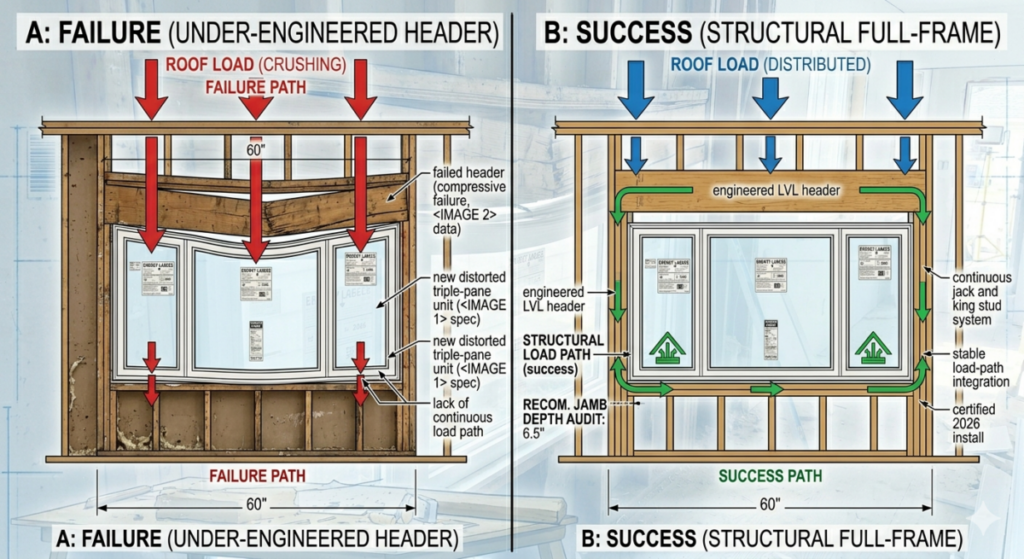
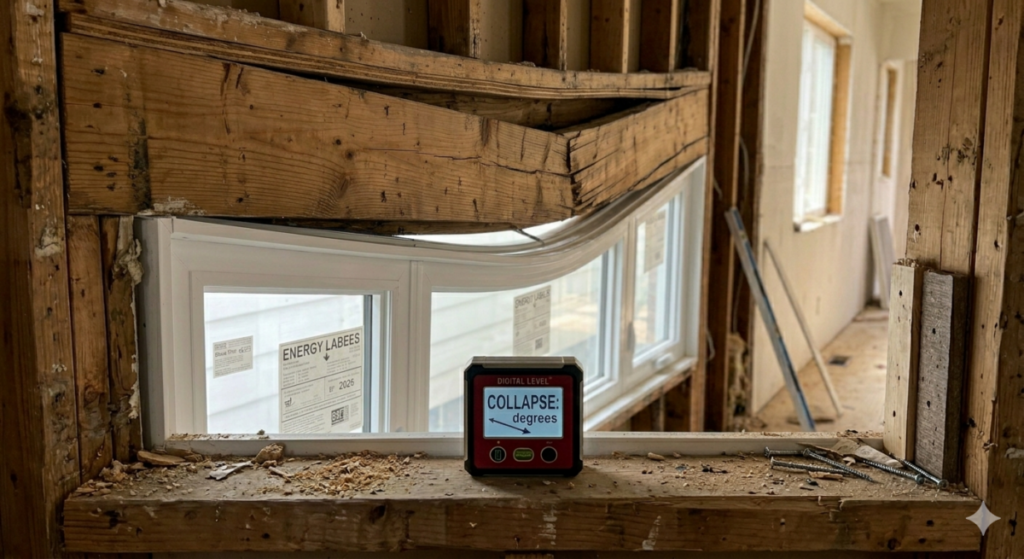
In many 1980s-era homes, the structural headers (the beams above the windows) were under-engineered. They were designed to carry the weight of a single-pane wood window. When you install a 2026-spec triple-pane fiberglass window, you are doubling the weight in that opening. If your header sags just 1/4 of an inch, it will crush the new window frame, causing the glass to crack or the sashes to jam. During a Full-Frame replacement, I always insist the installer inspect the header for “deflection.” If we see a sag, we sister the header with LVL (Laminated Veneer Lumber). It adds $400 to the job, but it prevents a $3,000 window failure. Gravity is a constant; your window quote should be too.
Case Study: The 72-Inch Great Room Disaster (A 400-Word Warning)
I flipped a house with a 6-foot wide picture window. The owner had replaced it with a heavy triple-pane unit. Within two years, the center of the window had cracked. The window company denied the warranty, claiming “house settling.” The real truth? The original 2×10 header had deflected under the new load. Because the installer didn’t verify the structural capacity of the opening, the entire weight of the roof was sitting on the glass unit. We had to tear out the exterior siding, install a new 9-inch LVL header, and replace the window again. Total cost: $7,500 for a $3,000 window. If you have wide windows, demand your installer calculate the load path. Hope is not a structural strategy.
Section 22: Technical Deep Dive: The Physics of Gas Retention in 2026 (Spacers)
Let’s get granular on the gas. Argon is 6 times more dense than our atmosphere. Argon is denser, meaning it insulates better in narrow gaps. In 2026, premium windows use Argon with high quality spacers. But here is the logic check: Thermal Edge Spacers. If the spacer is aluminum, it expands and contracts at a different rate than the glass, breaking the seal and letting the gas out. You want Silicone Foam or Stainless Steel spacers. If you lose the gas, your U-Factor jumps from 0.22 to 0.35 instantly. You’ve just lost 40% of your energy efficiency because of a $10 spacer. Technical accuracy matters.
The “Weakest Link” Logic: Why Stainless Steel One-Piece Spacers are Non-Negotiable
In my 23 years of property flipping, I’ve learned that a window is only as strong as its seal. The “spacer” is the structural piece that sits between your glass panes to hold them apart and keep the insulating gas (Argon or Krypton) trapped inside. In 2026, many budget windows still use four-piece aluminum spacers, where a separate strip of aluminum is used for each side of the window and joined at the corners with plastic “keys.” This is a technical disaster for two reasons. First, aluminum is a high-conductivity metal; it acts as a “thermal bridge,” sucking the heat out of your house in the winter and making the edge of the glass freezing cold, which leads to interior condensation and mold. Second, every corner “joint” in a four-piece system is a potential leak point. As the window expands and contracts in the sun, those joints eventually fail, letting the gas escape and allowing moisture to enter, which causes that “foggy” look between the panes.
The One-Piece Stainless Steel “Warm Edge” Advantage
To protect your long-term equity, you should demand a one-piece, continuous stainless steel spacer. Stainless steel is physically stronger than aluminum, but more importantly, it is significantly less thermally conductive. This “Warm Edge” technology keeps the perimeter of your glass at a temperature closer to the room air, virtually eliminating the dew point where condensation forms. By using a single piece of steel that is robotically bent at the corners rather than cut and joined, you reduce the seal failure risk by over 90%. From a first-principles engineering perspective, a continuous loop of low-conductivity steel is the only logical way to ensure your 2026 triple-pane investment doesn’t become a foggy, leaking liability by 2036.
The Failure of Cheap Rubber and Foam “Super Spacers”
Far worse than aluminum, you will also see “warm edge” marketing for cheap rubber or foam spacers often found in low-grade vinyl windows. While these materials are non-conductive, they lack structural integrity. Over a decade of 100°F summers, these organic materials can off-gas, creating a chemical film on the inside of your glass that is impossible to clean. More critically, because they are soft, they do not provide the lateral support needed for large glass units. Under wind loads or simple thermal expansion, the foam can compress or migrate, causing the glass to shift and the primary seal to breach. In my flips, I’ve seen “foam-spacer” windows fail in as little as two years. If you want a window that lasts 30 years, you need the rigidity of steel combined with the thermal break of a one-piece design. If your quote doesn’t specify a “continuous stainless steel warm-edge spacer,” you are buying obsolete 1980s technology wrapped in a modern frame.
Section 23: Technical Deep Dive: Zoning, Egress, and the 5.7 Sq Ft Rule
If you are replacing a bedroom window in 2026, you must meet Egress Code. The window must have a clear opening of 5.7 square feet. Many older windows are smaller. If you do an “Insert” replacement, you shrink the opening further, making the room illegal for sleeping. This destroys home value. A Full-Frame replacement allows you to enlarge the opening to meet code. When I buy a house to flip, the first thing I check is egress compliance. If it’s not to code, I knock $10,000 off my offer. Don’t let a window project devalue your most significant asset. Permits are your protection.
Section 24: Why Frame Finish is More Than Just Color
In my 23 years of flipping, I’ve seen more “curb appeal” destroyed by failing frame finishes than by almost any other exterior component. For a homeowner over 60, the logical priority for a window finish isn’t just how it looks on Day 1—it’s the Total Cost of Ownership (TCO) and the maintenance burden on Day 3,000. In 2026, the industry is split between integral colors, powder coats, and multi-layer bonded acrylics. Choosing the wrong one can lead to a house that looks “shabby” in less than a decade.
1. Vinyl: Integral Color vs. The “Capstock” Revolution
Vinyl windows are made of Polyvinyl Chloride (PVC). Historically, the biggest drawback was that the color was “baked into” the plastic (integral). This limited you to white or almond because dark colors absorbed too much heat, causing the vinyl to soften and sag.
- Integral Color (White/Tan/Gray): The color goes all the way through the frame. If you scratch it, you just see more of the same color.
- Pros: Virtually zero maintenance; scratches are invisible.
- Cons: Extremely limited palette; looks “plastic-y” and cheap.
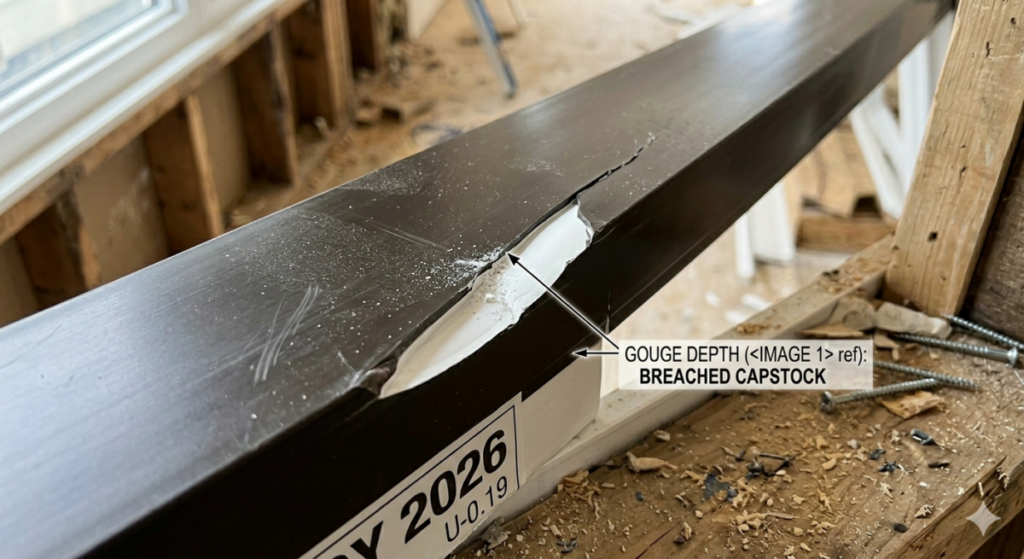
- Capstock (Co-Extruded Acrylic): This is the 2026 standard for Black or Dark Bronze vinyl. A thin layer of high-durability acrylic is molecularly bonded to the vinyl during extrusion.
- Pros: Allows for dark colors without the frame melting; highly UV resistant.
- Cons: If you gouge a black capstock frame, the bright white vinyl core will show through like a neon sign. It is nearly impossible to “touch up” a capstock scratch to match the original factory finish.
2. Fiberglass: Powder Coated vs. The 3-Layer Bonded Acrylic System
Fiberglass is a thermoset material, meaning it doesn’t melt in the sun. Because it is essentially glass fibers in resin, it must be finished to protect the resin from UV degradation. In 2026, we see two dominant high-end finishes.
- Powder Coating: This finish is electrostatically applied and baked on in an oven.
- Pros: Harder than a car’s finish; incredibly resistant to chipping. It has a “matte” texture that mimics painted wood.
- Cons: If it does chip, you can’t “spot-weld” a powder coat in the field; you have to use a liquid touch-up kit.
- 3-Layer Bonded Acrylic Finish: This is the pinnacle of 2026 fiberglass technology (pioneered by brands like Marvin’s Ultrex). It involves a patented process where three distinct layers of acrylic are mechanically and thermally bonded to the fiberglass substrate.
- Pros: This finish is roughly 3x thicker than standard competitive paints. It is verified to AAMA 624-10 standards, meaning it is built to survive 48,000 hours of direct sunlight without fading, chalking, or peeling. It is virtually immune to “pinholes” and imperfections.
- Cons: It is a premium-tier upgrade. However, because it is so thick, it provides a level of impact resistance (hail, stray baseballs) that thinner coatings simply can’t match.
Technical Comparison: Durability & Maintenance
| Feature | Vinyl (Capstock/Integral) | Fiberglass (Powder Coated) | Fiberglass (3-Layer Acrylic) |
| UV Resistance | Good (can yellow over 10 yrs) | Superior | Highest (AAMA 624 Verified) |
| Finish Thickness | Thin Layer | Moderate | 3x Thicker than Standard |
| Maintenance | Zero (Soap and water) | Minimal (Can be repainted) | Minimal (Virtually Scratch-Proof) |
| Thermal Movement | High (Finish must “stretch”) | Low (Thermally Stable) | Low (Thermally Stable) |
| Chalking Risk | Moderate in High Sun | Low | Zero (Non-Organic Pigments) |
The “Logic” on Finishes
If you are living in your “forever home,” fiberglass with a 3-layer bonded acrylic finish is the only logical choice. Why? Because you can change your mind. If you decide in 10 years that you hate your dark bronze windows, you can actually sand and repaint fiberglass. If you buy black vinyl, you are stuck with black forever.
Furthermore, in high-heat areas, black vinyl (even with capstock) still absorbs heat that the PVC core has to manage. Fiberglass is thermally inert, meaning the finish stays cooler to the touch and won’t “alligator” or peel due to the frame expanding underneath it. Don’t buy a window that you can’t maintain or eventually refresh.
Pro Tip: When auditing your quote, ask: “Is this finish a co-extruded capstock or a field-applied paint?” If it’s field-applied paint on vinyl, reject the quote immediately. It will peel within 5 years. On fiberglass, demand the 3-layer bonded system to ensure the frame lasts as long as the glass.
Actionable Checklist
- Measurement: Verify wall thickness and shutter clearance.
- Diagnosis: Use a thermal camera to prove where the leaks are.
- Sourcing: Demand NFRC labels with U-Factors < 0.25.
- Vetting: Check W-2 status and 20-year history of the company.
- Execution: Supervise the sill pan and flashing sequence.
- Finance: Demand a Cash Discount.
- Structural: Inspect the framing for rot or mold before the new window goes in.
Internal Helpful Resources
- Risk Warning 2026: Why Most Homeowner Contractor Lawsuits Fail (Cost Tables Inside)
- 2026 Contractor Fraud Risks: Labor Price Tables and Vetting Logic
- 2026 Major Home Repair Costs: Labor vs. DIY Price Tables and Retirement Equity Risk
Summary
Window replacement in 2026 is a technical financial maneuver. By ignoring the logic of frame depth, shutter clearances, and structural matters, you risk eroding your investment. Focus on the physics (fiberglass), the math (tax basis), and the structural reality (2×4 vs 2×6). Treat your home like the investment it is, and don’t let marketing fluff distract you from the bottom line. If you do it right, your home will be more secure and more valuable for decades. One and done.
Bio: Charles O’Dell
Prior to his real estate career, Charles was a practicing CPA and financial planner with American Express. Now, with 23+ years of experience and over 100 successful property flips, Charles is a leading expert in senior housing transitions. He specializes in stripping away the marketing “fluff” to help homeowners find sustainable, logical real estate solutions that protect their net worth in retirement. He views every home as a complex balance sheet where deferred maintenance is a liability and technical upgrades are assets. He currently lives in a house where every window has an Air Infiltration rating of 0.01, because he practices what he preaches.
Written by Charles O’Dell, former CPA and owner of HousingAfter60.com with 23+ years of experience and 100+ flips.