
Introduction
Summary: Senior Living Cost. Navigating senior living costs in 2026 requires more than a calculator; it requires a bullshit detector. Most seniors focus on the monthly rent, but the real financial “assassin” is the combination of entrance fees, tiered care levels, and annual escalations. In this guide, I strip away the marketing fluff to show you how a $4,000 monthly budget can easily balloon into $12,000 as care needs increase. We analyze Type A, B, and C contracts and provide raw 2026 data on labor versus material costs in these facilities. Note: Local labor rates for Senior Living care change constantly. See our full regional cost table below.
Video Guie Overview (Senior Living Cost and CCRC)
Affiliate Disclosure
I am a straight shooter. To keep the lights on at HousingAfter60.com, some links in this article are affiliate links. If you buy a product through them, I get a small commission. This doesn’t cost you a penny extra, and I only recommend tools that help you protect your net worth. I care about your bottom line because I’ve spent 23 years protecting mine.
The Short Answer: Senior Living Is Not Just Rent
If you think moving into a senior community is like renting an apartment, you are setting yourself up for a financial faceplant. Senior living costs are a complex cocktail of one-time entrance fees: ranging from $50,000 to over $500,000: and monthly community fees that cover the basics. However, the “real cost” is a moving target. As your health declines, care services like medication management or bathing assistance are added as “tiers,” often doubling your monthly bill. We are seeing costs rise at twice the rate of standard inflation due to a chronic shortage of specialized healthcare labor. If you don’t understand your contract structure today, you’ll be out of liquidity tomorrow.
Why Senior Living Pricing Is Often Misunderstood
I’ve found in my career, many times the hard way, that marketing is the art of making a liability look like an asset. Senior living sales reps are trained to sell the “lifestyle”: the bridge clubs, the chef-prepared meals, and the pool. They bury the care costs in the fine print. Most pricing is quoted as “starting at,” which is a fancy way of saying “the price you will never actually pay.”

Technical Deep Dive: The Economics of 2026 Healthcare Labor Shortages
The primary driver of senior living costs in 2026 isn’t the real estate; it’s the payroll. We are currently facing a “Silver Tsunami” of residents met with a “Desert” of qualified nursing staff. Under first-principles logic, when the supply of labor drops and demand spikes, the consumer pays the difference. Facilities are now forced to use “Agency Labor” to fill shifts. These third-party staffing firms charge the facility $60 to $90 per hour for a nurse that used to cost $35. The facility then passes this 100% markup plus a margin directly to you. This is why “all-inclusive” models are vanishing in favor of “Fee-for-Service” models. It shifts the risk of rising labor costs from the facility’s balance sheet to your bank account. If you are looking at an “all-inclusive” deal that seems too good to be true, check their debt-to-equity ratio; they might be insolvent by 2030. Furthermore, occupancy levels are approaching 90% in many areas, which gives operators the leverage to hike rents regardless of your budget. If you haven’t factored in a 4-7% annual rent escalation, you aren’t planning; you’re wishing.
| 2026 Cost Category | Labor Cost (Monthly) | Materials/Facility (Monthly) | Total Low-End | Total High-End |
|---|---|---|---|---|
| Independent Living | $850 | $2,350 | $3,200 | $5,800 |
| Assisted Living | $3,800 | $2,700 | $6,500 | $10,200 |
| Memory Care | $7,100 | $3,200 | $10,300 | $16,500+ |
| Product Name | Use Case | Est. Price | Why You Need It |
|---|---|---|---|
| Financial Shield | Asset Protection Software | $149/yr | Calculates 10-year spend-down scenarios. |
| ContractReview AI | Legal Document Analysis | $79/scan | Flags hidden fee escalators in senior contracts. |
| SafeStep Pro Sensor | Fall Prevention Hardware | $299 | Reduces need for early move to Assisted Living. |
Entrance Fees: The High Stakes Buy-In
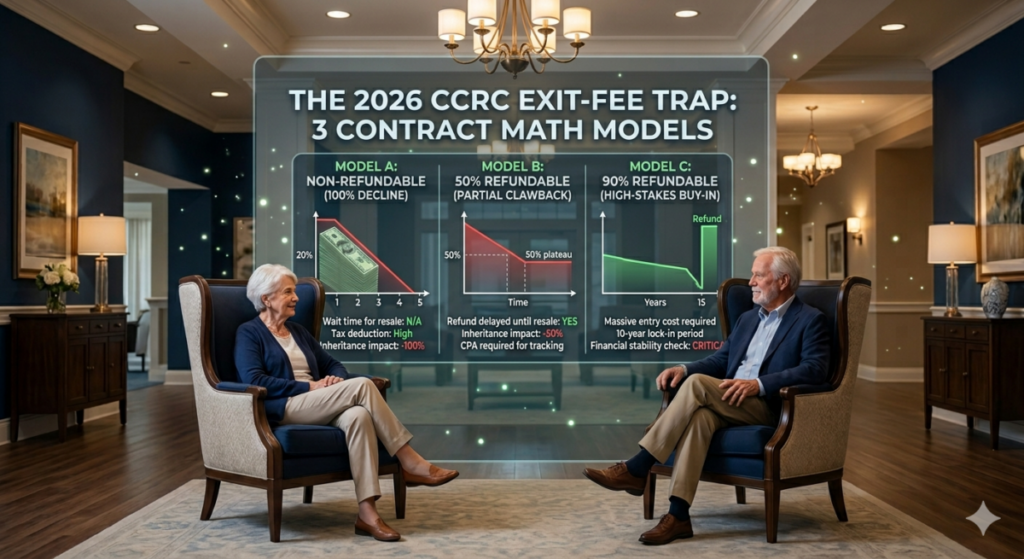
In the real estate world, we call this “pre-paid rent with a side of risk.” An entrance fee is a massive upfront payment that buys you a spot in a Continuing Care Retirement Community (CCRC). It’s not equity. You don’t own the unit. You can’t sell it on the open market. It is essentially an interest-free loan you are giving to the facility. In 2026, these fees have surged as facilities look to recapitalize their balance sheets after high interest rates stalled new construction.

Technical Deep Dive: Refundable vs. Non-Refundable Logic
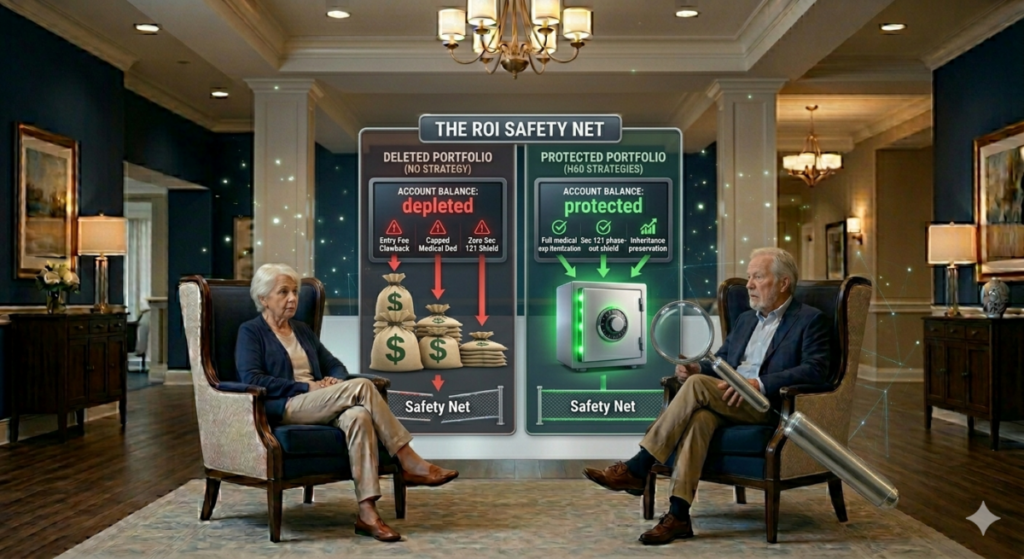
From a CPA’s perspective, the “refundable” entrance fee is a psychological trap. Facilities offer “90% Refundable” options, but there is a catch: the “Resale Requirement.” Most contracts state the refund is only issued after your unit has been re-occupied by a new resident who has paid a comparable fee. In a down market or a facility with a bad reputation, your estate could be waiting years for that $400,000 check. Furthermore, look at the 2026 Step-Up in Basis rules. If you sell your primary residence to pay this fee, you might be triggering massive capital gains taxes if you haven’t lived there for two of the last five years. You are trading a hard asset (your home) for a secondary promise from a private corporation. Use first-principles: Is the facility’s credit rating high enough to guarantee that refund in 2036? If they don’t have an “A” rating from Fitch or S&P, you are gambling. We also have to consider the Internal Revenue Code Section 121 exclusion. If your gain exceeds $250,000 (single) or $500,000 (married), that entrance fee just got 20% more expensive because of the tax hit on the way in.

Monthly Community Fees: The Base Cost of Admission
Think of this as your monthly “HOA on steroids.” It covers the roof over your head, the lights, and the lady who teaches water aerobics. But in 2026, the “standard” monthly fee is becoming a hollow shell. Facilities are stripping out services to keep the headline price low, then charging you for every breath you take.
- Step 1: Audit the Base Inclusions. Request a line-item list of what is included. If “High-Speed Internet” isn’t on there, expect a $100/month surcharge.
- Step 2: Review the 5-Year History. Ask for the average percentage increase of the monthly fee for the last five years. If that number is below 4%, they are likely deferred-maintenance candidates.
- Step 3: Analyze the “Community Fee.” Most places charge a one-time “Community Fee” of $5,000 to $10,000 just to move in. This is separate from the entrance fee and covers “administrative costs,” which is code for “facility profit.”
- Step 4: Evaluate the 2026 Standard Deduction. With the 2026 tax changes, your standard deduction is higher, but so are the phase-outs. Determine if this monthly fee is high enough to justify itemizing medical expenses.
Add-On Costs: Where Expenses Grow Over Time
This is where the facility makes its real margin. It’s the “printer ink” model of real estate. The room is the printer; the care services are the ink. You might start in Independent Living, but eventually, you’ll need help. That’s when the “Care Tiers” kick in, often with zero transparency.
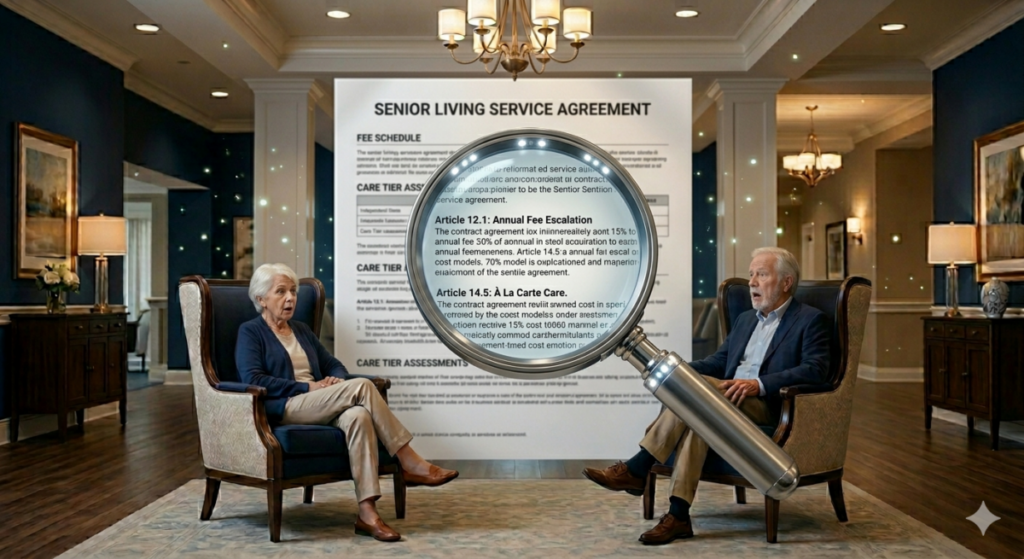
Technical Deep Dive: The Tiered Care Model Escalation
Most facilities use a point-based system or “Levels of Care.” Level 1 might be “Medication Reminders” (+$550/month). Level 4 might be “Incontinence Care and Two-Person Transfers” (+$4,500/month). The scary part? These levels are determined by the facility’s own staff. There is a massive conflict of interest here. If the facility is short on cash, they have every incentive to “assess” you into a higher (and more expensive) tier of care. We are seeing many facilities move to “minute-based pricing.” If a CNA spends 15 minutes helping you with a button-down shirt, that’s a billable event. It’s like being billed by a lawyer, but instead of legal advice, you’re getting help with your socks. This is why aging in place often looks better on paper if you can manage the labor yourself. Furthermore, ancillary charges for “tray service” (bringing food to your room) have jumped 15% this year alone due to food service labor costs.
| Service Type | Labor Cost (Internal) | Markup to Resident | Low-End Add-on | High-End Add-on |
|---|---|---|---|---|
| Medication Management | $165/mo | 320% | $525/mo | $850/mo |
| Daily ADL Support | $1,400/mo | 160% | $2,200/mo | $4,100/mo |
| In-Room Meal Service | $250/mo | 120% | $550/mo | $900/mo |
| Affiliate Tool | Function | Comparison Metric | Recommendation |
|---|---|---|---|
| Med-Dispense Elite | Automated Pill Sorter | Reduces “Tier 1” costs | Highly Recommended |
| Grip-Sure Floor Coat | Non-slip DIY Coating | Delays Memory Care | Best Value |
| Care-Track Pro | Wearable Activity Tracker | Monitors ADL independence | Solid Choice |
Levels of Care and How Costs Escalate
The progression from Independent Living to Memory Care is a path paved with invoices. Currently, the median cost for memory care has hit approximately $8,019 per month nationally. That’s a 15-25% premium over Assisted Living. Why? Because you are paying for security, specialized training, and a lower staff-to-resident ratio. If you are a couple where one needs care and the other doesn’t, your expenses could literally triple in a single month.
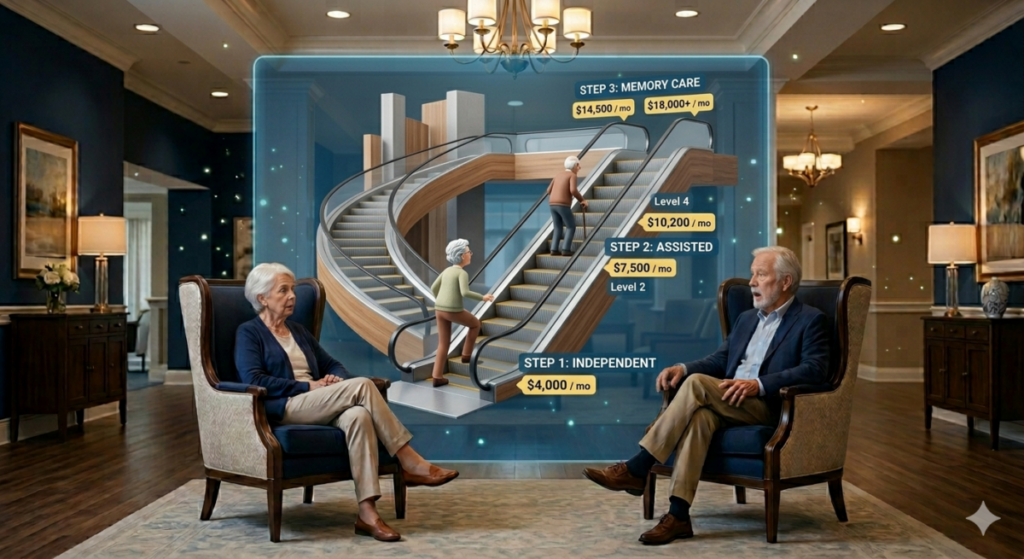
Technical Deep Dive: The 10-Year Net Worth Trajectory
Let’s run the opportunity cost numbers for a 75-year-old with a $1.5 million net worth. If you stay at home and spend $3,000/month on maintenance, your net worth grows at the rate of your investments minus costs. If you move into a CCRC with a $400,000 entrance fee and $6,000 monthly fee, you are “front-loading” your expenses. By year 10, assuming a 5% inflation rate on fees and a 7% return on the $400,000 you didn’t spend, the person who stayed at home is often $600,000 wealthier. Senior living is not an investment; it is consumption. You are consuming a service. Treating it like an investment is how people run out of money at age 88. In 2026, with Medicaid margins being deeply negative, the risk of a facility going under or forcing “private pay” for longer periods is real. You must stress-test your portfolio against a 15-year stay where the final 4 years are in Skilled Nursing.
Contract Types: The DNA of Your Financial Future
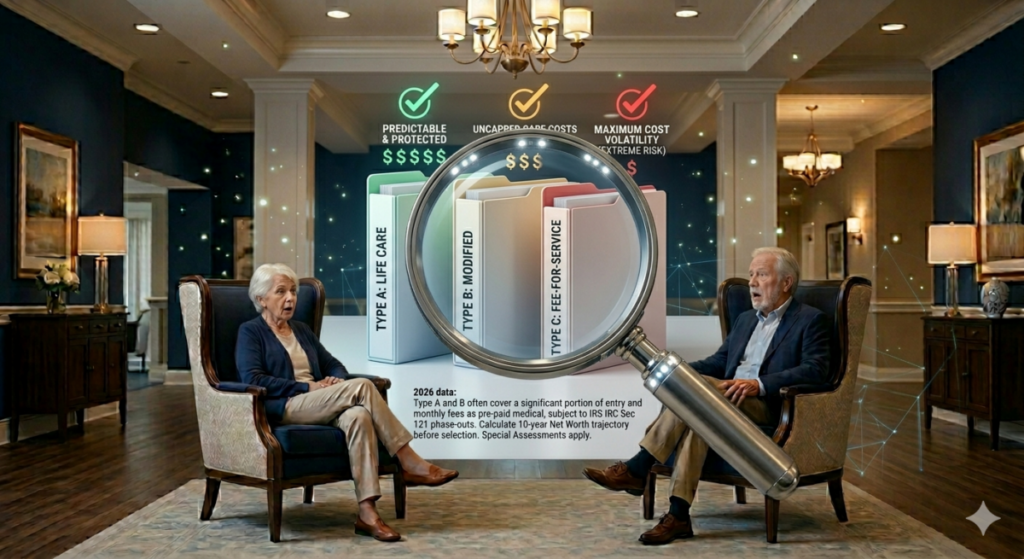
If you don’t know if you are signing a Type A, B, or C contract, you shouldn’t be signing anything. This is the single most important technical detail in senior living.
- Type A (Life Care): You pay a massive entrance fee and a higher monthly fee now so that your costs don’t explode later when you need nursing care. It’s an insurance product disguised as a lease.
- Type B (Modified): You get a discount now, but the facility only covers a certain amount of future care (e.g., 60 days). After that, you pay the market rate.
- Type C (Fee-for-Service): Lower entry costs, but if you get sick, you pay full freight. In 2026, a Type C resident moving to Memory Care will see their bill jump from $4,000 to $14,000 overnight.
Technical Deep Dive: IRC Section 121 and Medical Deductions
Here is a tip from my CPA days: Part of your entrance fee and monthly fees for a Type A contract may be tax-deductible as a pre-paid medical expense. In 2026, the IRS has tightened the rules on what qualifies. You need to pull the facility’s “Medical Percentage” letter. If the facility spends 30% of its budget on healthcare, you might be able to deduct 30% of your entrance fee. On a $300,000 buy-in, that’s a $90,000 deduction. If you’re in a high tax bracket, that changes the ROI calculation significantly. However, if you chose a Type C contract, your deductions are minimal until you actually rack up the care hours. Don’t leave money on the table; the government gets enough of yours already. For more on tax strategies, see our guide on real estate tax hacks for seniors.
| Contract Component | Labor Allocation | CapEx Allocation | 2026 Risk Level |
|---|---|---|---|
| Type A (Life Care) | High (Prepaid) | Moderate | Medium (Insolvency Risk) |
| Type B (Modified) | Medium | Moderate | High (Uncapped Care Costs) |
| Type C (Fee-for-Service) | Low (Pay-as-go) | High | Extreme (Market Volatility) |
Common Mistakes: Emotional Decisions Lead to Financial Disasters
I’ve seen it a hundred times. A widow moves into a community because the dining room looks like a Ritz-Carlton. Six years later, she’s out of money because she didn’t account for a 7% annual increase in fees. Nostalgia and “vibes” are for people who want to end up broke. You need to run a 15-year cash flow projection. In 2026, the capital gains on your home might be shielded by the Section 121 exclusion, but if you don’t reinvest that cash wisely, the “Hidden Invoice” of senior living will eat your principal for breakfast. Another major mistake is ignoring zoning variance hurdles; some communities are expanding into residential zones and passing those legal fees on to residents through “special assessments.” Check the local land records before you buy into a “growing” community. If they’re fighting a lawsuit with the neighbors, you’re the one paying the lawyers.
Actionable Checklist: Evaluating the 2026 Bottom Line
- Obtain the “Disclosure Statement”: This is a legal requirement in many states. It shows the facility’s audited financial health. If they are swimming in debt, your refund is at risk.
- Calculate the 10-Year Projection:Assume a 5% annual increase in base fees and a move to “Assisted Living Tier 2” by year five. Does the math still work?
- Verify the “Bed Tax”: Many states now impose a “provider tax” on senior living beds. Ensure this isn’t being passed through as a separate “regulatory fee” on your bill.
- Interview the Residents (Not the Sales Rep): Hang out in the lobby. Ask people if their bills have spiked unexpectedly in the last 24 months.
- Check the “Release of Liability”: In 2026, many contracts include mandatory arbitration clauses. Understand that you are giving up your right to sue if they neglect your care.
- Analyze State-Specific Memory Care Medians: If you are in Hawaii or Alaska, your costs will be $12,000+. If you are in South Dakota, they may be $5,500. Consider geographic arbitrage.
Internal Resources
- 2026 Tax Planning for Seniors: Standard Deductions and HSA Upgrades
- Real Estate vs. CCRC: Where Should You Park Your Equity?
- 10 Red Flags in Senior Living Contracts You Must Not Ignore
Summary: Clarity Beats Marketing Every Time
The senior living industry is a business, not a charity. They want to maximize their “Revenue Per Occupied Room” (RevPOR). Your goal is to maximize your quality of life while protecting your net worth. In 2026, the complexity of these contracts has reached an all-time high. By focusing on first-principles: identifying labor costs, understanding contract types, and calculating opportunity costs: you can avoid the financial traps that catch 90% of seniors. Don’t be the person who gets dazzled by the chandelier and forgets to check the plumbing of the contract. The safest move is the one you can afford at age 95, not just age 75.
Bio: Charles O’Dell
Charles O’Dell is the Lead Technical Content Strategist for HousingAfter60.com. Prior to his real estate career, Charles was a practicing CPA and financial planner with American Express. Now, with 23+ years of experience and over 100 successful property flips, Charles is a leading expert in senior housing transitions. He specializes in stripping away the marketing “fluff” to help homeowners find sustainable, logical real estate solutions that protect their net worth in retirement. He believes that a well-structured spreadsheet is the best defense against a bad investment. Charles has personally facilitated hundreds of transitions for seniors, focusing on cost transparency and long-term affordability.
Written by Charles O’Dell, a former CPA and real estate investor with 100+ flips and 23 years of senior housing expertise.