
A Homeowner’s Step-by-Step Guide Before You Sign a Contract
SECTION 1 — SHORT ANSWER
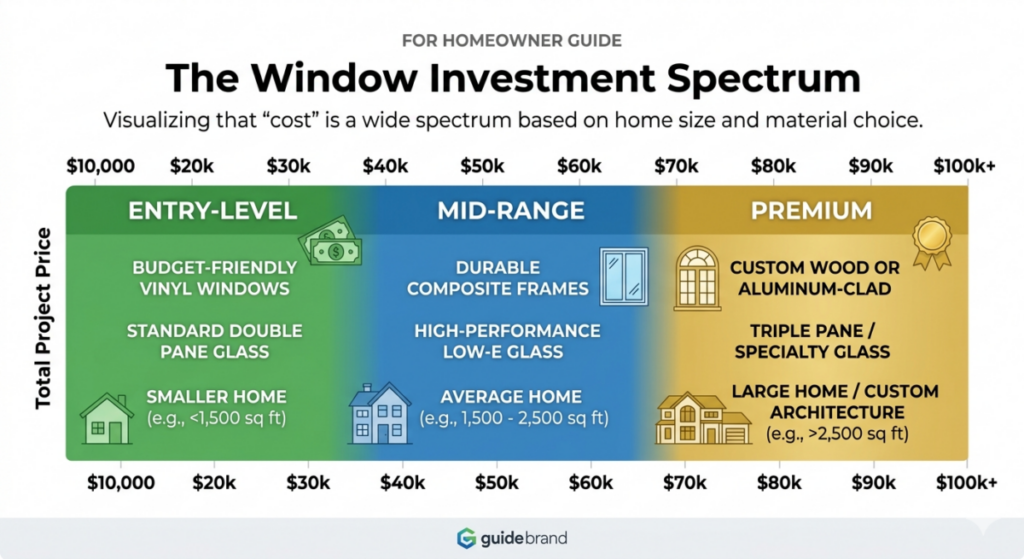
Replacing your windows for the entire home can cost anywhere from $10,000 to $100,000 or more. Most homeowners go into this process thinking they are simply “buying better windows.” In reality, they are making a series of decisions—about materials, installation, and contractors—that will determine whether that money is well spent or largely wasted.
This guide exists for one reason:
To help you avoid making a costly mistake.
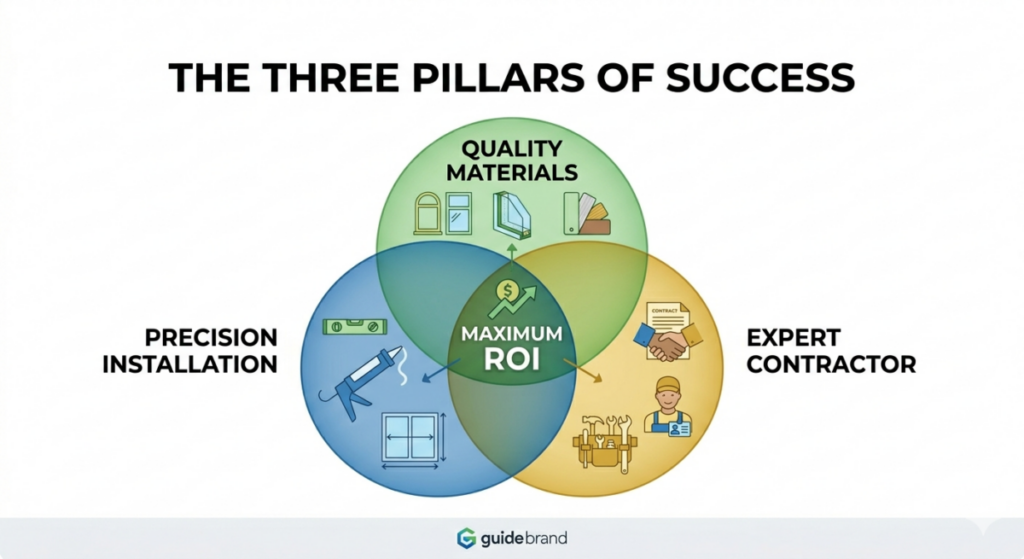
If you understand:
- What you’re actually buying
- How installation affects performance
- How to compare quotes correctly
…you will make a better decision than most homeowners.
This guide is written for people who are:
- Considering replacing their windows in the next 6–12 months
- Trying to understand conflicting sales information
- Looking for a clear, honest explanation of how this process works
SECTION 2 — THE BIGGEST MISTAKES HOMEOWNERS MAKE
Most window projects go wrong before the contract is even signed. Not because homeowners aren’t smart—but because the information they’re given is incomplete or misleading.
Let’s walk through the most common mistakes.
MISTAKE #1: Buying Based on Brand Name
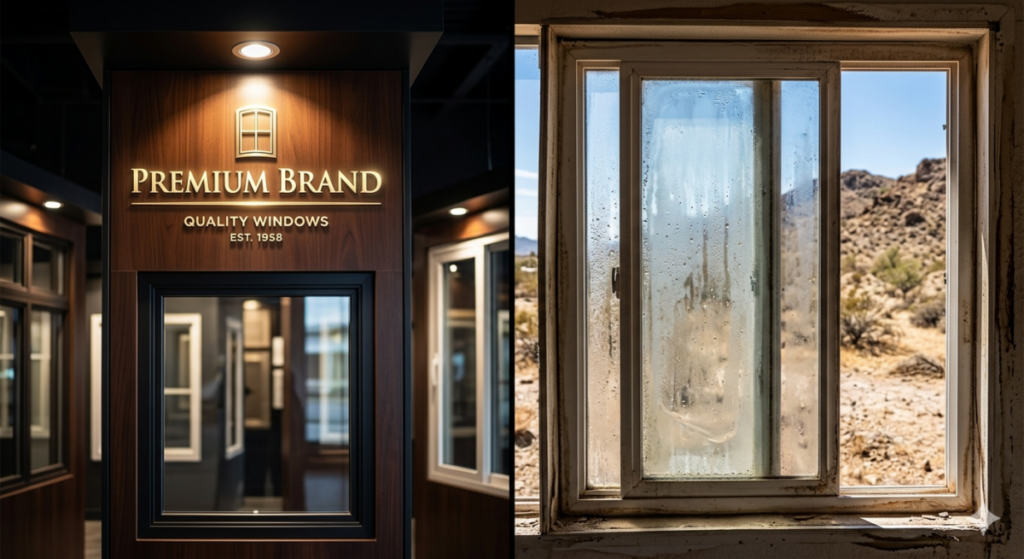
Most homeowners don’t realize they’re making this mistake when it happens.
It usually starts the same way.
A homeowner begins thinking about replacing their windows. Maybe the house feels hotter than it should. Maybe the windows are getting hard to open. Maybe they’ve just been told, “It’s time.”
So they do what most people do—they start researching.
Very quickly, they run into brand names. Some sound familiar. Some are positioned as “premium.” Some are recommended in reviews. And naturally, the thinking becomes:
“If I just choose a good brand, I’ll be fine.” (Is this true?)
That feels logical. It feels safe.
But this is where things quietly go off track.
Because a window brand is not a one-size-fits-all solution.
A product that performs well in one part of the country can behave very differently somewhere else. The materials, the construction, and even the way the window is assembled all respond differently depending on the environment.
I’ve seen homeowners choose a well-known brand—one they felt confident about—only to find that a few years later, things weren’t holding up the way they expected.
This is not always an issue with the window; it very well can be the environment.
Not catastrophic failure. Not something that shows up in the first year.
Instead, it’s gradual.
You start to notice small things:
- The frame doesn’t look quite as tight as it used to
- Operation isn’t as smooth
- Seals don’t feel as solid
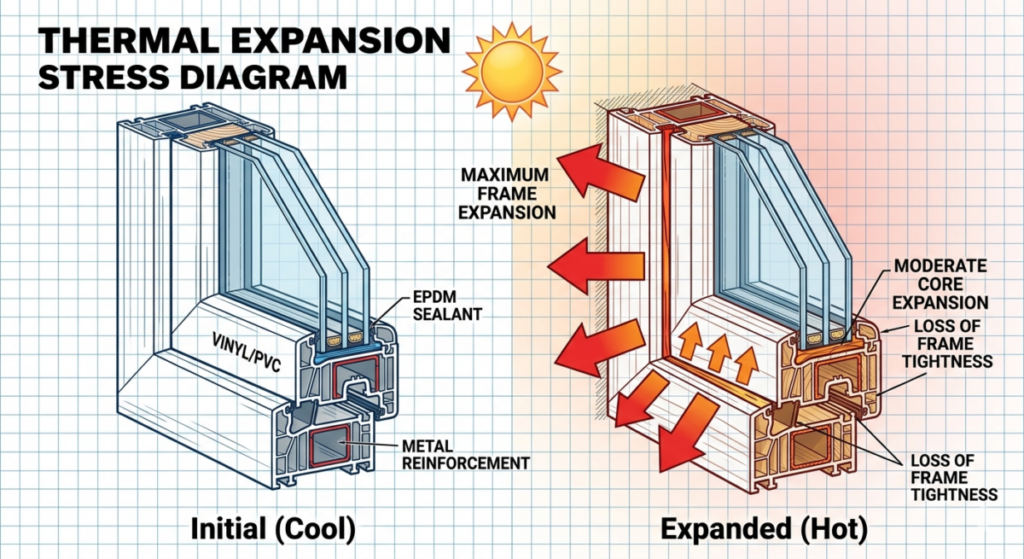
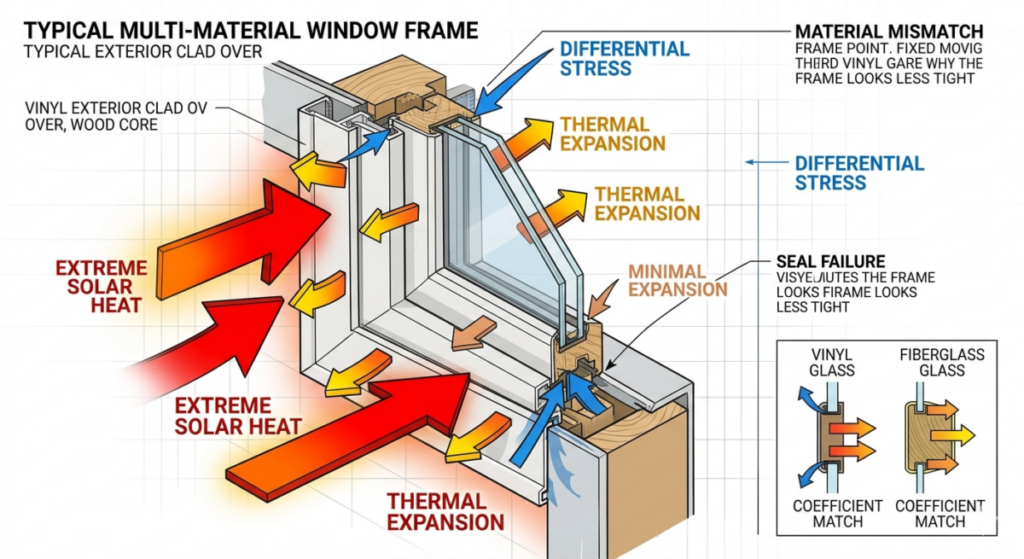
Nothing dramatic—but not what you expected when you made a major investment.
And the frustrating part?
They didn’t make a “bad” decision.
They made an incomplete one.
They chose based on brand reputation, not fit for their home.
What wasn’t considered was:
- The climate the window would live in every day
- The sun exposure hitting that specific wall
- How the material behaves under long-term heat (sometimes cold too) stress
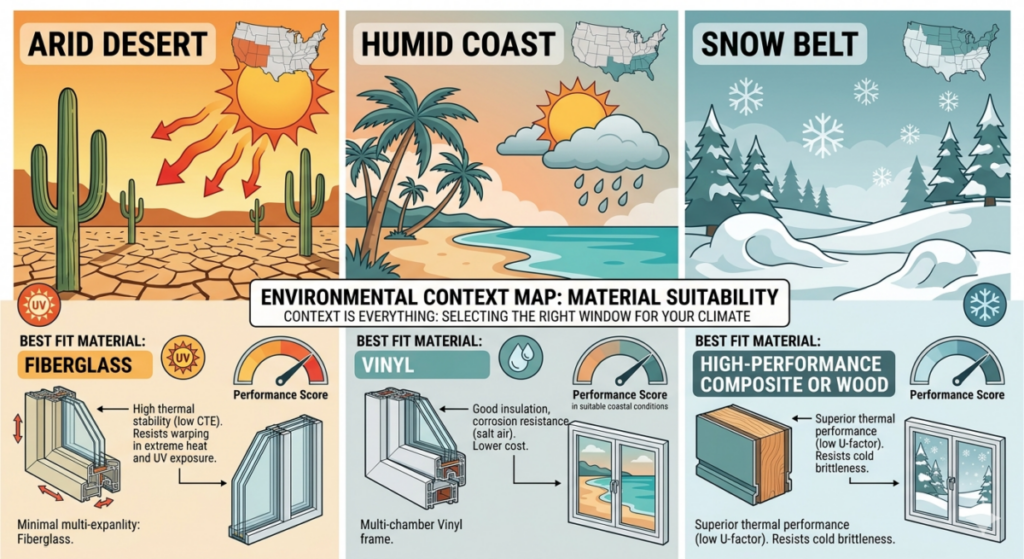
These are the factors that determine how a window actually performs over time—not just how it performs when it’s new.
This is where most homeowners are at a disadvantage. They’re trying to make a decision based on marketing, reputation, and surface-level comparisons—without realizing that context is everything.
The better approach is simpler—but it requires a shift in thinking.
Instead of asking:
“What’s the best window brand?”
You ask:
“What window is the best fit for my home, in my environment, over the next 10–25 years?”
That question leads you in a completely different direction.
It forces you to consider:
- How materials behave over time
- What performance actually means in your situation
- Whether the product matches your long-term goals
Because in the end, the goal isn’t to buy a well-known brand.
The goal is to make a decision you won’t regret years from now.
Why Brand Alone Isn’t Enough
| What Homeowners Focus On | What Actually Matters |
| Brand reputation | Climate compatibility |
| Marketing claims | Material behavior over time |
| Price vs competitors | Installation + environment |
| “Top-rated” labels | Long-term durability in your conditions |
Example – My Own Home
I purchased a home when my children were younger and I was just getting involved in buying rental properties and house flipping. The home was 3 years old when I bought it and had builder grade aluminum framed windows with dual pane glass.
Living in Gilbert, Arizona, the summers can be brutal. Our second summer in the home and we realized the heat was just unbearable. The HVAC system in many rooms just could not keep them comfortable, while other rooms that did not get a lot of sun were cold.
Coming from an accounting background, “yes, I’m a bean counter by training”, I installed higher grade vinyl framed windows with Low E-3 glass package. That summer, what a difference those windows made. All rooms were now comfortable, and my summer air-conditioning bills saw a real drop in expense.
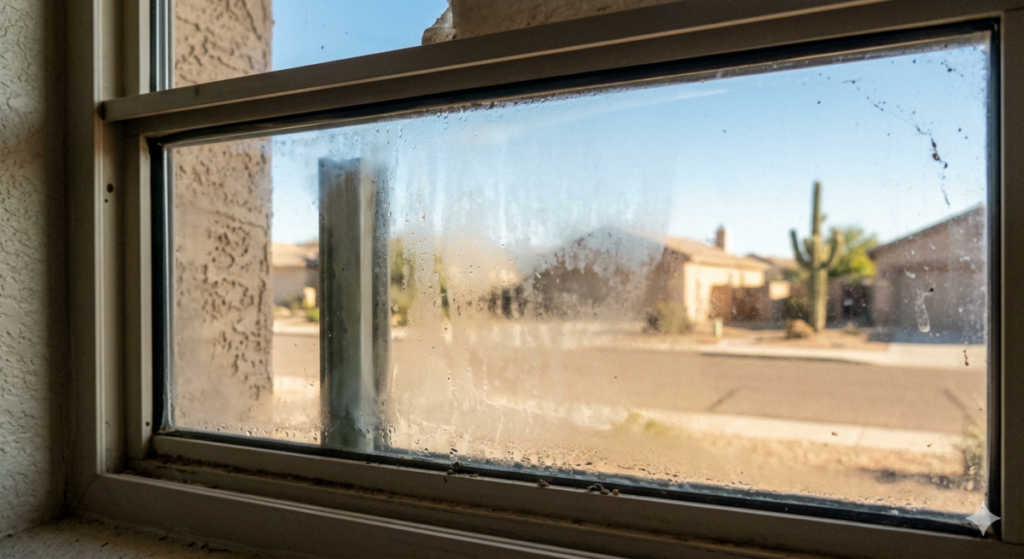
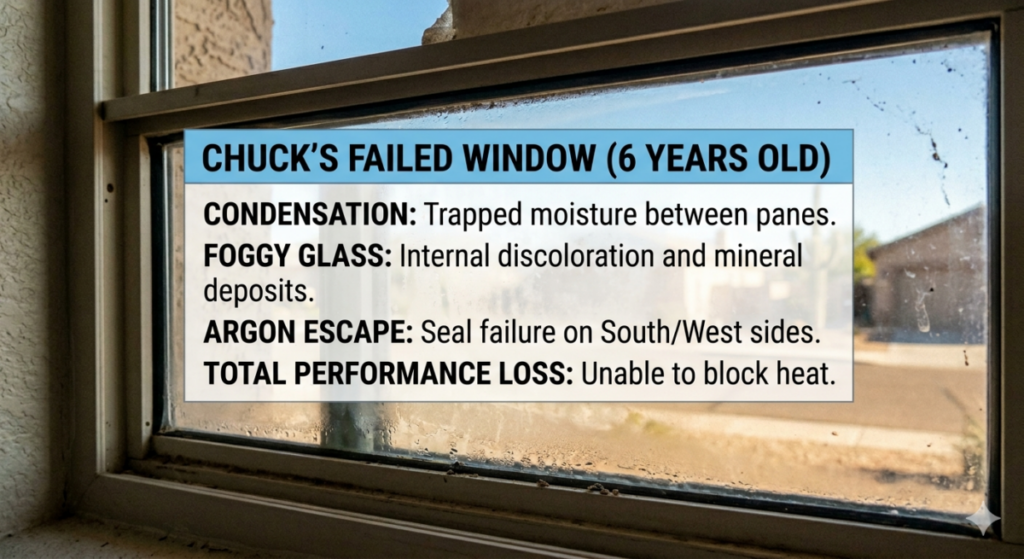
By the third summer, some of the windows would not open. By the sixth year, a few were leaking water, and they were not rejecting the heat the way they did when new. The seals between the glass holding in the Argon gas had let the gas escape and the windows were no longer doing their job.
Remember, these were only 6 years old. The windows on the west and south sides of the home were already failing and I had to replace them again. I did not make the same mistake twice!
MISTAKE #2: Choosing Materials Without Understanding Climate Impact
Most homeowners think of windows as a static product.
Once they’re installed, the assumption is:
“They’re in. They’ll just sit there and do their job.”
But that’s NOT what actually happens.
Every single day, your windows are expanding, contracting, heating up, cooling down, and absorbing sunlight. And over time, those small movements add up.
This is called thermal expansion. Most all materials will increase in size when heated up, and then decrease in size when cooled down. A great example is asphalt pavement. Have you ever noticed how, when new, the asphalt pavement on a street looks great? Then in about 3 years, it starts developing cracks in every direction?
This is caused by “thermal expansion”. The problem is over time the asphalt become brittle and will not flex the way it did when new. So, when it shrinks from cooling down, it just cracks. In very hot climates, vinyl window frames can react the same way.
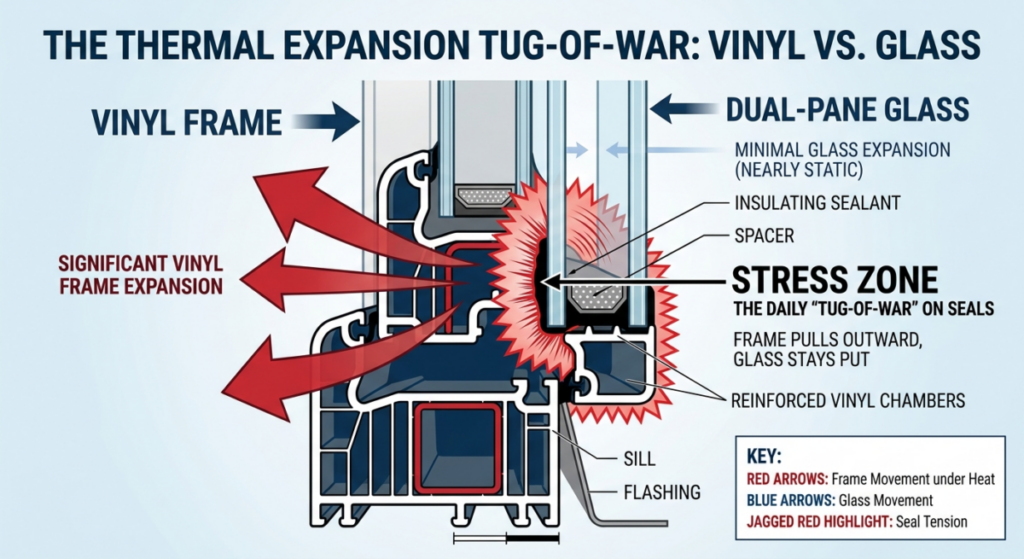
Did you know that vinyl window frames expand, every day, 7 times more than the glass? That means the window seals are in a daily “tug of war” with the vinyl window frame.
The problem is, most homeowners never think about that—until years later.
I remember walking into a home where the homeowner felt something wasn’t right, but couldn’t quite explain it.
Nothing looked obviously broken.
The windows were still in place. The glass was intact. At a glance, everything seemed fine.
But as we started looking closer, you could see it:
- The frame didn’t sit as tightly as it once did
- The operation felt slightly off
- The edges weren’t as clean and consistent
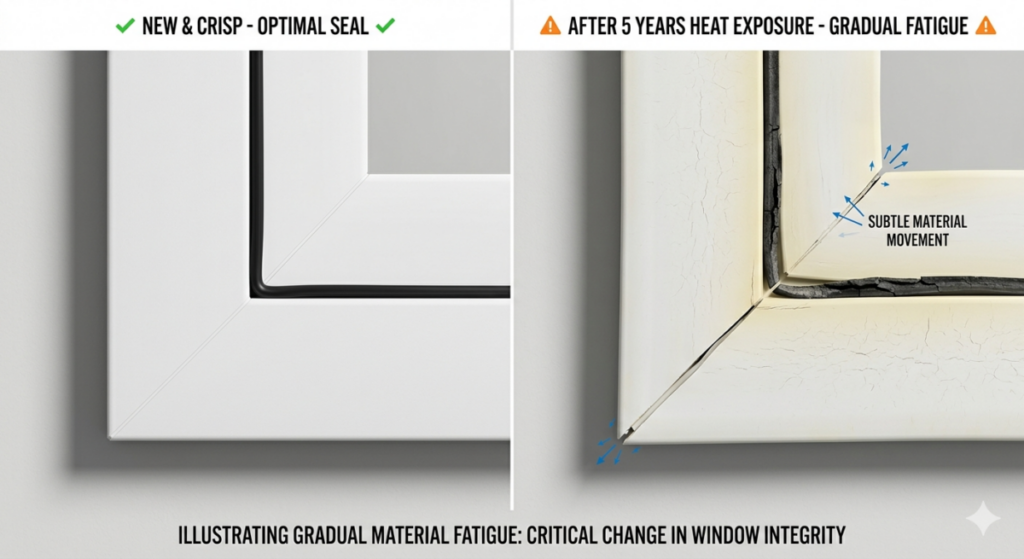
It wasn’t a failure. It was something more subtle—and more common.
It was gradual material fatigue. Much like human skin over time.
And when I asked why they had chosen the windows they did, usually vinyl in a hot climate, the answer is always the same. It was a lot cheaper to put in.
They had chosen a product that works perfectly well in a milder climate—but was now living in an environment it wasn’t really designed for. Over the long haul, it wasn’t the best choice.
This is what most homeowners don’t realize:
A window doesn’t just perform based on how it’s built.
It performs based on where it lives.
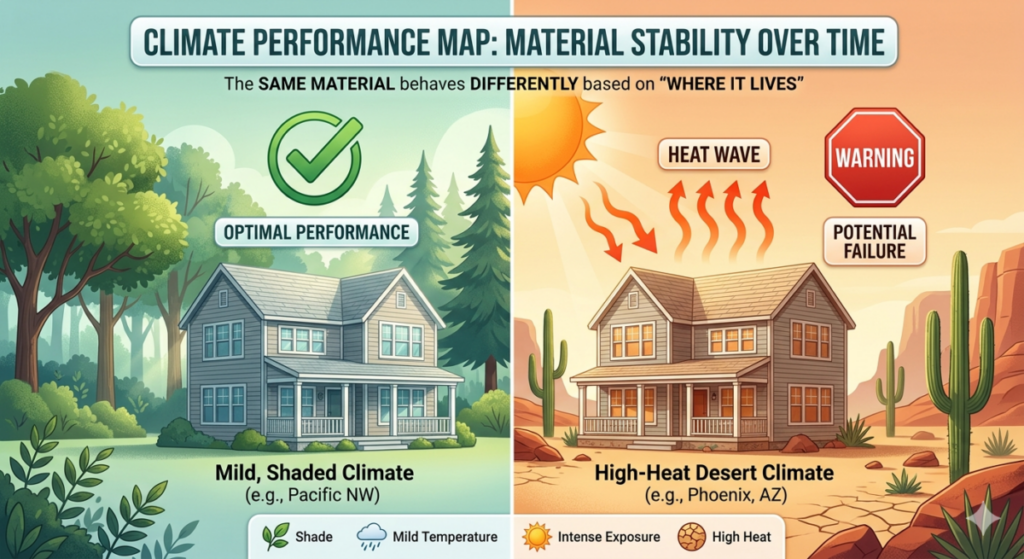
In hot climates—especially places with intense, prolonged sun exposure—materials behave very differently.
Some materials:
- Expand and contract significantly as temperatures rise and fall
- Soften or lose rigidity under constant heat
- Break down faster under UV exposure
And the key point is this:
None of this happens overnight.
You don’t see it in year one.
You often start to notice it in year three.
Over time, those daily cycles—heat, expansion, cooling, contraction—begin to affect how the window performs.
That’s when homeowners start to feel it:
- Slight air movement
- Reduced smoothness in operation
- Subtle changes in fit and finish
Not enough to trigger a warranty claim. But enough to realize the window isn’t performing the way they expected.
This is where the misunderstanding happens.
Homeowners assume:
“If it’s a good material, it should work anywhere.”
But that’s not how materials work.
Every material has strengths.
Every material has limitations.
The real question isn’t:
“Is this a good material?”
It’s:
“How does this material behave over time in my specific environment?”
This is especially important in environments with:
- High heat
- Constant sun exposure
- Large temperature swings between day and night
I live in Arizona near Phoenix. I can’t tell you how many severely warped and cracked vinyl framed windows I have seen. If in the direct sunlight and heat, many fail in less than three years. In those conditions, material stability becomes one of the most important factors in long-term performance.
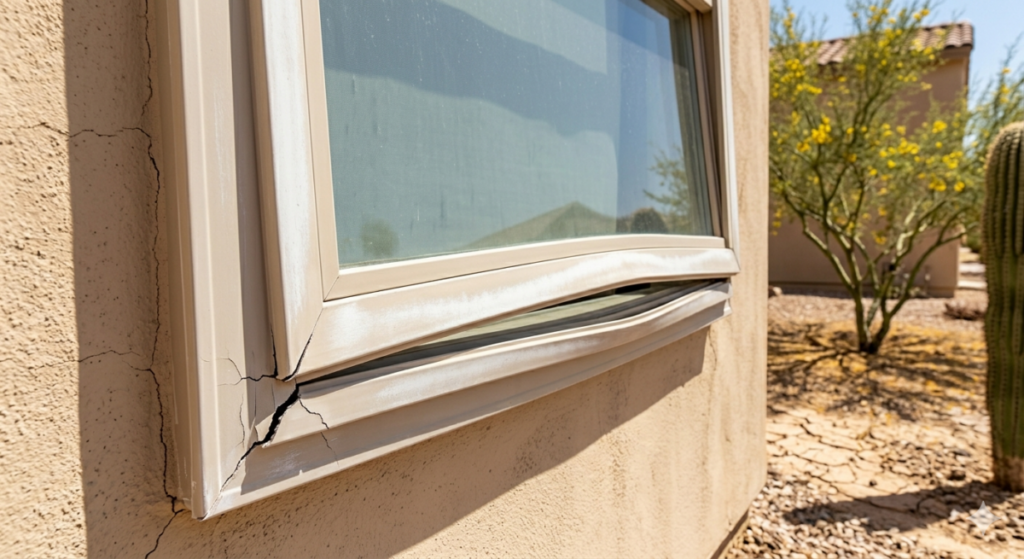
And yet, it’s one of the least discussed during most sales conversations.
So the mistake isn’t choosing the “wrong” material in a general sense.
The mistake is choosing a material without understanding how it will perform where you live.
The better approach is to slow the decision down and ask:
- How does this material handle long-term heat exposure?
- How does it respond to expansion and contraction?
- What does it look and perform after 3, 8, 13 years in a climate like mine?
Because once the windows are installed, you don’t get to revisit that decision.
And the difference between materials doesn’t always show up right away.
It shows up later—when performance starts to matter.
How Climate Affects Window Materials Over Time
| Material Behavior Factor | Why It Matters in Hot Climates |
| Thermal Expansion | Repeated expansion/contraction can affect fit and seals |
| UV Exposure | Long-term sun exposure can degrade certain materials |
| Structural Stability | Some materials maintain shape better under heat stress |
| Lifespan Consistency | Performance over 5–25 years varies by material and environment |
MISTAKE #3: Not Understanding Installation (Where Most Projects Go Wrong)
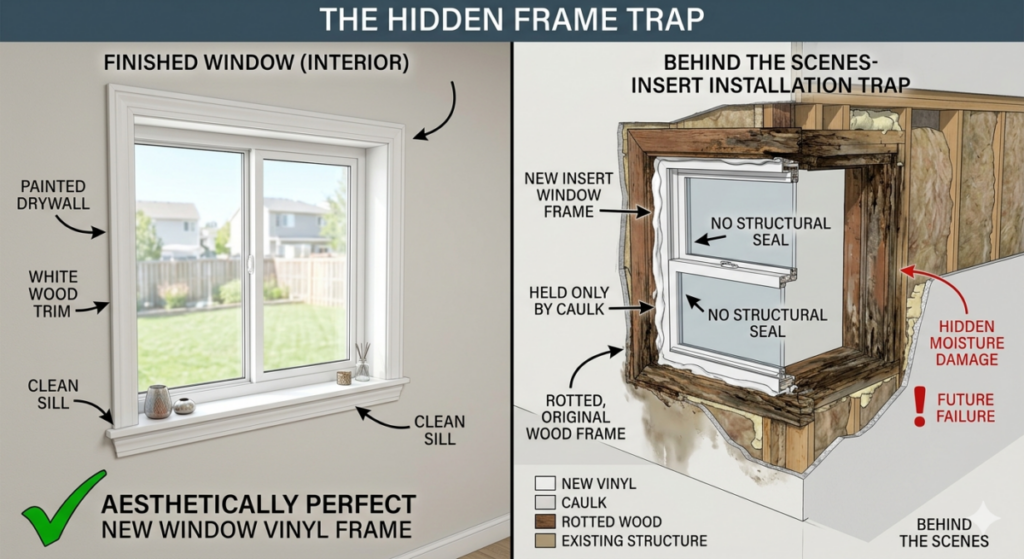
Most homeowners believe they are buying windows.
They’re not.
They’re buying an installation process—and that process determines whether the project succeeds or fails.
It usually starts with a simple assumption.
A homeowner gets a quote, looks at the window brand, the price, maybe the warranty, and thinks:
“As long as the window is good, everything else should fall into place.”
That assumption is wrong more often than people realize.
Because two companies can sell what appears to be the same window, at two different prices… and deliver completely different outcomes.
The difference isn’t the product.
It’s how that product is installed.
I’ve been in homes where the homeowner thought they had a full replacement done—only to find out later they didn’t.
From the outside, everything looked fine.
From the inside, everything looked clean.
But once you understand what to look for, the difference becomes obvious.
The original frame was still there.
The new window had simply been placed inside it.
That’s called an insert (or retrofit) installation.
INSERT – (Sometimes called Retrofit or Jump Frame) Installation (What Most Homeowners Get Without Realizing It)
This method:
- Leaves the original window frame in place
- Installs a new window inside that existing frame
On paper, it sounds efficient. And in some cases, it can be appropriate.
But here’s what’s often not explained clearly:
- You are not replacing the full window system
- You are building on top of what’s already there
- Any existing issues in the original frame remain
Homeowners are often told:
“You don’t need to remove everything.”
Sometimes that’s true. But sometimes it’s simply a faster, less expensive approach for the installer—NOT the best long-term solution for the homeowner.
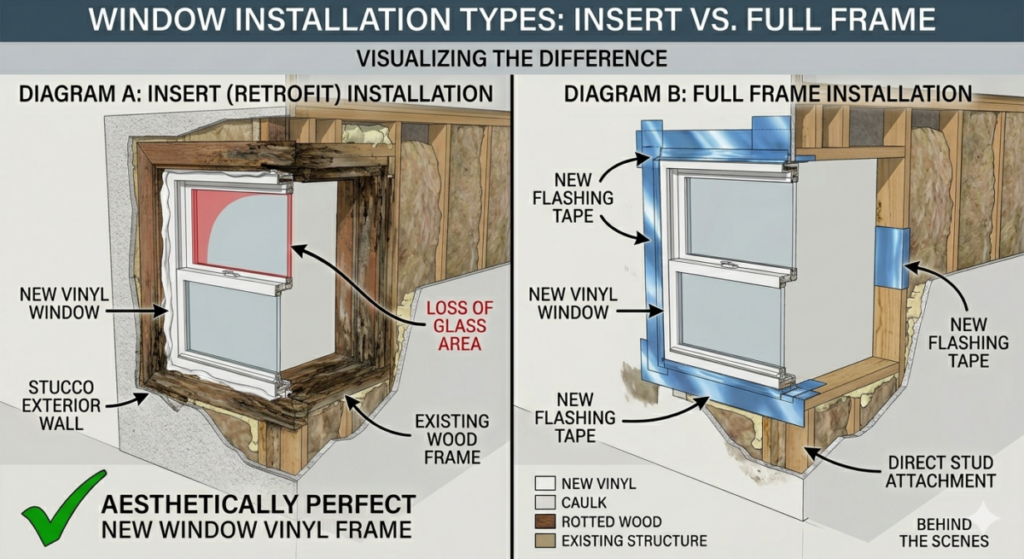
FULL FRAME REPLACEMENT – (What Most Homeowners Think They’re Getting)
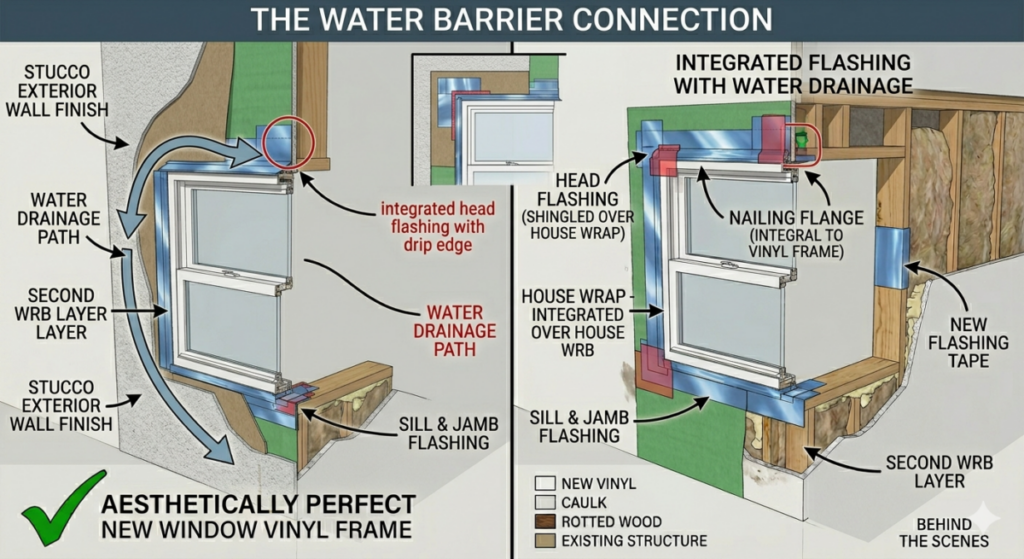
New Full Frame Install With New Flashing And Water Barrier (Stucco)
This method:
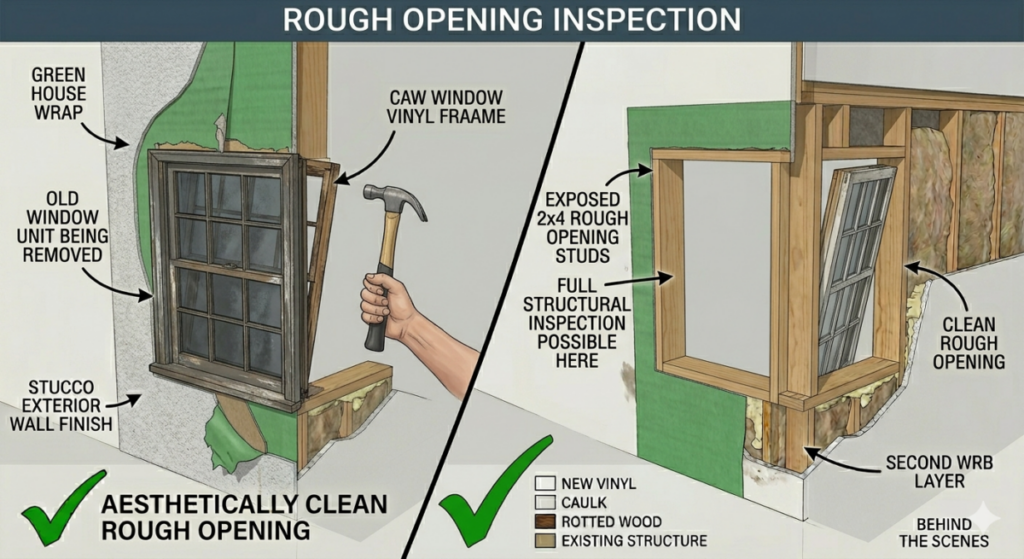
- Removes the entire existing window, including the frame
- Exposes the original rough opening
- Installs a completely new window system
- Includes new sealing and water barrier protection
This is not just a window swap. It’s a rebuild of the opening itself.
Why This Difference Matters
This is where most homeowners underestimate the impact.
A window is only as good as:
- The surface it’s installed into
- The seal that protects it
- The way water is managed around it
If those things aren’t done correctly, it doesn’t matter how “good” the window is.
I’ve seen situations where:
- A high-end window was installed into a compromised frame
- Gaps were covered with caulking instead of properly sealed
- No real water barrier was installed
At first, everything looked fine.
But over time:
- Air leakage increased
- Moisture found its way in
- Performance dropped
And the homeowner had no idea why.
The Real Issue: Most Homeowners Don’t Know What to Ask
This isn’t a knowledge problem—it’s an information gap.
Most homeowners are never clearly told:
- What type of installation they’re getting
- What is being removed—and what is staying
- How the opening will be sealed and protected
Instead, they hear:
“We’ll take care of everything.”
That sounds reassuring—but it’s not specific.
And when you’re making a five-figure decision, specifics matter.
What You Should Be Asking Instead
Before you agree to anything, you should be able to answer these questions clearly:
- Is this an insert installation or a full frame replacement?
- What happens to the existing frame?
- How is the opening sealed against water?
- What exterior work is included (stucco, trim, finishing)?
If those answers are vague, incomplete, or avoided—that’s a problem.
The Bottom Line
Homeowners spend a lot of time comparing:
- Brands
- Glass packages
- Prices
But the biggest difference in outcome usually comes down to one thing:
How the window is installed
Because at the end of the day, you’re not just buying a window. “In stucco homes, especially in the Southwest, how the exterior is tied back into the window during installation can make a major difference in long-term performance.”
You’re buying:
- The removal process
- The preparation of the opening
- The sealing and protection system
- The long-term performance of that installation
Get that part wrong, and even a great window won’t save you.
Get it right, and even a mid-range product can perform well for years.
The installation method is often more important than the window itself.
Straight Talk
Most homeowners think they’re choosing between window brands.
They’re not.
They’re choosing between:
- Two completely different installation philosophies – And most don’t realize it until it’s too late.
Insert vs Full Frame: What You’re Actually Getting
| Category | Insert (Retrofit) | Full Frame Replacement |
| Existing Frame | Left in place | Completely removed |
| Glass Area | Slightly reduced | Maintained or maximized |
| Installation Time | Faster | Longer |
| Cost | Lower | Higher |
| Structural Inspection | Limited | Full access to opening |
| Water Protection | Depends on existing condition | New barrier installed |
| Long-Term Durability | Depends on old frame condition | More consistent |
MISTAKE #4: Believing Energy Savings Claims Without Context
Energy efficiency is usually the first thing homeowners hear about when they start looking into replacement windows.
The message is simple—and very appealing:
“New windows will lower your energy bills.”
That sounds reasonable. In some cases, it’s true.
But what most homeowners are not told is this:
The actual savings are often smaller—and more complicated—than expected.
It usually starts during a sales conversation.
A homeowner is told:
- Their current windows are “inefficient”
- New windows are “energy efficient”
- And upgrading will result in noticeable savings
Sometimes numbers get mentioned:
- 20%
- 30%
- Even higher
At that point, the decision begins to feel easier.
If the windows are going to “pay for themselves,” then the higher cost seems justified.
But that’s where expectations and reality often diverge.
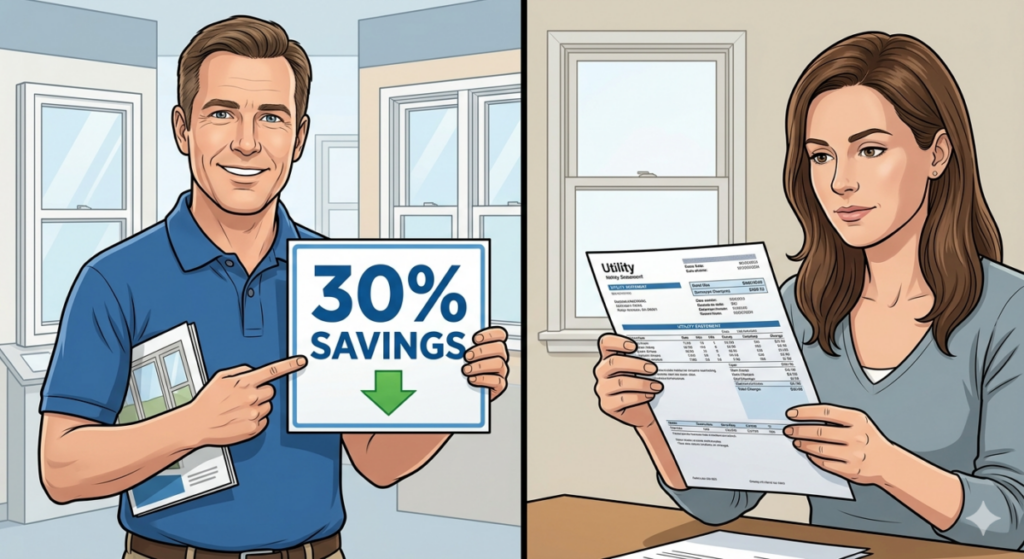
I’ve had conversations with homeowners who replaced their windows expecting a meaningful drop in their energy bills.
After the project was complete, they waited.
And waited.
And when the next utility bills came in, the difference—if there was one—was smaller than expected.
Not zero. But not what they had in mind when they made the investment.
The reason is simple:
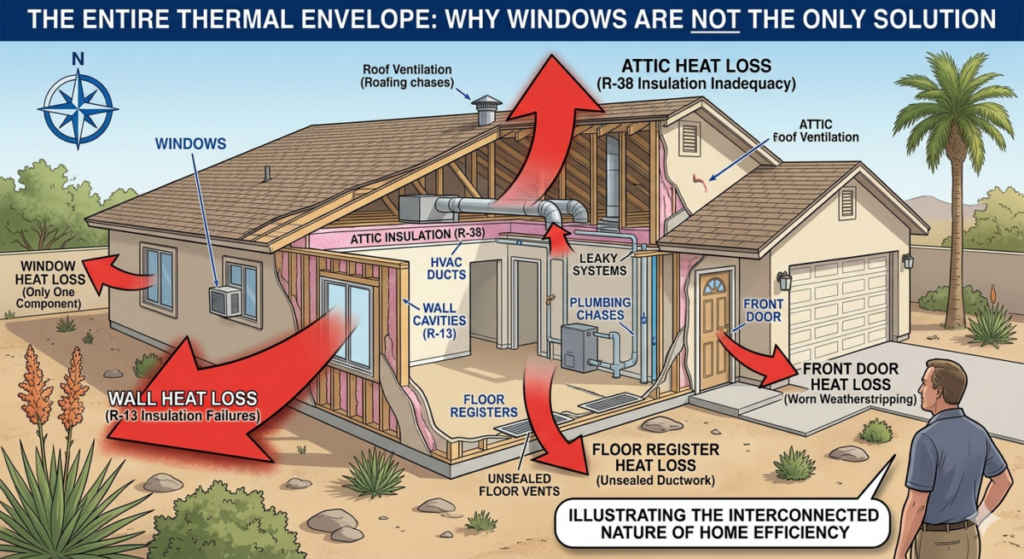
Windows are only one part of a much larger system.
Your home’s energy use is affected by:
- Insulation in the walls and attic
- Air sealing throughout the home
- Ductwork and HVAC efficiency
- Orientation of the home to the sun
- Shade, roofing, and ventilation
Windows play a role—but they are not the whole picture.
Where Energy Savings Do Show Up
This is the part that often gets overlooked.
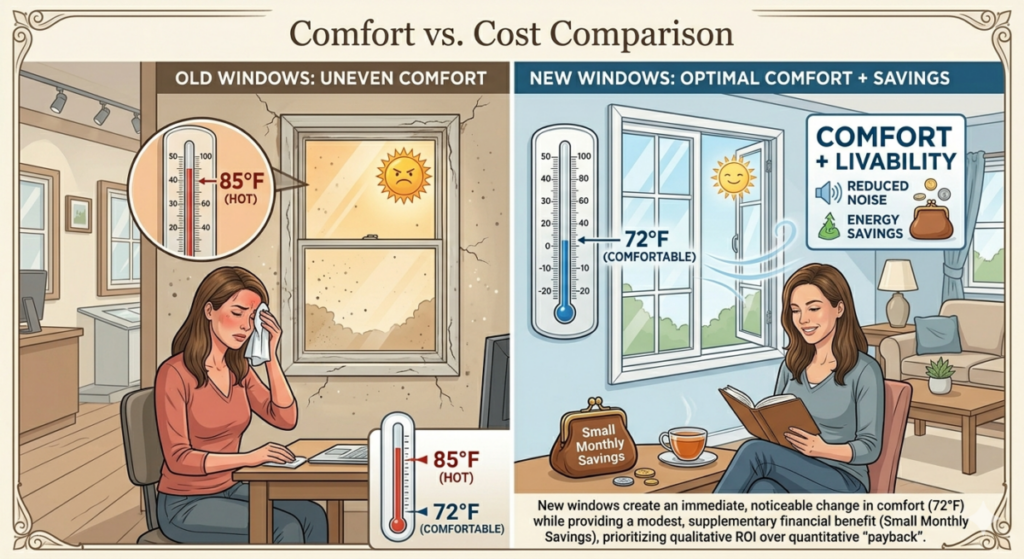
Even when bill savings are modest, homeowners frequently notice improvements in:
- Comfort (rooms feel more consistent)
- Reduced heat transfer near windows
- Less draftiness
- Better noise reduction
These are real benefits. They just don’t always translate into dramatic dollar savings.
Why the Numbers Get Misleading
Energy savings claims are often based on:
- Ideal conditions
- Specific home types
- Controlled testing environments
But your home is not a lab.
It has:
- Unique construction
- Existing weaknesses
- Variables that no estimate fully captures
So when a number is presented without context, it can create expectations that are difficult to meet.
The Real Question You Should Be Asking
Instead of asking:
“How much will I save on my energy bill?”
A better question is:
“How will these windows improve the comfort and performance of my home—and are those improvements worth the cost?”
That shift changes everything.
Because now you’re evaluating:
- Real, noticeable benefits
- Long-term usability
- Overall home performance
—not just chasing a projected number.
The Bottom Line
Energy efficiency is a valid benefit of replacing windows.
But it should be viewed as:
- One factor among many
- Not the primary justification for the purchase
If you go into the decision expecting:
- Better comfort
- Improved performance
- Long-term durability
You’ll likely feel good about the outcome.
If you go in expecting the windows to “pay for themselves” through energy savings alone…
You most likely will be disappointed.
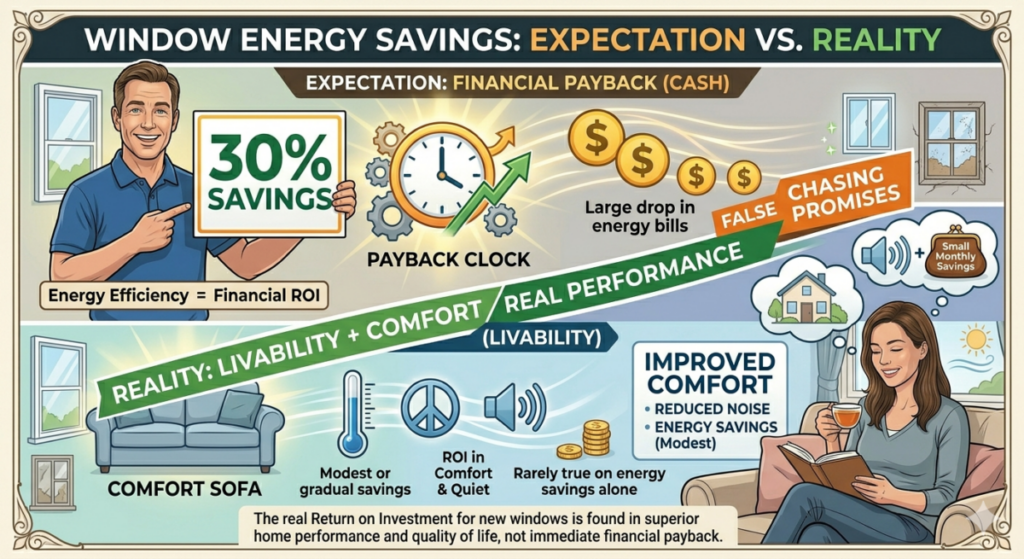
Energy Savings: Expectation vs Reality
| Common Expectation | What Typically Happens |
| Large drop in energy bills | Modest or gradual savings |
| Windows “pay for themselves” | Rarely true on energy savings alone |
| Immediate noticeable cost reduction | Often minimal or delayed |
| Energy efficiency = financial ROI | Often comfort + usability benefits |
“In hot climates, especially where air conditioning runs most of the year, windows can help reduce heat gain—but they’re still just one part of the overall energy picture.” Windows are worth it—but not for the reasons people are often told.
MISTAKE #5: Comparing Quotes That Are Not Actually Comparable
By the time most homeowners get to this point, they think they’ve done their homework.
They’ve met with a few companies.
They’ve heard different presentations.
And now they’re sitting at the table with two or three quotes trying to decide what to do.
On the surface, it seems straightforward:
“Which one is the best value?”
But this is where many homeowners make one of the most expensive mistakes in the entire process.
Because what looks like a simple comparison… usually isn’t.
I’ve sat with homeowners who had two quotes in front of them.
One was noticeably lower.
The other was significantly higher.
Naturally, the question was:
“Why is this one so much more expensive?”
That’s the right question.
But what most people don’t realize is that they’re often not comparing the same project.
At first glance, both quotes might say:
- “Replacement windows”
- “Energy efficient glass”
- “Professional installation”
It sounds identical.
But when you start to break it down, the differences begin to show.
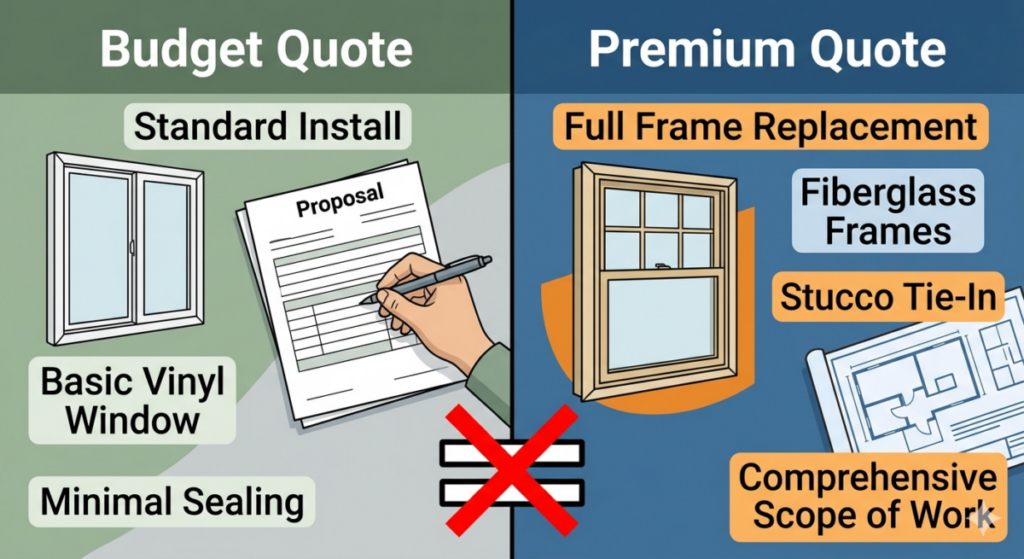
One quote may include:
- A full frame replacement
- New sealing and water protection
- Exterior finish work (stucco or trim tie-in)
The other may include:
- An insert installation
- Minimal exterior work
- No changes to the existing frame
Now you’re not comparing two prices.
You’re comparing two completely different scopes of work.
Why This Happens
Most proposals are written to be:
- Easy to understand
- Easy to sell
Not necessarily easy to compare.
Key details are often:
- Simplified
- Grouped together
- Or left vague
So the homeowner is left trying to make a decision based on:
- Price
- Brand name
- General impressions
Instead of clear, side-by-side information.
What Homeowners Think They’re Comparing
Most people believe they are comparing:
- Window quality
- Price
- Warranty
Those are important—but they’re not the full picture.
What They Should Be Comparing
To make a real decision, you need to understand:
- Installation type (insert vs full frame)
- Frame material
- Glass package details
- Scope of work (what’s included and what’s not)
- Exterior finishing and repair
Until those are clearly defined, price differences don’t mean much.
A Real-World Example
Let’s look at how this plays out:
| Category | Company A | Company B |
| Installation Type | Insert | Full Frame |
| Frame Material | Vinyl | Fiberglass |
| Exterior Work | Minimal | Full stucco tie-in |
| Total Cost | $14,000 | $19,500 |
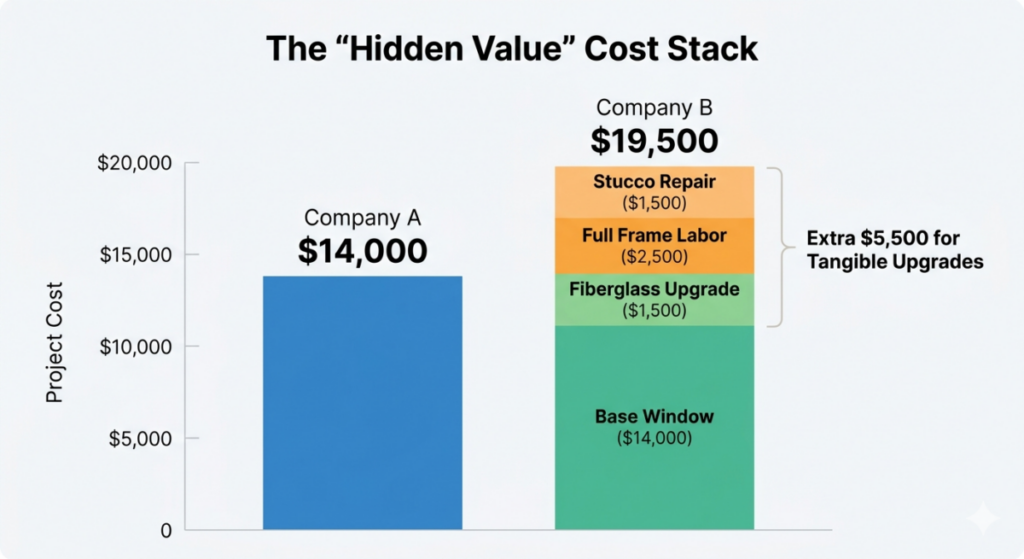
At first glance, Company B looks overpriced.
But in reality, Company B is offering:
- A more extensive installation
- More labor
- More materials
- A different long-term outcome
Once you understand that, the price difference starts to make sense.
The Real Risk
The biggest risk is not overpaying.
It’s choosing a lower-priced quote thinking you’re getting the same thing… and finding out later that you’re not.
That’s when homeowners say:
“I wish I had known what to ask.”

How to Compare Quotes Properly
Before making a decision, you should be able to answer these questions clearly for each quote:
- What type of installation is being done?
- What exactly is being removed—and what is staying?
- What materials are being used?
- What work is included on the exterior?
- What happens if issues are found during installation?
If those answers aren’t clear, the quote isn’t complete.
The Bottom Line
A lower price is not always a better deal.
A higher price is not always overpriced.
Until you understand:
- What is being done
- How it is being done
- And what is included
…you’re not really comparing quotes. You’re guessing!
Quote Comparison Checklist
| Item to Compare | Why It Matters |
| Installation Type | Determines scope, durability, and cost |
| Frame Material | Affects long-term performance |
| Glass Package | Impacts comfort and efficiency |
| Exterior Work Included | Prevents hidden costs later |
| Total Scope of Work | Defines what you’re actually buying |
“I’ve seen homeowners choose a lower quote thinking they were saving money, only to realize later they weren’t comparing the same project.”
MISTAKE #6: Falling for High-Pressure Sales and “Today Only” Pricing
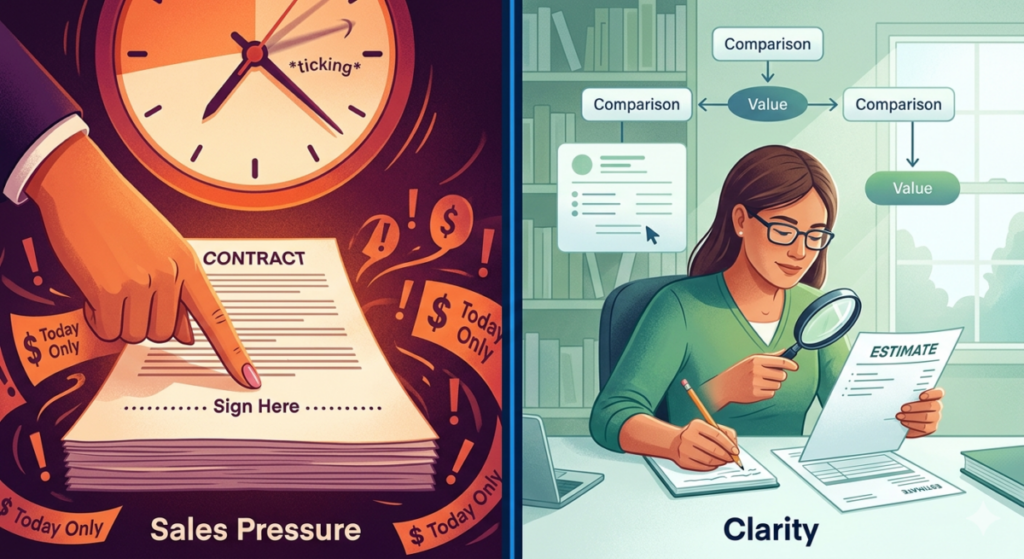
By the time most homeowners reach this stage, they’ve already invested time.
They’ve done research.
They’ve scheduled appointments.
They’ve listened to presentations.
And now, finally, they’re ready to get answers.
That’s when the tone of the conversation often changes.
At some point during the appointment, the numbers come out.
The price is presented—usually higher than expected.
There’s a pause.
And then, almost immediately, the next part begins.
“If you decide to move forward today, we can apply a discount.”
Sometimes it’s framed as:
- A limited-time promotion
- A manager-approved discount
- A one-day-only price

And suddenly, the conversation is no longer about windows.
It’s about making a decision—right now.
This is where many homeowners feel stuck.
On one hand:
- They don’t want to overpay
- They don’t want to lose a “good deal”
On the other hand:
- They don’t feel fully confident
- They still have unanswered questions
So they do what people naturally do under pressure.
They make a decision to relieve the tension.
I’ve spoken with homeowners after the fact who said:
“We felt like we had to decide right then.”
Not because they were convinced.
But because the situation made it uncomfortable to wait.
What’s Actually Happening
It’s important to understand this clearly:
Pricing that only exists “today” is not stable pricing.
It is part of a sales structure designed to create urgency.
That doesn’t automatically mean the company is dishonest.
But it does mean:
- The pricing is flexible
- The timing is being controlled
- The decision is being accelerated
And when a decision is rushed, it’s harder to evaluate:
- The product
- The installation
- The overall value
Why This Pressure Often Works
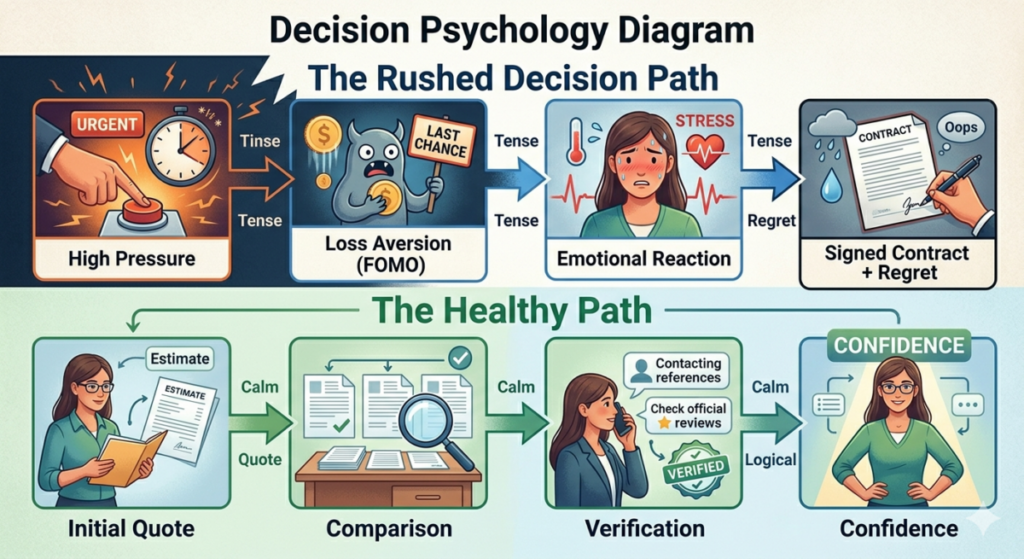
This approach works because it targets a natural human response.
When faced with:
- A potential loss (“this deal goes away”)
- Time pressure
- A high-dollar decision
Most people shift from thinking carefully to reacting quickly.
The goal becomes:
“Don’t lose the opportunity.”
Instead of:
“Make the right decision.”
The Risk
The risk isn’t just overpaying.
It’s agreeing to something you don’t fully understand.
Because once the contract is signed:
- The scope is locked in
- The pricing is set
- The ability to compare is gone
And if you later realize something wasn’t clear, it’s much harder to go back.
What a Healthy Buying Process Looks Like
A legitimate project should allow you to:
- Review the details without pressure
- Compare multiple options
- Ask follow-up questions
- Take time to think
If a company is confident in what they’re offering, their value should hold up tomorrow—not just today.
What You Should Do Instead
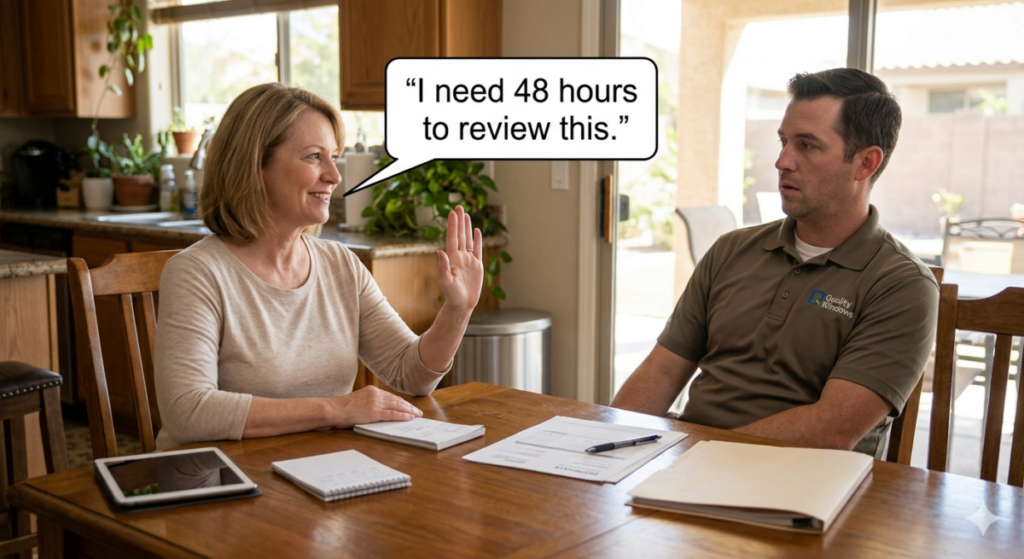
When you hear:
“This price is only good today”
A simple response is:
“I don’t make decisions like this on the spot. I need time to review everything.”
That does two things:
- It resets control of the conversation
- It gives you space to evaluate clearly
A reputable company will respect that.
If they don’t, that tells you something important.
The Bottom Line
You don’t need to rush this decision.
In fact:
The more pressure you feel, the more important it is to slow down.
Because window replacement is not a small purchase.
It’s a long-term decision that affects:
- Comfort
- Performance
- Cost
And it should be made with clarity—not urgency.
Pressure vs Reality
| What You Hear | What It Usually Means |
| “This price is only good today” | Pricing is flexible and negotiable |
| “Manager approval required” | Structured discount process |
| “We can lower it if you sign now” | Incentive to close immediately |
| “This deal won’t be available later” | Urgency is being used to drive decision |
“I’ve seen homeowners agree to projects they didn’t fully understand—not because they were convinced, but because they felt pressured to decide.”
SECTION 3 — HOW WINDOW REPLACEMENT ACTUALLY WORKS
When you replace windows, you are not buying a single product. You are buying a system made up of three parts:
1. THE FRAME – What Your Window Is Really Made Of (And Why It Matters Over Time)
When most homeowners look at a window, they see the glass.
That’s natural. It’s the most visible part.
But the part that determines how that window performs over time—the part that quietly does the real work—is the frame.
The frame is what:
- Holds everything together
- Keeps the glass properly aligned
- Maintains the seal over time
- Handles expansion, contraction, and constant exposure to the elements
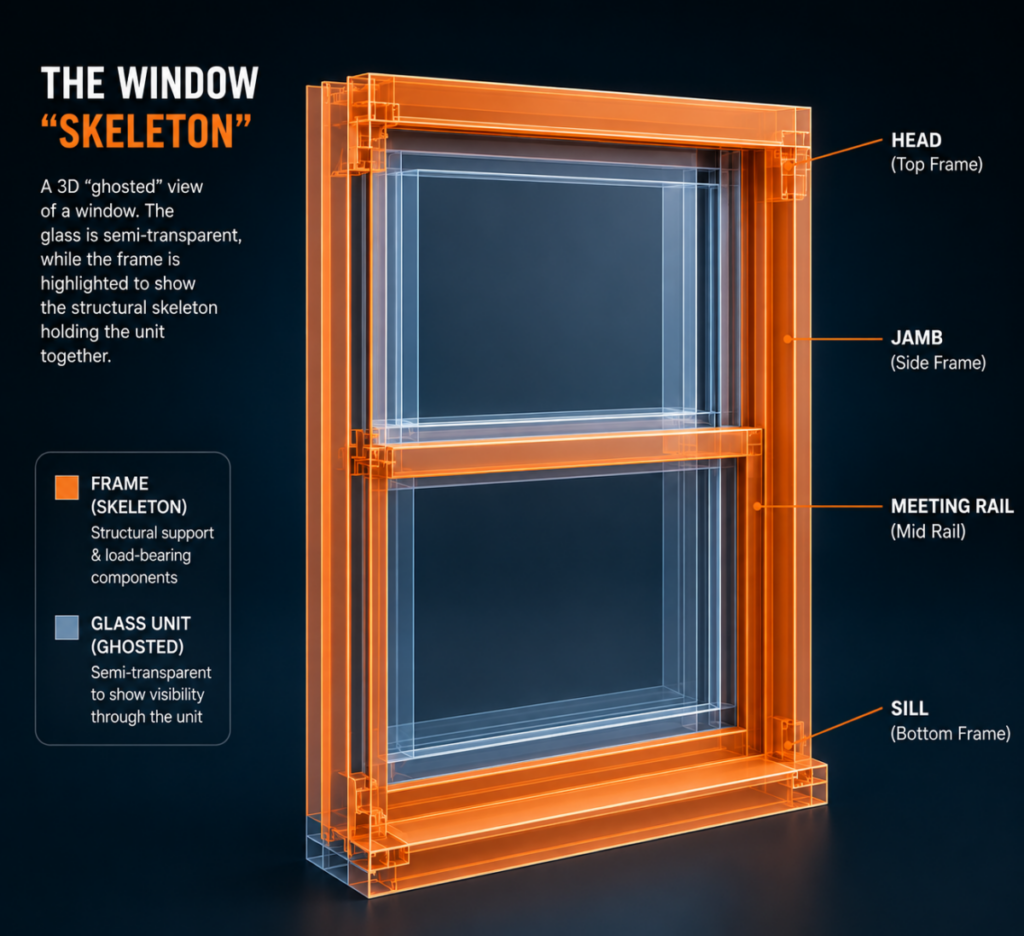
And unlike the glass, which tends to perform consistently, the frame is constantly reacting to its environment.
What Most Homeowners Assume
The common assumption is simple:
“If the window is well-built, it should last.”
That sounds reasonable.
But what’s often missing from that thinking is this:
Different materials behave very differently depending on where they are installed.
A window frame isn’t sitting in a controlled environment.
It’s exposed to:
- Daily heat cycles
- Direct sunlight
- Temperature swings
- Long-term stress over years—not months
And over time, those conditions begin to reveal the strengths—and weaknesses—of the material.
A Real-World Perspective
I’ve walked through homes where the windows were only a few years old, and something felt slightly off.
Not broken. Not failed.
Just… not as solid as expected.
The homeowner couldn’t always point to a specific issue. But when you operated the window or looked closely at the frame, you could tell:
- It didn’t feel as rigid
- It didn’t operate as smoothly
- The fit wasn’t quite as tight
And when you step back and look at the bigger picture, the reason usually comes down to one thing:
The material was not a great match for the environment it was living in.
Why Environment Matters More Than People Think
In a mild climate, many materials perform well.
But in more demanding environments—especially places with:
- High heat
- Intense sun exposure
- Large temperature swings
…the behavior of the frame becomes much more important.
Because now, instead of occasional stress, the material is dealing with constant stress.
Every day:
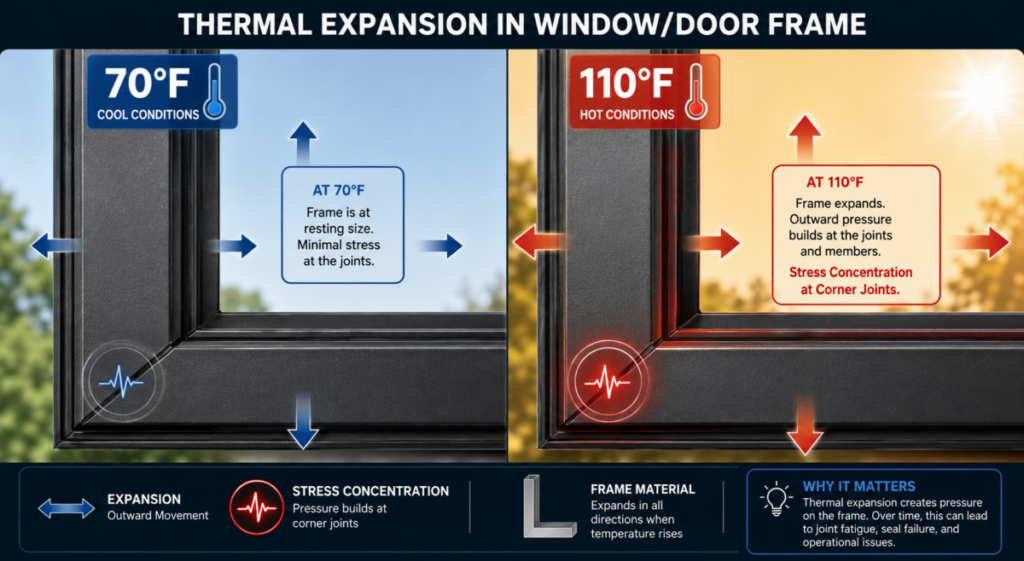
- It heats up
- It expands
- It cools down
- It contracts
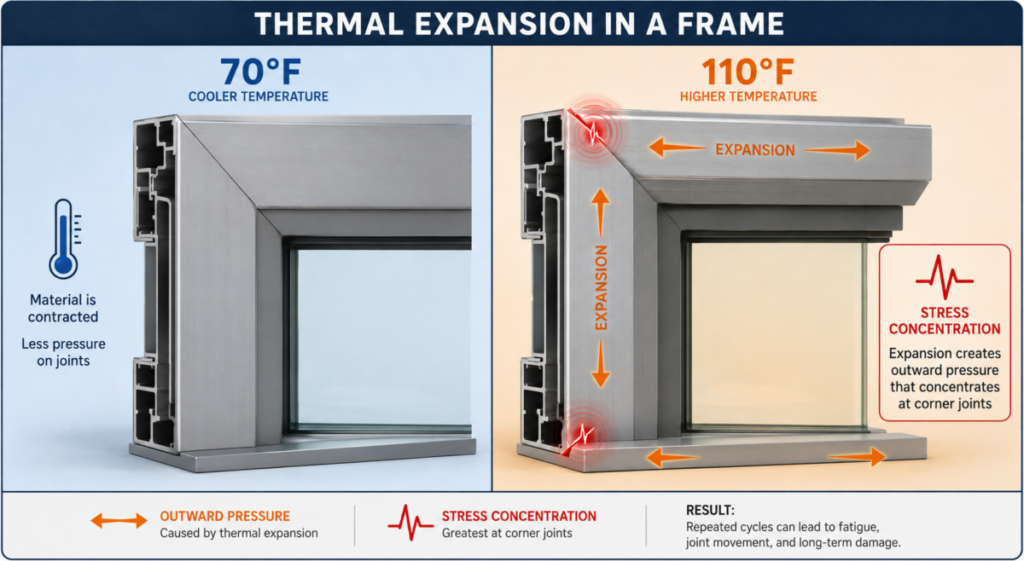
This is known as “Thermal Expansion”. The cycle repeats every day and happens thousands of times over the life of the window.
Some materials handle that well.
Some don’t.
How Different Frame Materials Behave
This is not about “good” vs “bad.”
It’s about understanding how each material responds over time.
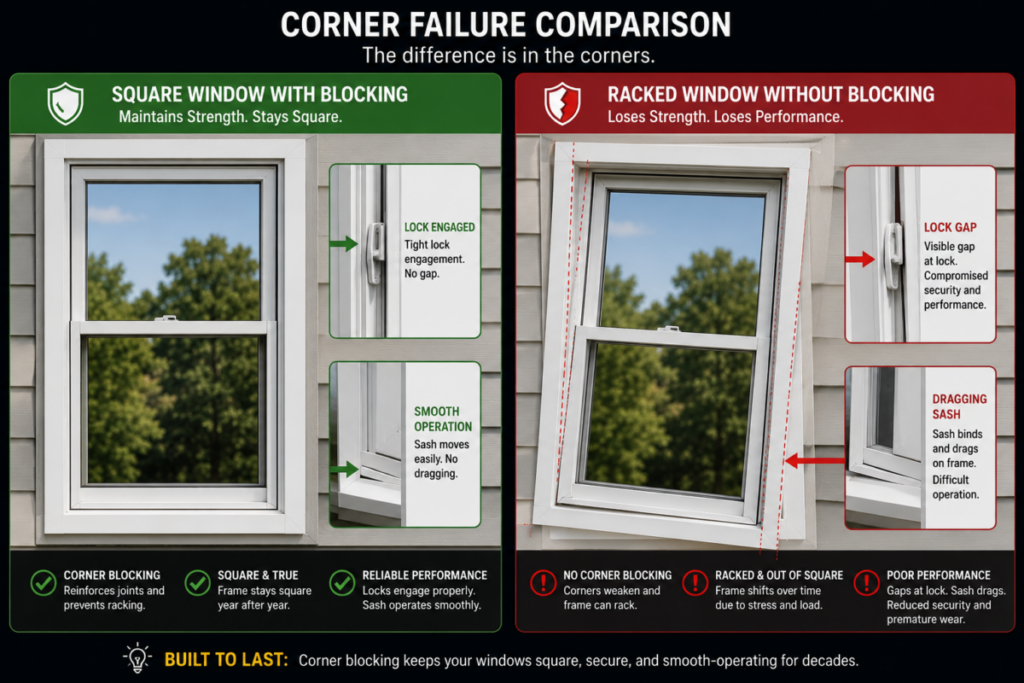
Corner Blocking (Frame & Sash) — Why It Matters More Than You Think
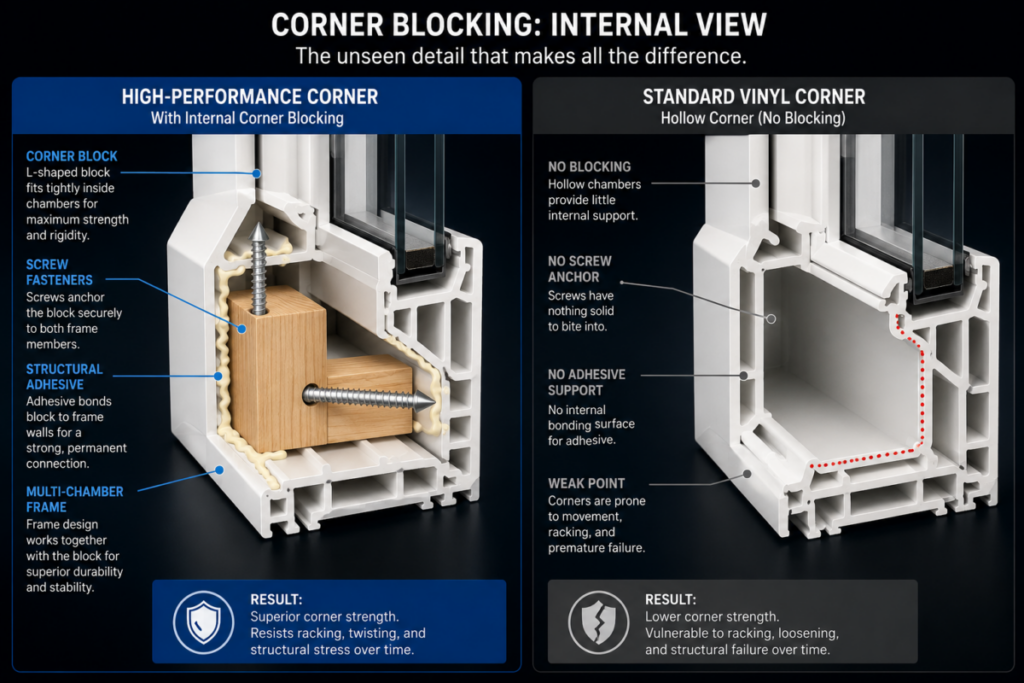
One of the least visible—but most structurally important—features in a quality window is corner blocking. This applies to both the main frame and each operable sash. Most homeowners never hear about it, yet it plays a major role in how long a window holds its shape, seals properly, and continues to operate smoothly over time.
What is corner blocking?
Corner blocking refers to the reinforcement placed inside the corners where the vertical and horizontal members of a window frame or sash meet. In higher-quality construction, these corners are not just fused or glued—they are mechanically reinforced with solid blocks, often secured with both fasteners (screws) and adhesives.
Why Corner Blocking Is Important
1. Maintains Structural Integrity Over Time
- Windows expand and contract constantly due to temperature swings—especially in hot climates.
- Without reinforcement, the corners are the weakest point and can gradually shift or deform.
- Corner blocking acts like a brace, locking the geometry of the frame and sash in place.
Result: The window stays square and true, even after years of heat cycling.
2. Preserves the Seal and Energy Efficiency
- The insulating glass unit (IGU) depends on a tight, consistent seal within the sash.
- If the sash corners flex or spread, even slightly, it can:
- Break the seal
- Allow air infiltration
- Reduce energy efficiency
Result: Proper corner reinforcement helps maintain the air-tight seal that keeps hot air out and conditioned air in.
3. Prevents Operational Problems
- Windows that lose their square shape become difficult to open, close, or lock.
- Common symptoms of poor corner construction:
- Sashes that bind or drag
- Locks that don’t align
- Gaps that appear over time
Result: Corner-blocked sashes maintain alignment, so the window continues to operate smoothly and securely.
4. Adds Long-Term Durability (Especially in Extreme Climates)
- In high-heat environments, materials like vinyl can soften slightly under sustained temperatures.
- Over time, this can lead to:
- Corner separation
- Frame warping
- Reduced lifespan
- Reinforced corners resist these forces, particularly when paired with stronger materials like fiberglass.
Result: A more durable window that resists the long-term effects of heat, UV exposure, and daily use.
How This Compares to Typical Construction
Many standard windows rely on:
- Heat-fused (welded) corners only
- Minimal internal reinforcement
- No mechanical fastening at stress points
While this approach reduces manufacturing cost, it also means:
- Less resistance to movement
- Greater risk of corner failure over time
In contrast, windows with true corner blocking treat the corner as a structural joint—not just a connection point.
Bottom Line
Corner blocking is one of those features you’ll never see—but you’ll feel the difference over time.
- It keeps the window square
- It protects the seal
- It ensures smooth operation
- It extends the life of the unit
If a window lacks proper corner reinforcement, it may look fine on day one—but it’s far more likely to develop problems as the years go on.
VINYL FRAMES
Vinyl is popular for a reason:
- Lower cost
- Good initial energy performance
- Widely available
But vinyl is also very sensitive to:
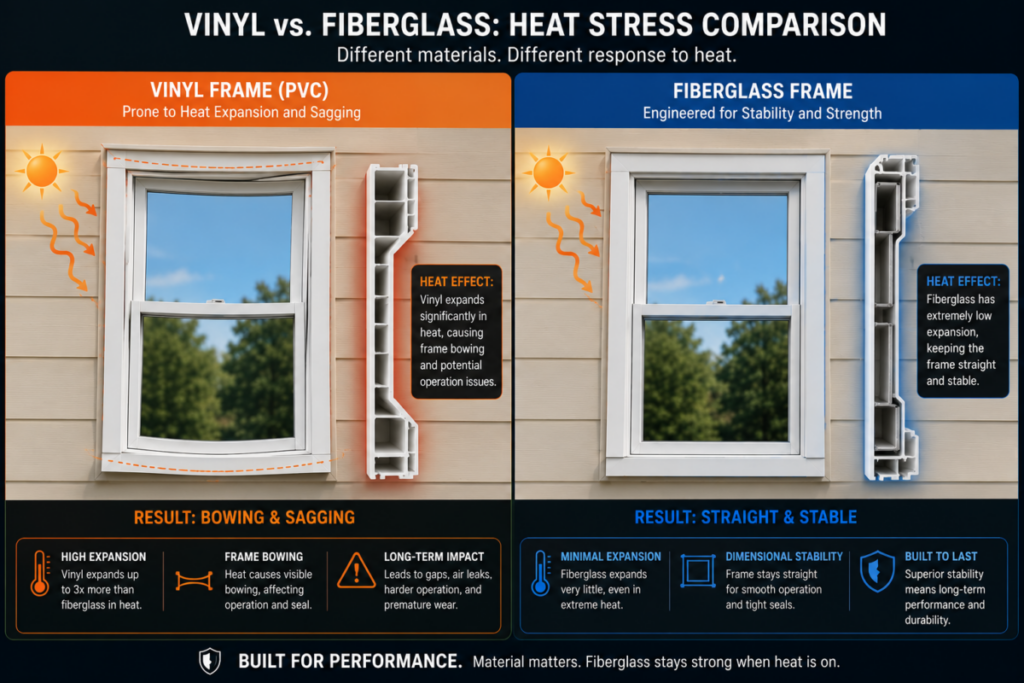
- Heat expansion and contraction
- Long-term UV exposure
In hotter climates, this can lead to:
- Increased movement over time
- Reduced rigidity
- Gradual changes in fit and operation
That doesn’t mean vinyl is always a bad choice.
It means: – It performs differently depending on where it’s used.
Vinyl Frame Corners
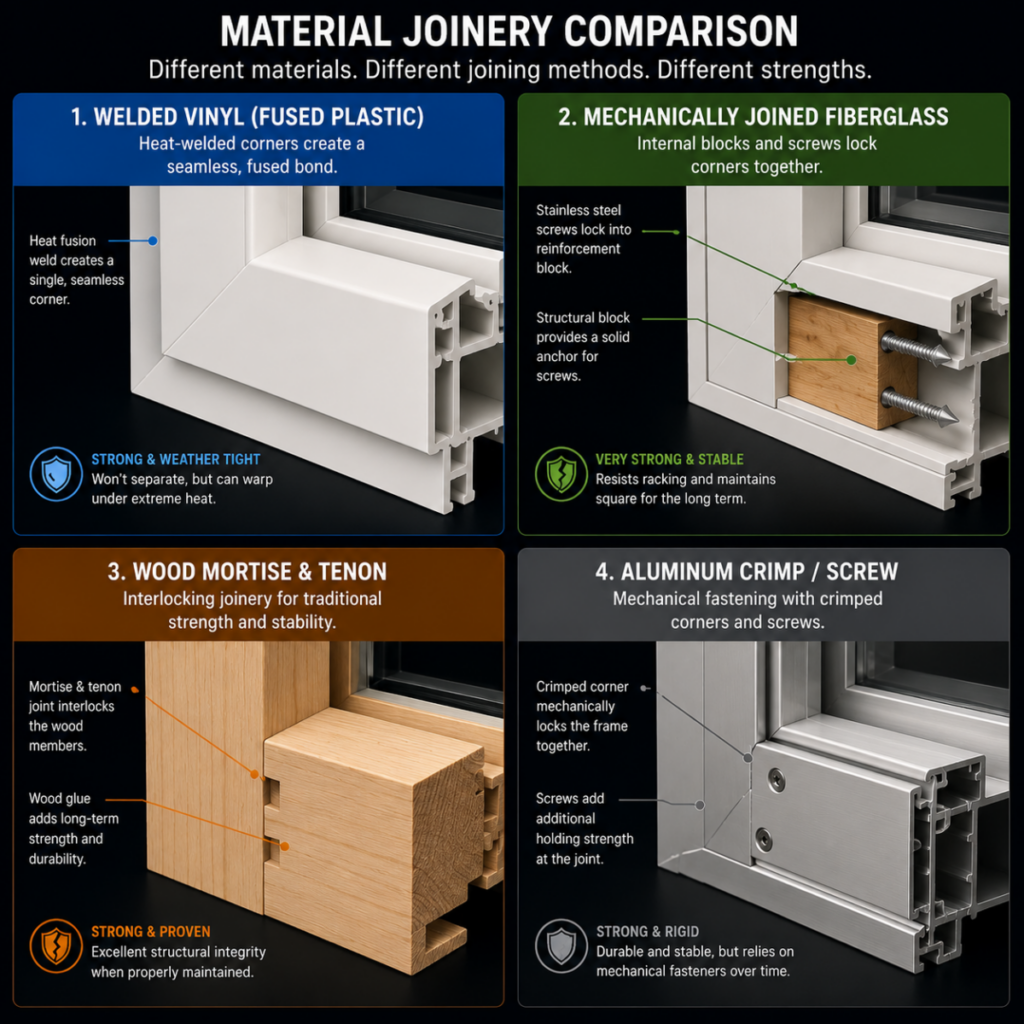
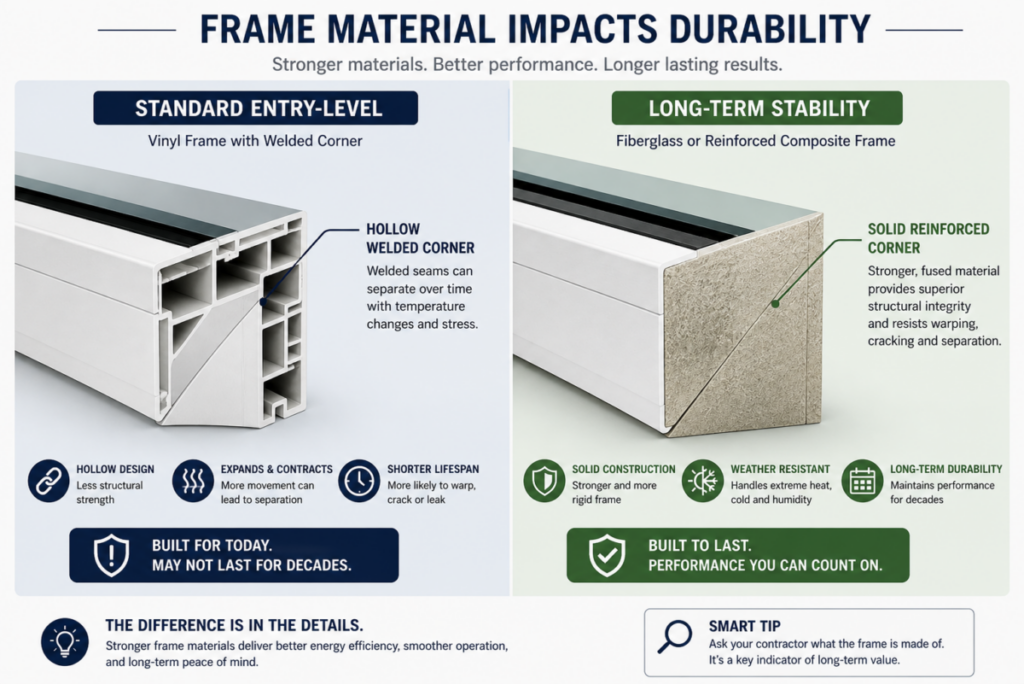
- Most vinyl-framed windows use a heat-welded corner process
- Frame pieces are fused together rather than mechanically fastened
- This creates a clean, seamless appearance
- No visible joints or fasteners at the corners
- The strength of the corner depends entirely on:
- The quality of the weld
- The stability of the vinyl material
- Vinyl naturally expands and softens under heat
- Especially noticeable in high-temperature climates like Arizona
- Over time, this can lead to:
- Slight movement in the corners
- Loss of squareness
- Potential corner separation
- Unlike reinforced systems, most vinyl windows have:
- No internal corner blocking
- No mechanical fasteners at the corners
- The result:
- Corners can become a long-term weak point compared to reinforced frame designs
FIBERGLASS FRAMES
Fiberglass is known for:
- Strength and rigidity
- Lower expansion and contraction compared to vinyl
- Stability under temperature changes
Because of that, it tends to:
- Maintain shape consistently over time
- Handle long-term heat exposure more effectively
This often makes it a stronger candidate in environments where stability matters.
Fiberglass Frame Corners
- Fiberglass-framed windows typically use mechanically assembled corners rather than relying only on fusion
- Frame members are joined with internal corner blocks, fasteners, and structural adhesives
- The material itself is rigid and dimensionally stable
- Expands and contracts very little with temperature changes
- Corners are treated as a structural joint, not just a connection point
- Reinforcement helps lock the frame and sash into a permanent square shape
- This construction helps prevent:
- Warping or twisting
- Corner separation
- Loss of alignment over time
- The result:
- A stronger, more stable frame that maintains seal integrity and smooth operation over the long term
WOOD / COMPOSITE FRAMES
Wood offers:
- Natural insulation properties
- A more traditional appearance
But it also requires:
- Significant Maintenance
- Protection from moisture and sun exposure
Composite (frames made up of more than one material such as Andersen’s Fibrex) materials attempt to improve on vinyl and wood by:
- Increasing durability
- Reducing maintenance requirements
Performance depends heavily on:
- Product design
- Installation quality
- Ongoing maintenance
Wood Frame Corners
- Wood-framed windows typically use traditional joinery at the corners
- Most commonly mortise-and-tenon or doweled joints
- Corners are usually glued and mechanically fastened
- Adhesives + pins, screws, or staples reinforce the joint
- Wood itself is rigid and strong, providing a solid base for the joint
- Less flexible than vinyl, but still subject to natural movement
- Because wood is an organic material, corners can be affected by:
- Moisture absorption and drying cycles
- Expansion, contraction, and potential swelling
- Over time, if not properly maintained, this can lead to:
- Joint loosening
- Minor separation at corners
- Need for repainting or sealing to protect integrity
- The result:
- Strong initial construction, but long-term durability depends heavily on ongoing maintenance and moisture control
ALUMINUM FRAMES
Aluminum is:
- Very strong
- Structurally stable
But it also:
- Conducts heat more readily
- Can transfer outside temperatures more easily into the home
Because of that, aluminum is often used in:
- Specific architectural applications
- Situations where strength is prioritized over insulation
- Many commercial building applications
Aluminum frames were used in residential construction probably as the principal material of choice from the 1960s through the early 2000s. The period prior to energy savings becoming prevalent. Since aluminum is itself a very poor insulator, its use in residential construction is ver, very low; but still available.
The Key Insight Most Homeowners Miss
The goal is not to find the “best” material.
The goal is to find the material that will:
Hold up the best over time in your specific environment and for your intended purposes with the home.
That depends on:
- Climate
- Sun exposure
- How long you plan to stay in the home
- Your expectations for performance
The Better Question to Ask
Instead of asking:
“Which material is better?”
Ask:
“How will this material behave in my home over the next 10–20 years?”
That question leads to a much better decision.
The Bottom Line
The frame is not just part of the window.
It is the foundation of the window’s performance.
And while all materials have their place, the difference between a good experience and a disappointing one often comes down to this:
How well the material matches the environment it’s placed in.
Window Frame Materials: Real-World Behavior
Aluminum Frame Corners
- Aluminum-framed windows typically use mechanically fastened corner joints
- Frame members are cut and joined using screws, brackets, or crimped connections
- Many designs also include corner keys or brackets inside the frame
- These help align and reinforce the joint during assembly
- Aluminum is very rigid and does not expand or contract much with temperature
- Helps the frame maintain its shape over time
- However, the strength of the corner depends on:
- The quality of the mechanical connection
- Precision during manufacturing and assembly
- Over time, potential issues can include:
- Loosening of fasteners
- Slight joint movement if not tightly secured
- The result:
- Strong, stable corners when well-built, but performance relies heavily on connection quality rather than material flexibility
Window Frame Materials Summary
| Material | Strengths | Considerations in Hot Climates |
| Vinyl | Lower cost, energy efficient | Expands/contracts more over time |
| Fiberglass | Strong, stable, durable | Higher cost, but more consistent performance |
| Wood/Composite | Insulating, aesthetic appeal | Requires maintenance, varies by product |
| Aluminum | Strong, durable | Transfers heat more easily |
“In hotter climates, where windows are exposed to direct sunlight day after day, how the frame handles expansion and long-term heat becomes one of the most important factors in how the window performs over time.”
2. THERMAL EXPANSION:The Hidden Force That Determines How Windows Age
Most homeowners never think about what their windows go through in a single day.
But every day—especially in hot climates—your windows are moving.
Not visibly. Not dramatically.
But constantly.
What Happens Every Day
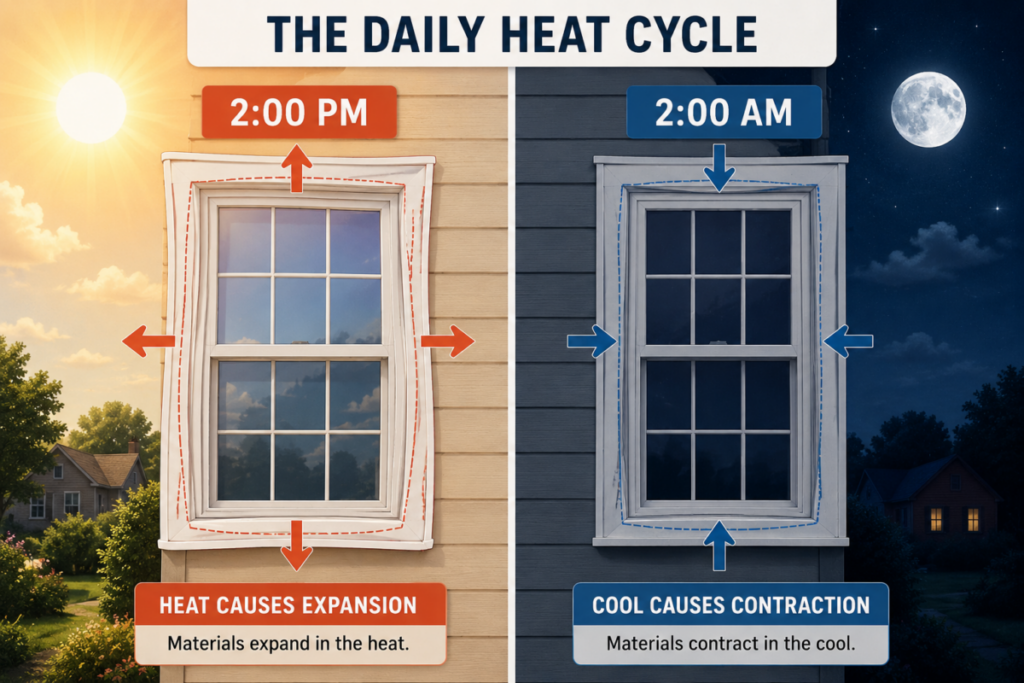
From morning to late afternoon, your windows are exposed to:
- Rising temperatures
- Direct sunlight
- Heat buildup in the frame and glass causing expansion of the material
Then at night:
- Temperatures drop
- Materials cool
- Everything contracts
This creates a daily expansion and contraction cycle.
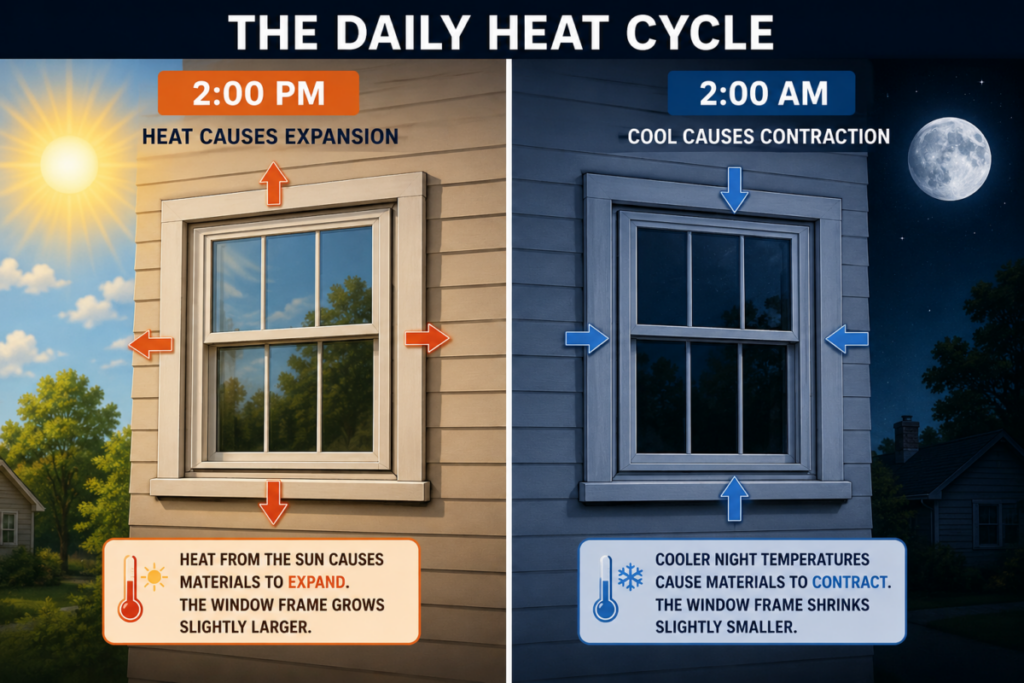
And over the life of a window, that cycle doesn’t happen a few times.
It happens:
- Hundreds of times per year
- Thousands of times over a decade
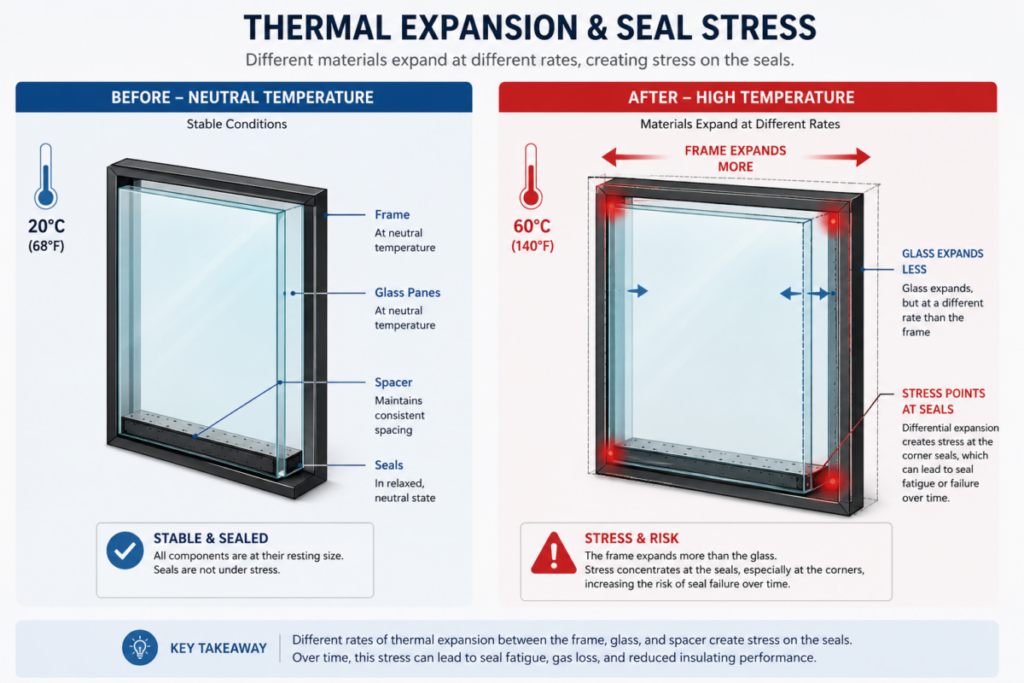
The Problem: Materials Don’t Move the Same Way
Here’s where things get interesting—and where problems begin.
A window is made of multiple materials:
- The glass
- The frame
- The seals that hold everything together
Each of these materials expands and contracts at a different rate.
They are not moving together.
They are pulling against each other.
A Simple Way to Think About It
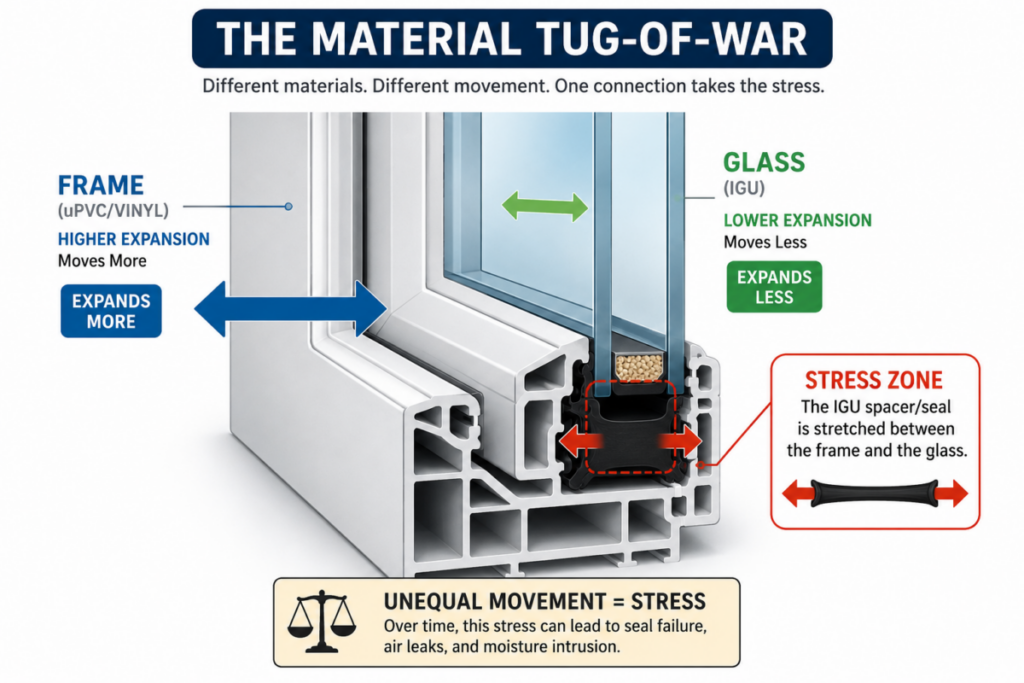
Think of the window as a system where:
- The glass wants to move one amount
- The frame wants to move a different amount
- The seals are stuck in between trying to hold everything together
It becomes a constant tug of war.
And the seals are in the middle of that fight—every single day.
How Much Do Materials Actually Move?
This is where understanding the differences matters.
Below is a simplified comparison of how common window materials expand relative to glass:
Relative Thermal Expansion (Simplified Comparison)
| Material | Expansion vs Glass | What That Means |
| Glass | Baseline (1x) | Very stable, minimal movement |
| Fiberglass | ~1–2x | Moves very similar to glass |
| Wood | ~2–4x (variable) | Moderate movement, depends on moisture |
| Vinyl | ~6–8x | Expands and contracts significantly more |
| Aluminum | ~2–3x | Moderate expansion, conducts heat quickly |
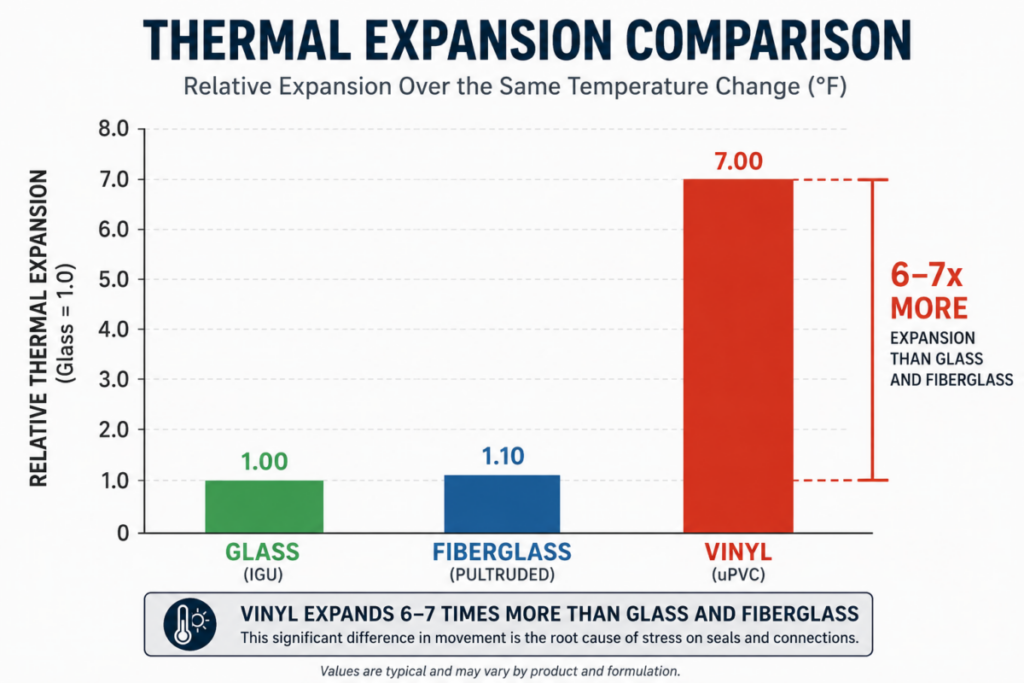
Why This Matters
When materials expand at similar rates, the system stays relatively stable.
When materials expand at very different rates, stress builds up.
And that stress has to go somewhere.
Where the Stress Shows Up
The weakest point in this system is almost never the glass.
And it’s usually not the frame.
It’s the seals.
These seals:
- Hold the glass in place
- Keep air and moisture out
- Maintain the insulating barrier
But they are flexible by necessity—and that makes them vulnerable.
What Happens Over Time
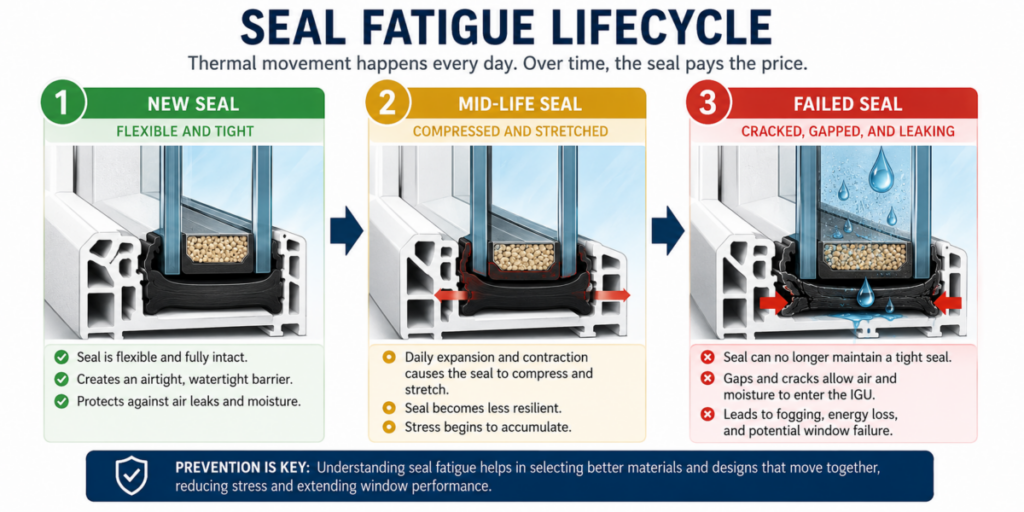
When materials expand and contract at different rates:
- The frame pushes against the glass slightly as it expands
- Then pulls back as it contracts
- The seals stretch and compress repeatedly
At first, this is handled without issue.
But over time:
- The seals begin to fatigue
- They lose elasticity
- They no longer return to their original shape
Eventually, they start to fail.
Real-World Example
This is something I’ve seen often.
A homeowner has windows that are a few years old.
They don’t see cracks.
They don’t see anything obviously broken.
But they start noticing:
- Slight fogging between panes
- A subtle draft near the window
- A loss of that “tight” feeling the window once had
What’s happening isn’t sudden failure.
It’s the result of years of small, repeated stress.
The daily tug of war has slowly worn down the system.
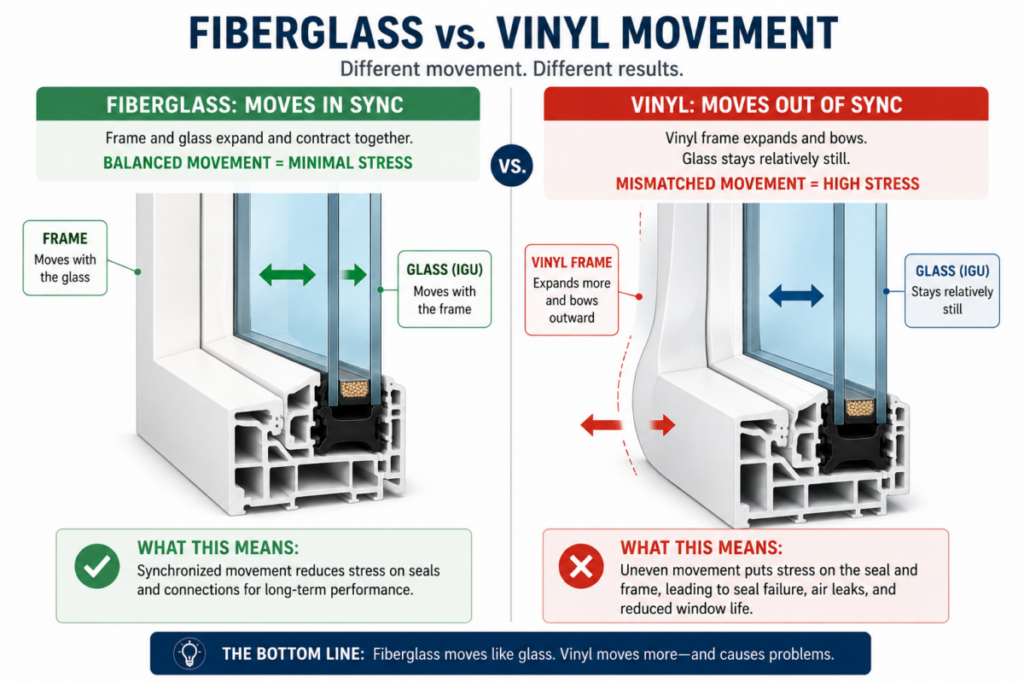
Why Fiberglass Often Gets Attention Here
One reason certain materials are favored in more demanding climates is because of how closely they move compared to glass.
For example:
- Fiberglass expands at a rate very similar to glass
- That means far less stress on the seals
- Very little movement between components
So instead of a tug of war, the system moves more in sync.
That doesn’t make it perfect—but it reduces one of the major long-term stress factors.
Why Vinyl Gets Scrutinized in Hot Climates
Vinyl, on the other hand:
- Expands and contracts significantly more than glass
- Is more sensitive to heat buildup
- Moves much more during each daily cycle
That increased movement doesn’t necessarily cause immediate failure.
But over time, it can:
- Increase stress on seals
- Affect long-term fit and operation
- Contribute to gradual performance loss
The Key Insight
This is what most homeowners are never told:
Windows don’t usually fail all at once. They wear out slowly due to repeated stress over time.
And one of the biggest sources of that stress is:
? mismatched expansion between materials
The Better Question to Ask
Instead of asking:
“Which window is more energy efficient?”
Ask:
“How well do these materials move together over time?”
Because that determines:
- How long the seals last
- How well the window maintains performance
- How the window feels and operates years later
The Bottom Line
Every day, your windows go through a cycle of:
- Expansion
- Contraction
- Stress
- Recovery
When materials are closely matched, that cycle is manageable.
When they’re not:
The system is under constant strain—and over time, something gives.
Most often, it’s the seals.
Important Insight:Your windows don’t fail because of one bad day.
They fail because of thousands of small stress cycles over time.
3. THE GLASS PACKAGE: – Where Comfort, Efficiency, and FailureAll Begin
When homeowners think about windows, they usually think about the glass as a simple component.
Clear. Flat. Transparent.
But modern window glass is not just glass.
It’s a sealed system, built to:
- Control heat
- Reduce noise
- Block air and dust
- Manage moisture
And when that system works properly, the difference is noticeable.
When it doesn’t… the problems show up slowly—and then all at once.
What a “Glass Package” Really Is
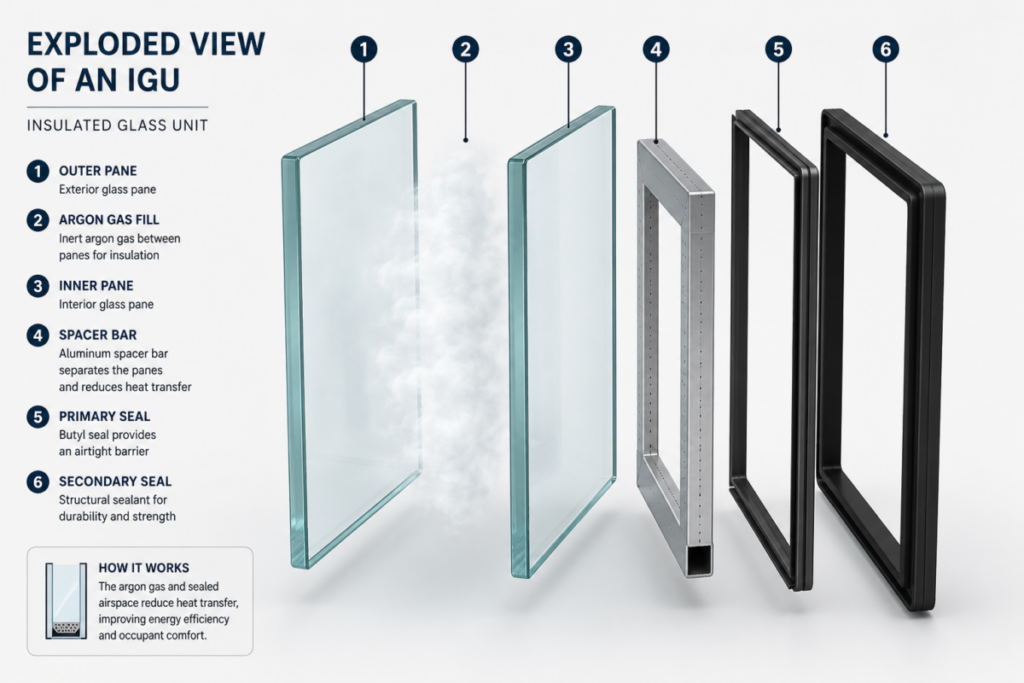
A modern window is typically made of:
- Two (or sometimes three) panes of glass
- A sealed space between those panes
- Gas inside that space (often argon)
- A spacer system that separates and seals the glass
- A perimeter seal that holds everything together
This entire assembly is called the Insulated Glass Unit (IGU).
And everything about how its performance comes down to one thing:
How well that sealed system holds up over time
Argon Gas: What It Does—and Why It Matters
Between the panes of glass is not just air.
In most modern windows, that space is filled with argon gas.
Why Argon Is Used
Argon is:
- Denser than air
- Slower to transfer heat and noise
- More stable inside a sealed unit
Because of that, it helps:
- Reduce heat transfer (keeping hot air out and cool air in)
- Improve overall energy efficiency
- Help improve sound dampening
What Homeowners Don’t Realize
Argon only works if it stays inside the glass unit.
And it stays inside because of the seals.
If those seals fail—even slightly:
- Argon begins to escape
- Outside air begins to enter
- The insulating performance drops
This doesn’t happen overnight.
It happens gradually.
What Happens When Argon Is Lost
At first, nothing is obvious.
But over time:
- The window becomes less efficient
- Interior comfort drops
- You may eventually see fogging between the panes
At that point, the seal has failed—and the glass unit is compromised.
Why Seal Failure Happens
This connects directly to what we covered earlier:
Thermal expansion
As the frame and glass expand and contract at different rates:
- Stress is placed on the perimeter seals
- That stress repeats daily
- Over time, the seals fatigue
And once the seal is compromised, the system begins to break down.
Real-World Pattern
- Lower stability materials (Vinyl) ? more movement ? more seal stress
- Higher stability materials (Fiberglass) ? less movement ? less seal stress
That’s why some windows:
- Lose performance in a few years
…while others:
- Maintain integrity for decades
The Spacer System: The Most Overlooked Component
Between the panes of glass is a spacer.
Most homeowners have never heard of it.
But it plays a critical role.
What the Spacer Does
The spacer:
- Keeps the panes properly separated
- Holds the shape of the glass unit
- Contains desiccant (to absorb moisture)
- Forms part of the seal system
Think of it as the backbone of the IGU.
Types of Spacers (And Why They Matter)
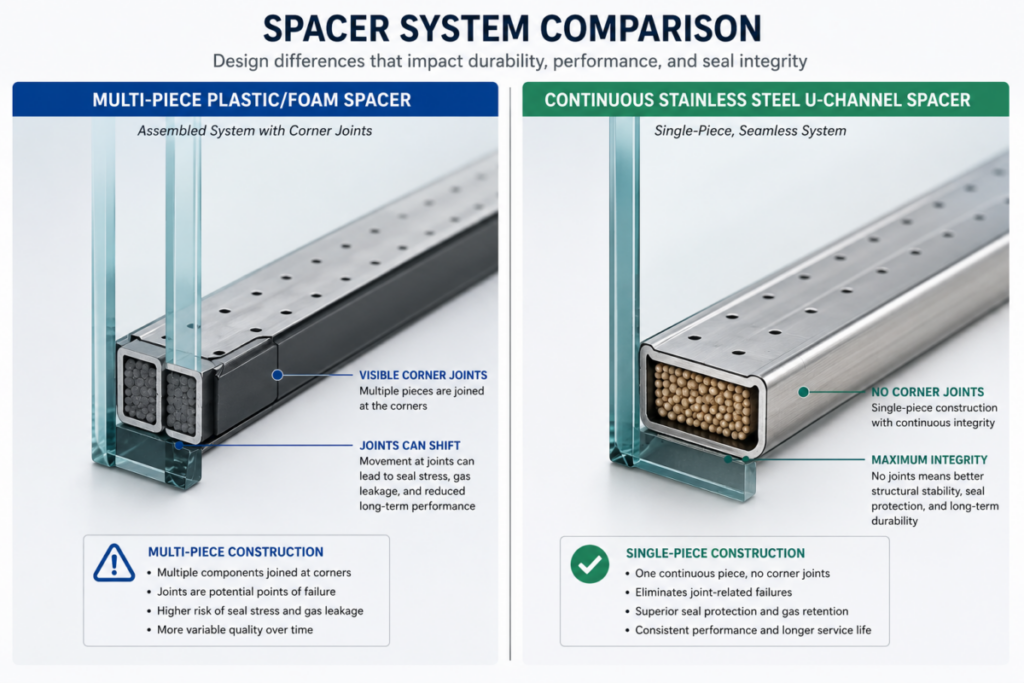
Not all spacers are built the same.
Lower-End Spacer Systems
- Foam
- Rubber
- Hard plastic
- Multi-piece designs with joints
Concerns:
- More points of failure
- Greater susceptibility to seal breakdown
- Less long-term structural stability
Higher-End Spacer Systems
- Stainless steel (often one continuous piece)
Advantages:
- Fewer joints (less chance of failure)
- Greater durability
- Better long-term seal integrity
Why Joints Matter
Every joint in a spacer system is a potential failure point.
More joints = more opportunities for:
- Air infiltration
- Moisture intrusion
- Seal breakdown
A single-piece spacer system reduces those risks significantly.
How the Glass Is Held in Place (This Matters More Than People Think)
This is rarely explained clearly—but it should be.
There are two very different approaches:
Encapsulated Glass Systems (Higher-End Approach)
Used by some premium manufacturers.
The glass unit is:
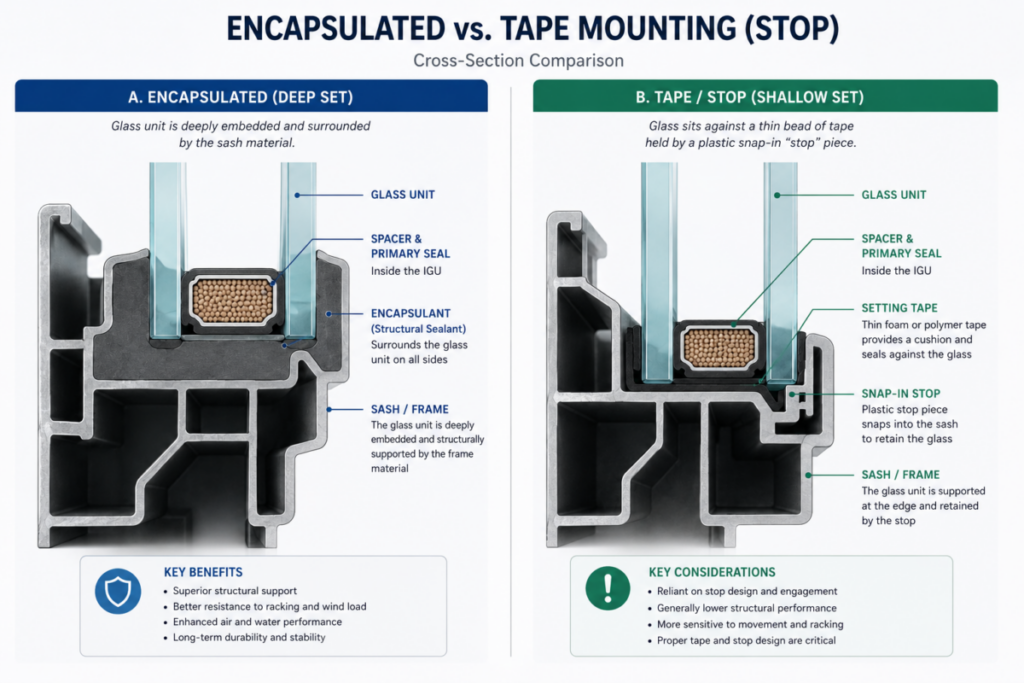
- Fully integrated into the sash
- Supported on multiple sides
- Mechanically secured—not just adhered
Advantages:
- Better structural integrity
- Reduced movement
- Less stress on seals
- More consistent long-term performance
Adhesive / Tape + Glass Stop Systems (Common in Lower-Cost Windows)
The glass is:
- Glued or taped into place
- Held with a removable “glass stop” trim piece
Concerns:
- Relies more on adhesives over time
- Less structural integration
- More potential for slight movement
- Greater long-term stress on seals
Air, Dust, and Water Control
A properly built glass system doesn’t just insulate—it protects.
Air Movement
A well-sealed IGU:
- Prevents air infiltration between panes
- Helps maintain interior comfort
If seals degrade:
- Air enters the system
- Performance drops
Dust Control
Dust between panes is a clear sign of failure.
That means:
- The seal is compromised
- The system is no longer airtight
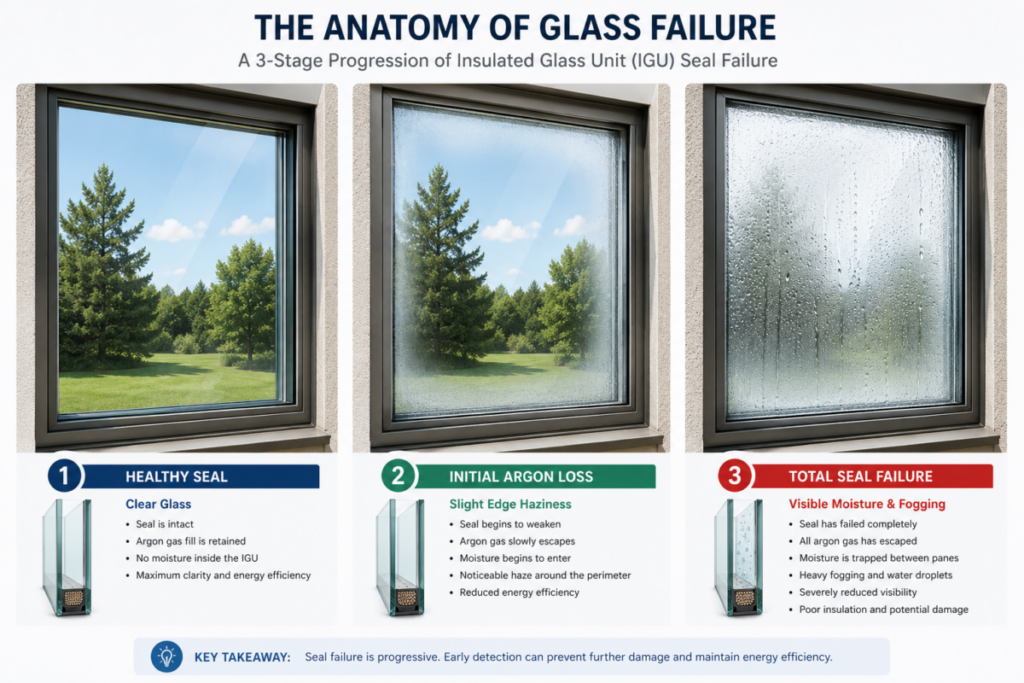
Water and Moisture Control
Inside the spacer is a desiccant designed to absorb moisture.
But once seals fail:
- Moisture enters faster than it can be absorbed
- Condensation appears
- Fogging develops
At that point, the glass unit must be replaced.
Sound Control: What Actually Makes a Difference
Many homeowners expect windows to significantly reduce noise.
Glass does play a role—but not in the way most expect.
What Helps with Sound Reduction
- Multiple panes (double or triple)
- Tighter seals
- Heavier (thicker) glass
What Doesn’t Help as Much as People Think
- Gas fill (argon helps slightly, but not dramatically)
- Marketing claims without structural differences
Glass Thickness: A Big but Overlooked Factor
Not all glass is the same thickness.
Standard Glass (Thinner)
- More common in lower-cost windows
- Adequate performance
- Generally 1.6 mm to 1.7 mm
Thicker Glass (Higher-End Systems)
- More rigid
- Less prone to vibration
- Better sound dampening
- Improved durability
- Generally 3.1 mm
Why Thickness Matters
Thicker glass:
- Moves less under stress
- Handles environmental pressure better
- Contributes to a more solid, stable window
The Key Insight
This is what ties everything together:
The performance of a window is not just about what it’s made of—it’s about how well all the components stay sealed and stable over time.
That includes:
- The gas inside
- The spacer system
- The seals
- The way the glass is mounted
The Bottom Line
When evaluating windows, don’t just ask:
“Is this double pane?”
Ask:
- How is the glass sealed?
- What type of spacer is used?
- How is the glass held in place?
- How well will this system hold up over time?
Because once the seal fails:
- The gas is gone
- The performance drops
- And the window is no longer doing what it was designed to do
Glass Package Components: What Actually Affects Performance
| Component | Why It Matters |
| Argon Gas | Reduces heat transfer, improves efficiency |
| Spacer System | Maintains structure and seal integrity |
| Seal Quality | Keeps gas in and moisture out |
| Glass Thickness | Affects durability and sound control |
| Mounting Method | Impacts long-term stability and seal stress |
Important: – Once a window seal fails, the glass unit cannot be “fixed”—it must be replaced.
This explains why windows fail over time—not just how they’re marketed
4. THE INSTALLATION: (Critical)
This is where most homeowners misunderstand what they’re buying.
Generally, in the world of replacement windows, there are two types of installation methods:
- Insert (This is often called Jump frame, Insert, or Retro-Fit)
- Full-Frame
The installation is one of the, if not the most important part of the window decision making and long-term performance. We’re going to walk through the advantages and disadvantages of both installation types.
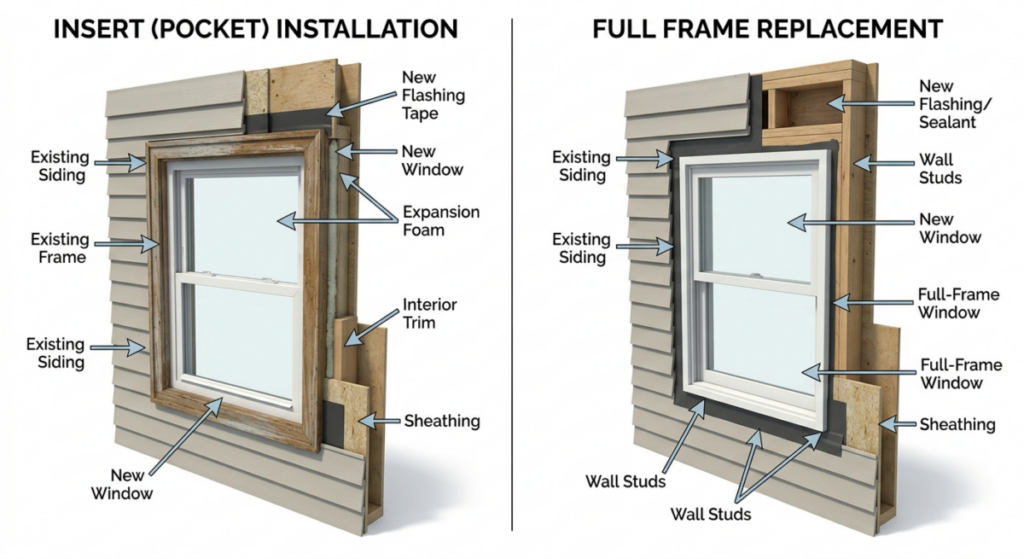
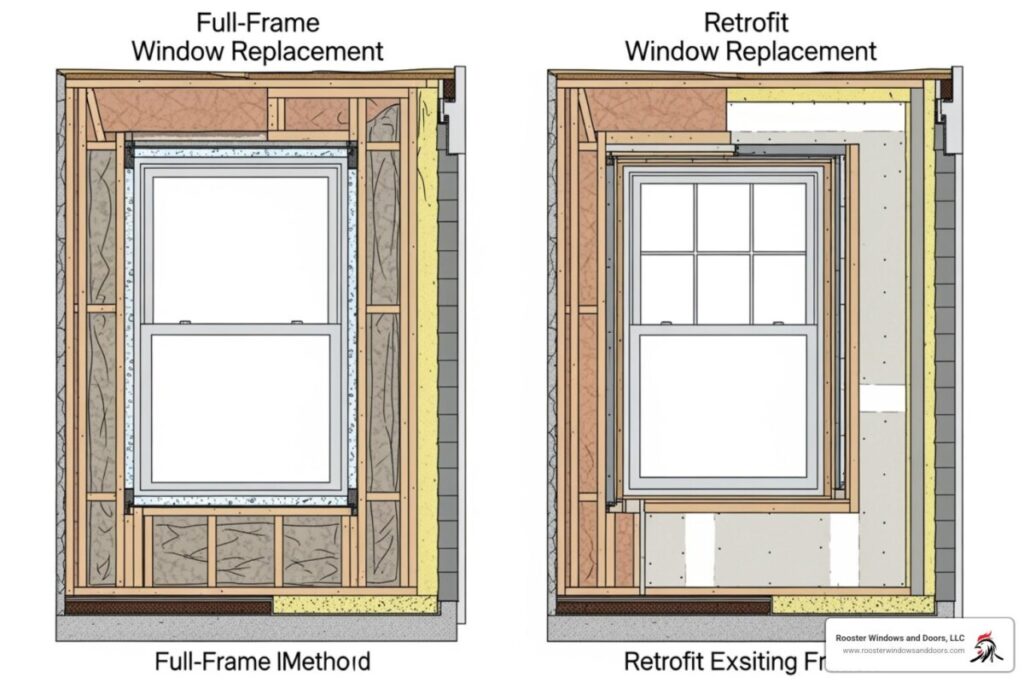
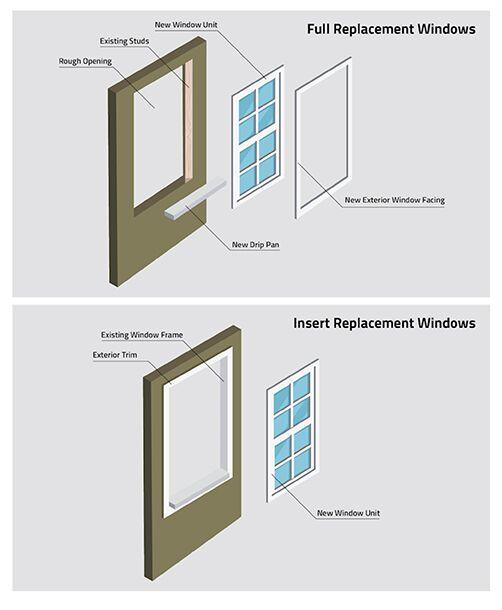
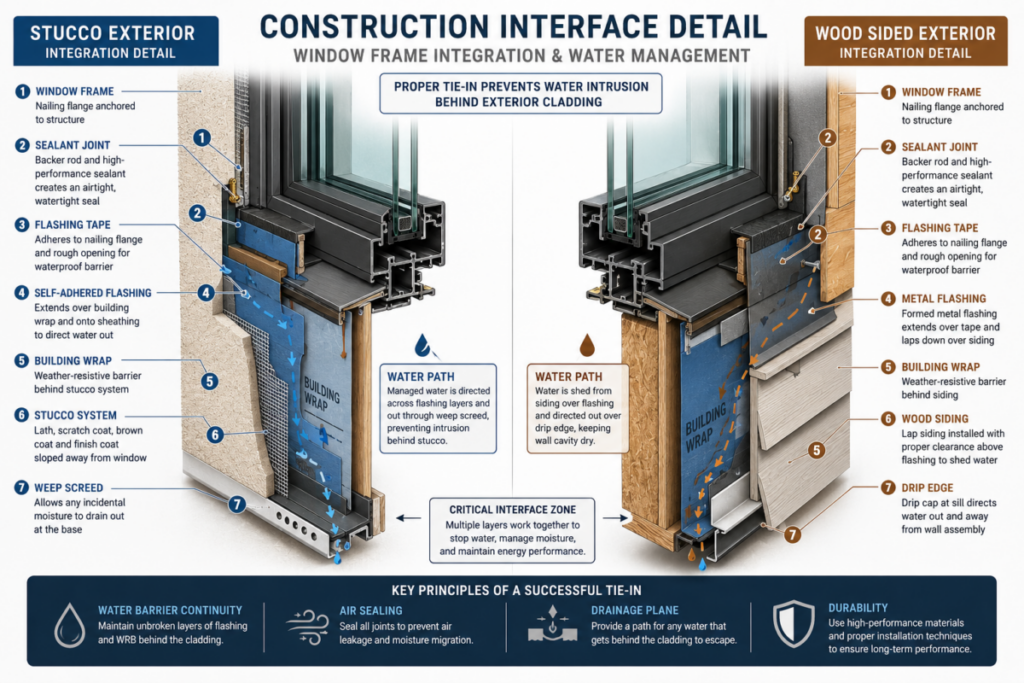
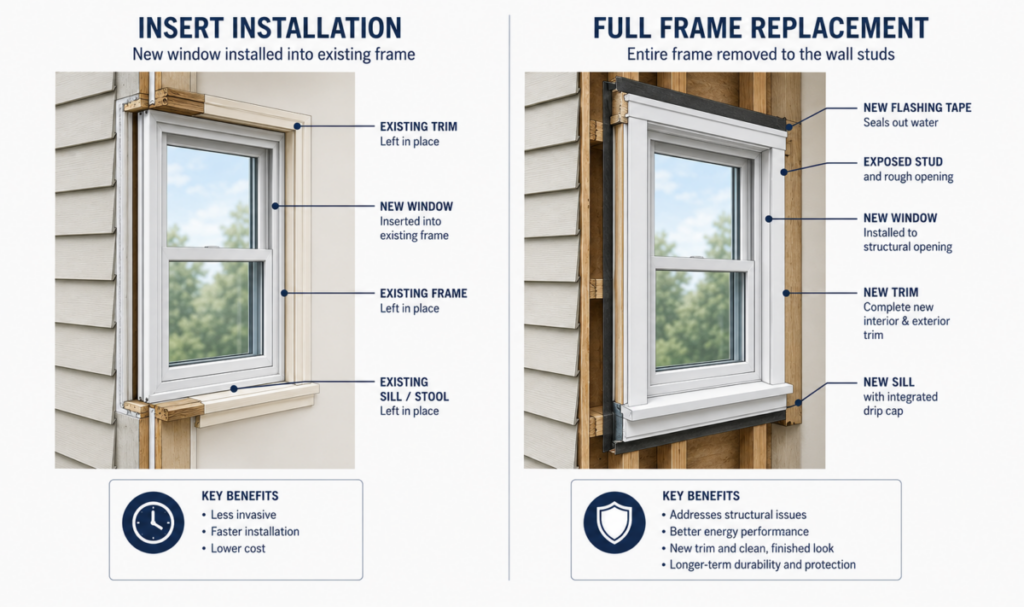
The diagram below shows an overview of the two types of installation. We’ll climb into the detail.
Insert (Retrofit) (Jump Frame) Installation Method
Different companies call this different things, trying to avoid the negative connotations. However, it is all the same thing.
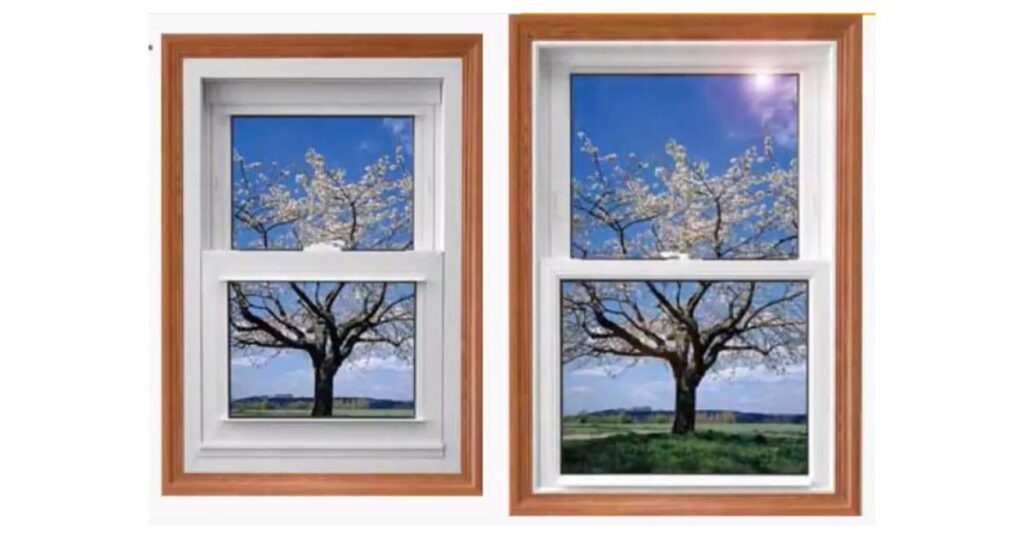
The Retrofit, (Insert, Jump Frame) method:
- Leaves the original frame in place
- Inserts a new window inside it
Advantages:
- Lower cost
- Faster installation
- Less disruption
Disadvantages:
- Smaller glass area
- Relies on existing frame condition and water barrier
- Does not address hidden underlying issues of the original window, its flashing, or its water barrier
- Fails easily in hot climates or lots of sun exposure
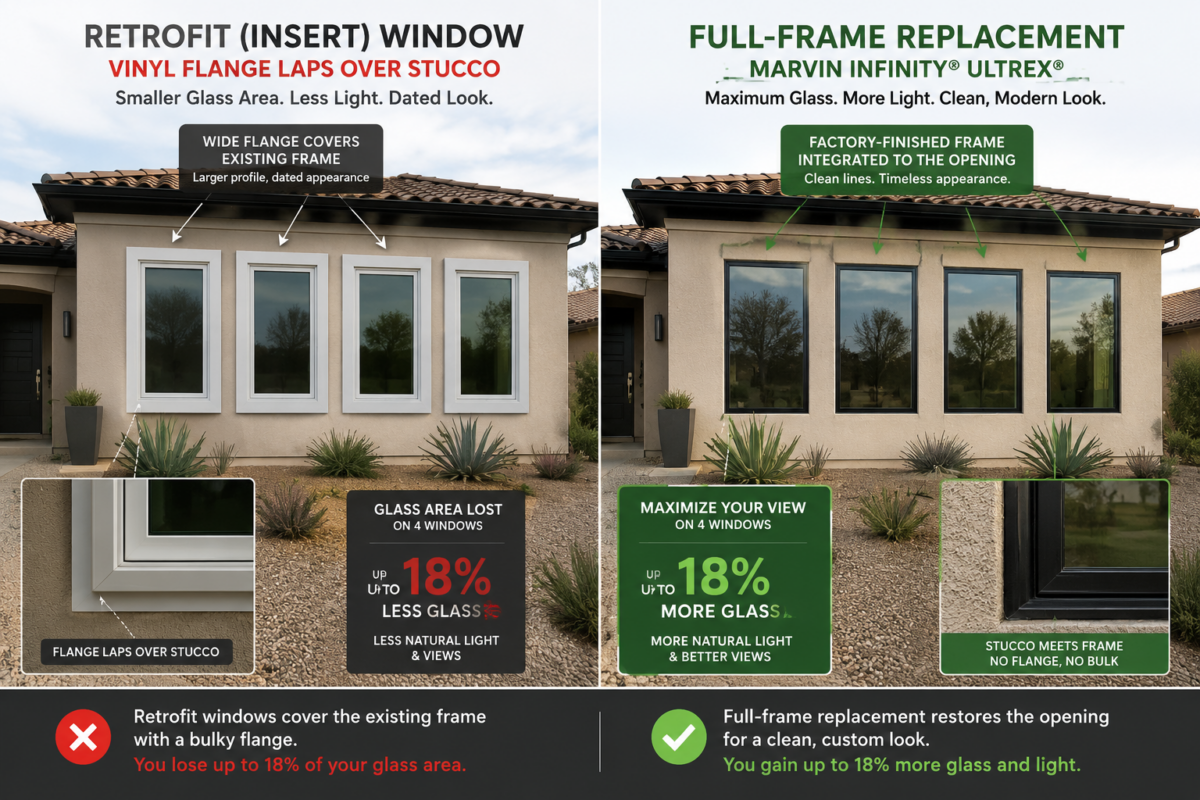
Full Frame Replacement Installation Method
Full-Frame Replacement Method:
- Removes the entire existing window
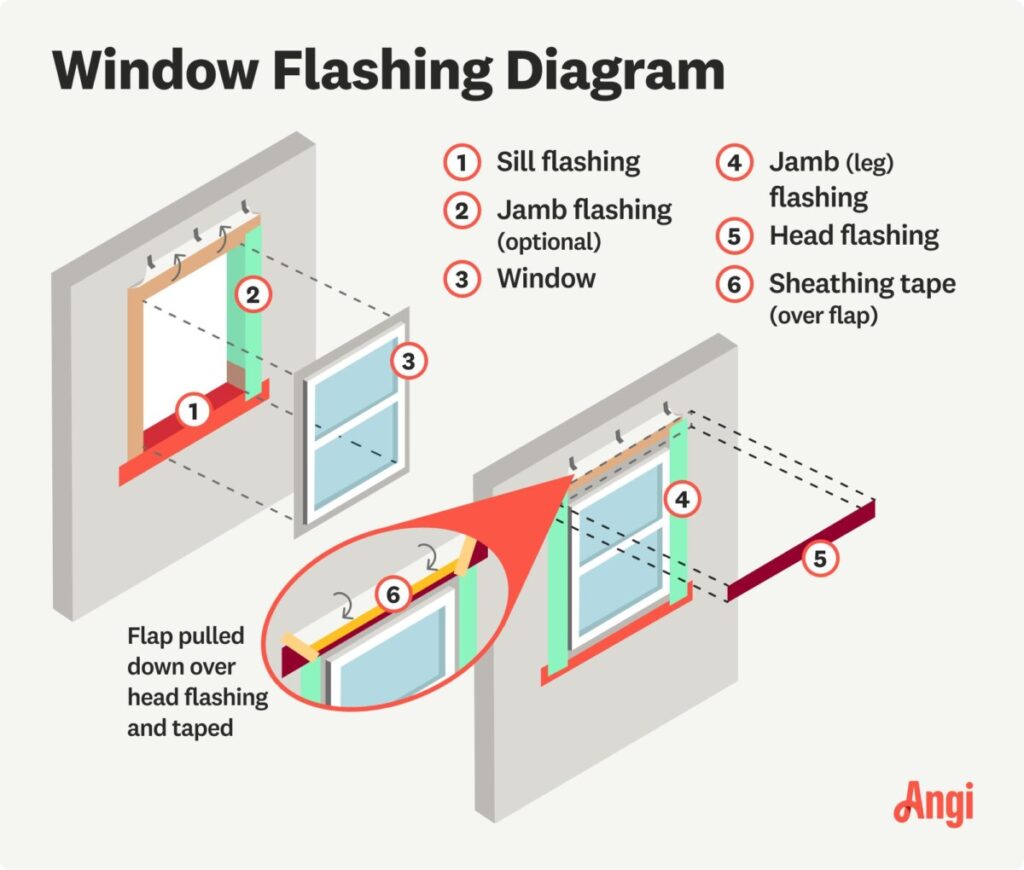
- Installs a completely new frame
- Includes new sealing and water protection
- Repairs the exterior, stucco, siding, etc. back up to the new frame, just as originally done when the home was built.
Advantages:
- Restores the opening to like-new condition
- Addresses structural and moisture concerns
- Superior long-term performance
Trade-offs:
- Higher cost
- More labor-intensive
SECTION 4 — THE DECISION FRAMEWORK: HOW TO THINK THROUGH THIS CORRECTLY
By this point, you’ve probably realized something:
Replacing your windows is not a simple “yes or no” decision.
It’s a series of decisions—about:
- Materials
- Installation
- Long-term performance
- Cost vs value
And if you try to make those decisions all at once, it becomes overwhelming.
That’s where most homeowners get stuck.
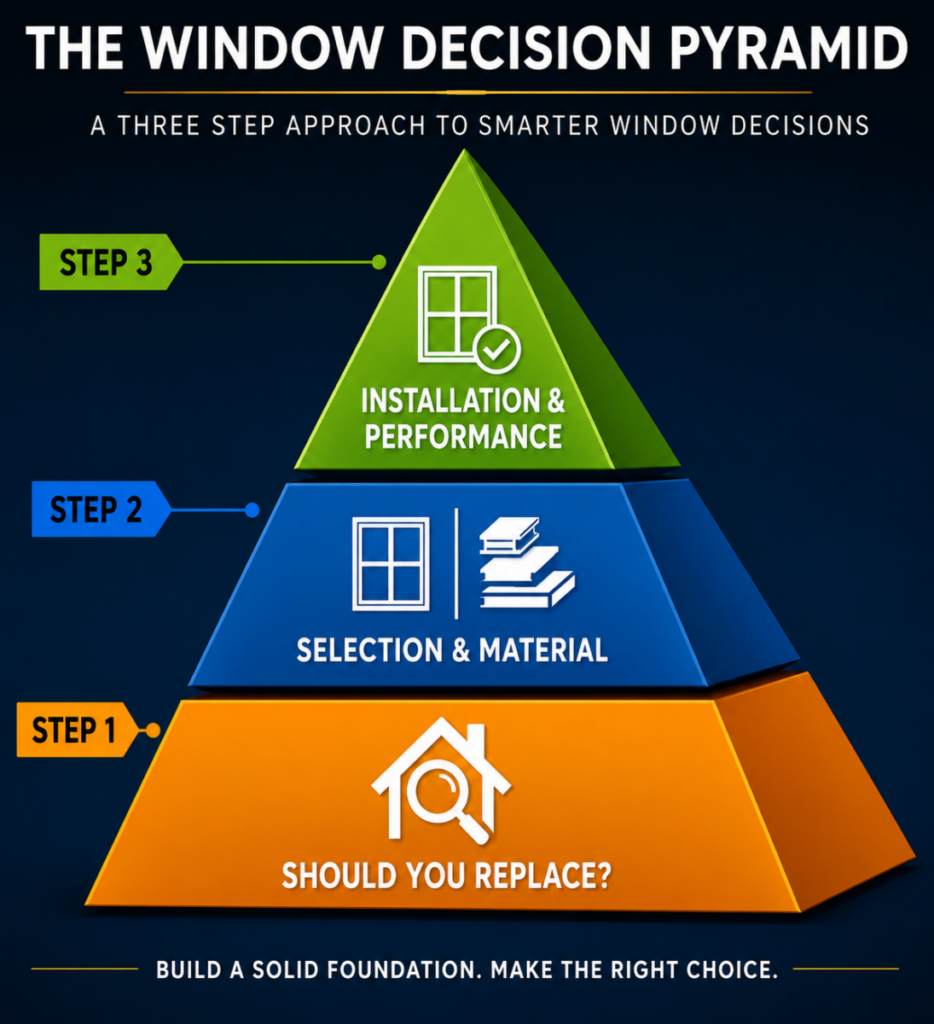
So instead of trying to figure everything out at once, the better approach is to break this into three clear steps.
Each step builds on the one before it.
STEP 1: Should You Replace Your Windows at All?
This sounds obvious—but it’s often skipped.
Many homeowners move straight to:
“Which windows should I buy?”
Without first asking:
“Do I actually need to replace them right now?”
When Replacement Clearly Makes Sense
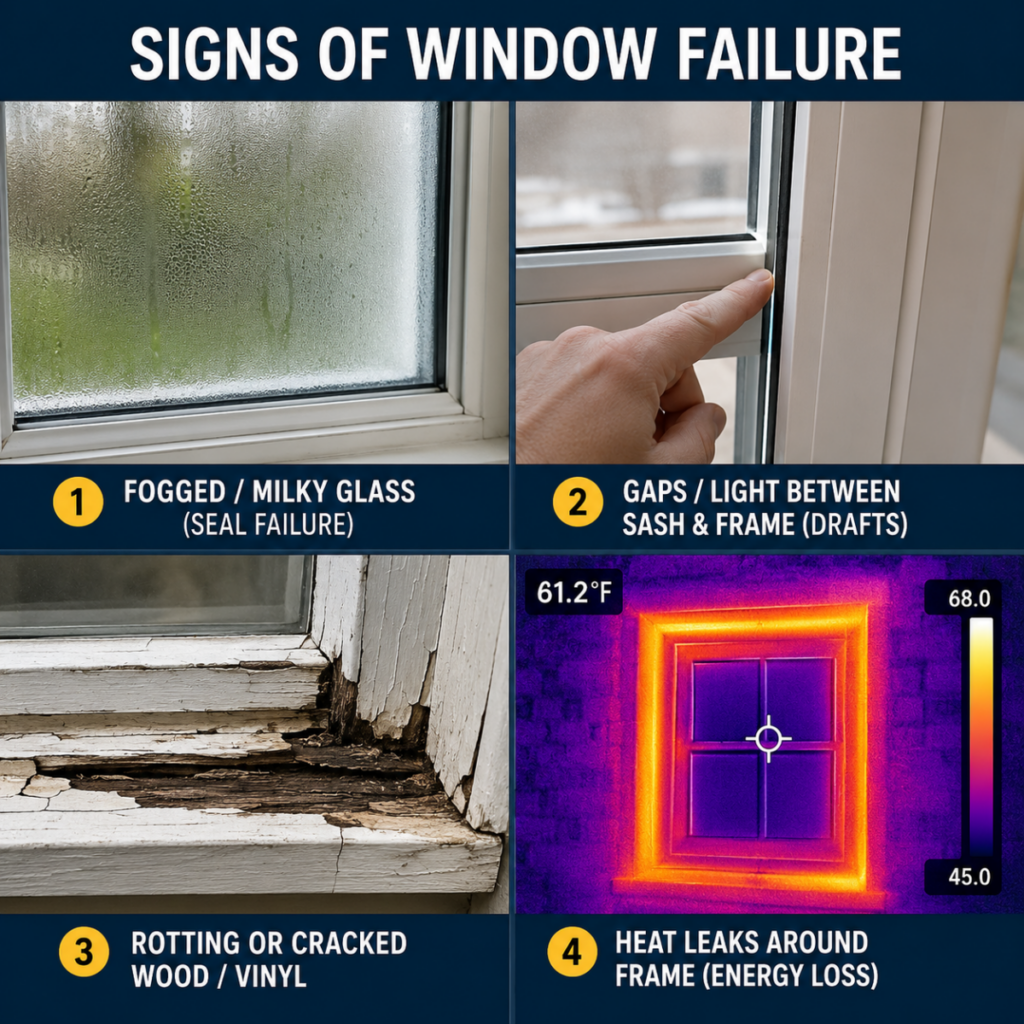
Replacement is usually justified when you’re experiencing:
- Operational issues
(windows stick, don’t open, or won’t stay up) - Air leakage or drafts
(you feel temperature differences near the window) - Visible deterioration
(warping, cracking, failing seals, fogging glass) - Comfort problems
(rooms are consistently hotter or colder) - Noise concerns
(outside sound is a problem) - Water leaks
(water coming inside the window)
- Dust issues
(lots of dust in and around the window and window sill)
In these cases, the window system is no longer performing the way it should.
When Replacement Might NOT Be Necessary
This is where many homeowners go wrong.
Replacement may not make sense if:
- You’re expecting large energy savings alone to justify the cost
- The windows are still structurally sound and functional
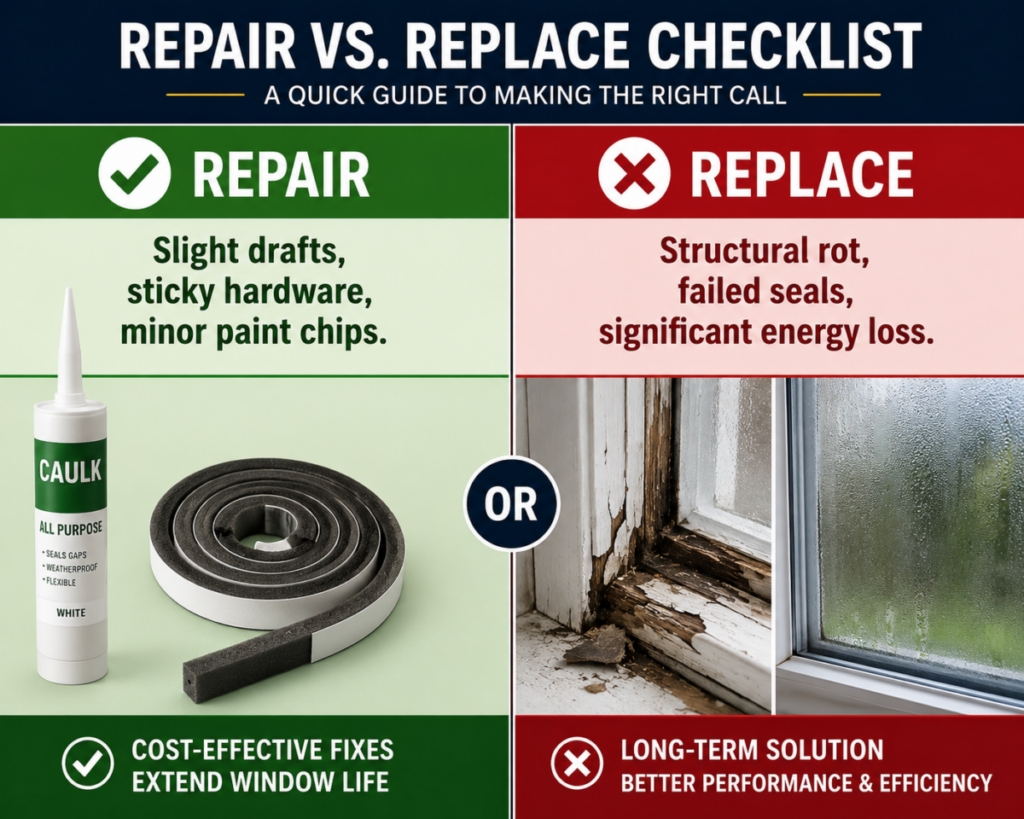
- The issue could be addressed with repair, sealing, or maintenance
The Key Insight
Not every problem requires full replacement.
Sometimes the better decision is:
- Repair
- Adjust
- Improve sealing
This is especially important if:
- You’re planning to move
- Budget is limited
- The current windows still have life left
A Better Way to Think About Step 1
Instead of asking:
“Should I replace my windows?”
Ask:
“Are my current windows failing—or just not perfect?”
That distinction matters.
STEP 2: What Type of Window Fits Your Home (Not Just What Sounds Good)
Once you’ve decided replacement makes sense, the next step is where most of the real mistakes happen.
This is where homeowners start looking at:
- Brands
- Features
- Pricing
But without a clear framework, those comparisons don’t mean much.
What Actually Determines the Right Window
The “right” window is not universal.
It depends on how it will perform in your specific situation.
That includes:
1. Climate (This Is the Starting Point)
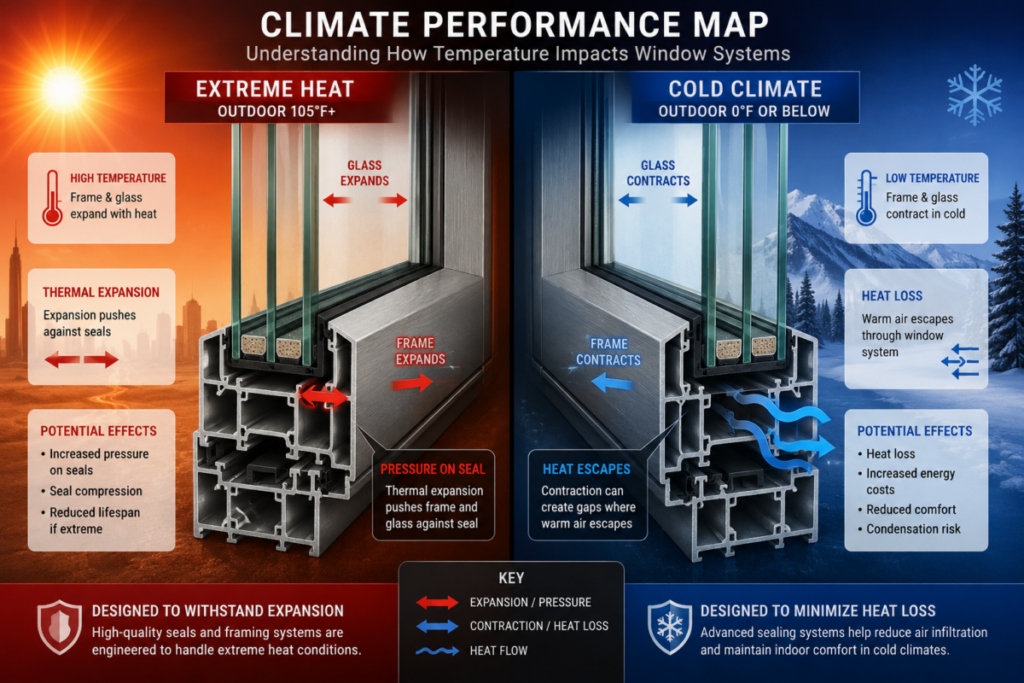
Your climate determines:
- How materials behave
- How much thermal expansion occurs
- How much stress is placed on seals and components
In hotter climates:
- Heat exposure is constant
- Expansion cycles are more aggressive
- Material stability becomes more important
2. Sun Exposure
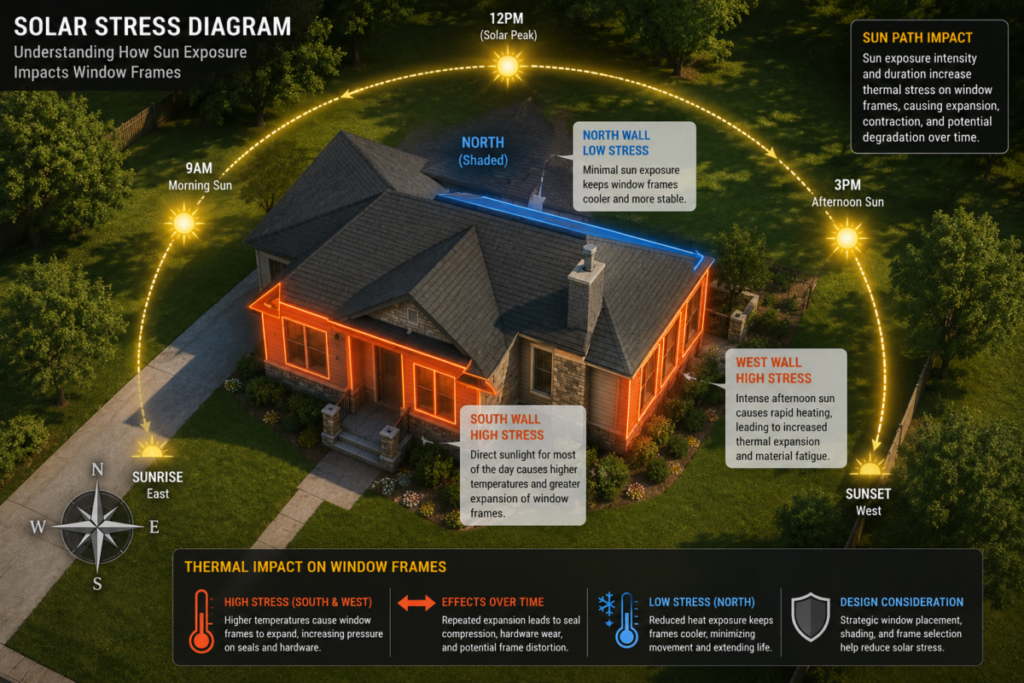
Not all windows on your home experience the same conditions.
For example:
- South- and west-facing windows may receive intense, prolonged sunlight
- North-facing windows may experience much less stress
That means:
The same material may perform differently depending on location on the house
3. Home Construction
The type of home matters more than most people realize.
For example:
- Stucco homes require proper exterior tie-in during installation
- Older homes may have framing or sealing issues that need to be addressed
- Some homes are better suited for full frame replacement than insert
4. Budget and Time Horizon
This is where practical decisions come in.
Ask yourself:
- How long do I plan to stay in this home?
- What type of resale value will the newwindows add?
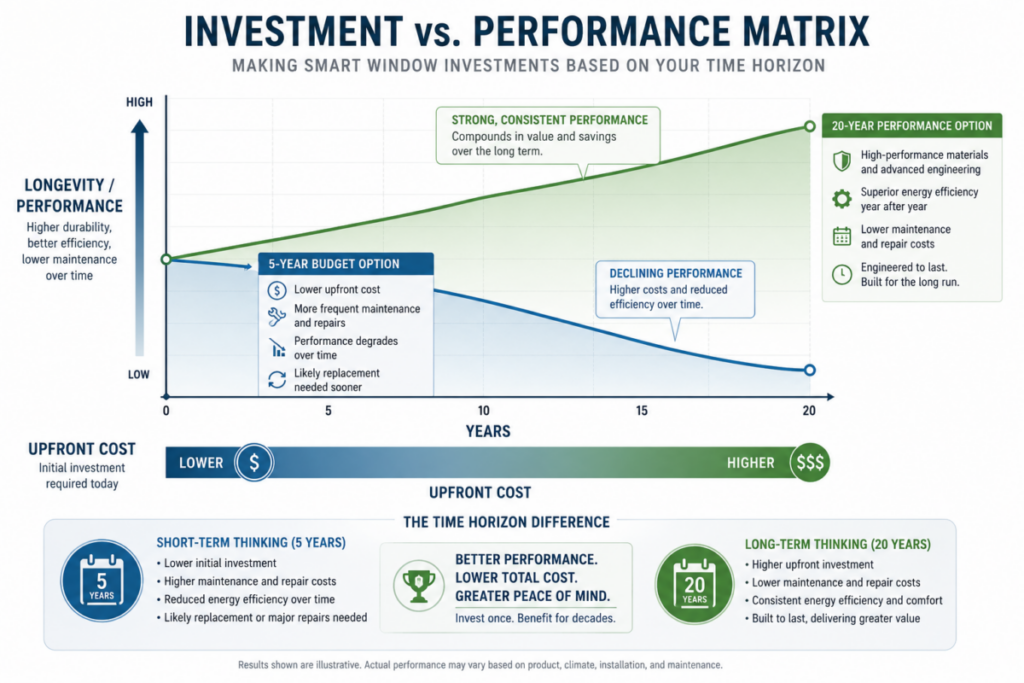
- Am I optimizing for long-term performance or short-term cost?
A homeowner planning to stay 15–20 years will make a different decision than someone planning to move in 3–5 years.
The Key Insight
The best window is not the most expensive one—it’s the one that fits your environment and your goals.
Step 3: What Level of Product Actually Makes Sense for You
This is where everything comes together.
By now, you understand:
- Materials behave differently
- Installation matters
- Performance depends on environment
Now the question becomes:
How much window do you actually need?
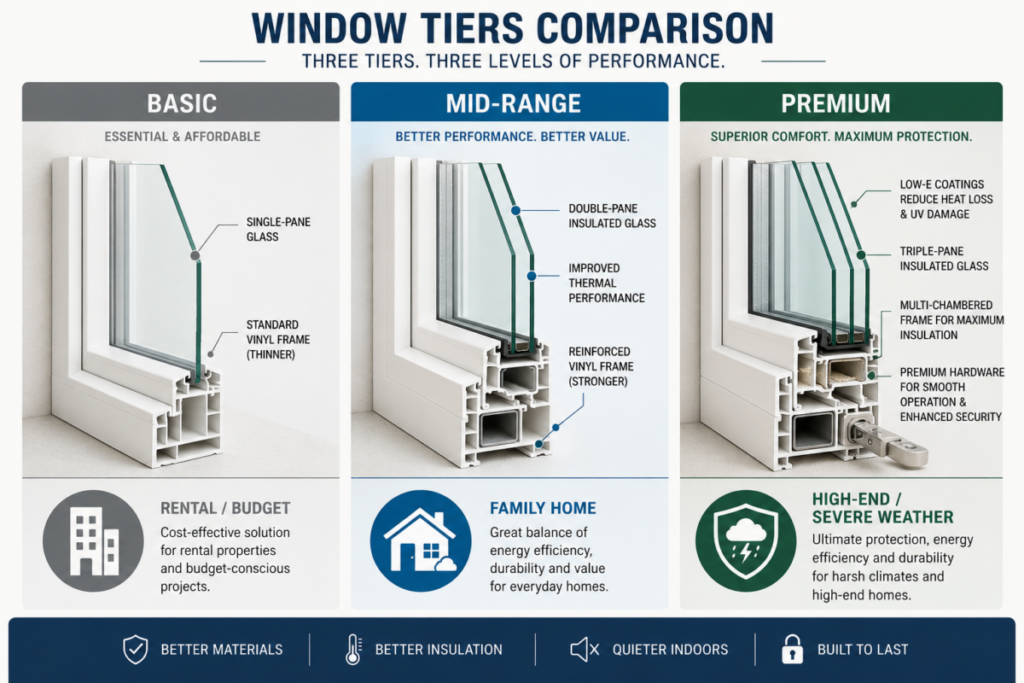
| Tier | Description | Best For |
| Basic | Lower cost, shorter lifespan | Rentals, short-term ownership |
| Mid-Range | Balanced performance and cost | Most homeowners |
| Premium | Higher durability and performance | Long-term ownership, harsh climates |
Important:
Premium is not always necessary—but in certain environments, it may be justified.
Understanding the Three General Levels
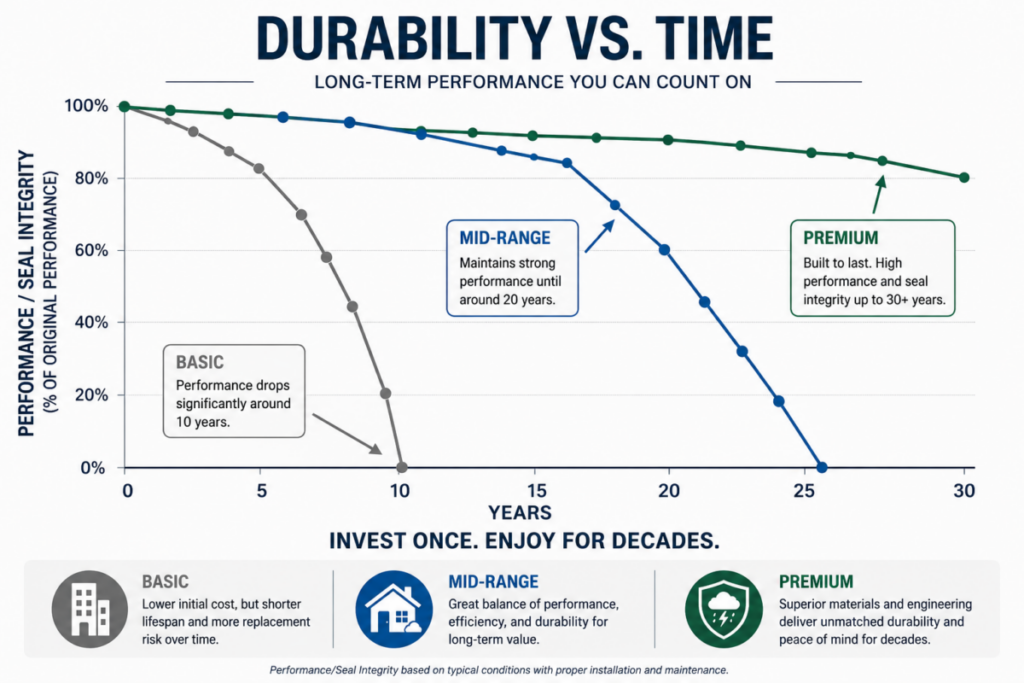
Most window options fall into three broad categories:
Basic
- Lower upfront cost
- Simpler construction
- Shorter expected lifespan
Best for:
- Rental properties
- Short-term ownership
- Tight budgets
Mid-Range
- Balanced cost and performance
- Better materials and construction
- More consistent long-term behavior
Best for:
- Most homeowners
- Moderate-term ownership
Premium
- Higher-end materials
- More stable construction
- Better long-term durability
Best for:
- Long-term ownership
- Harsh climates
- Homeowners prioritizing performance and longevity
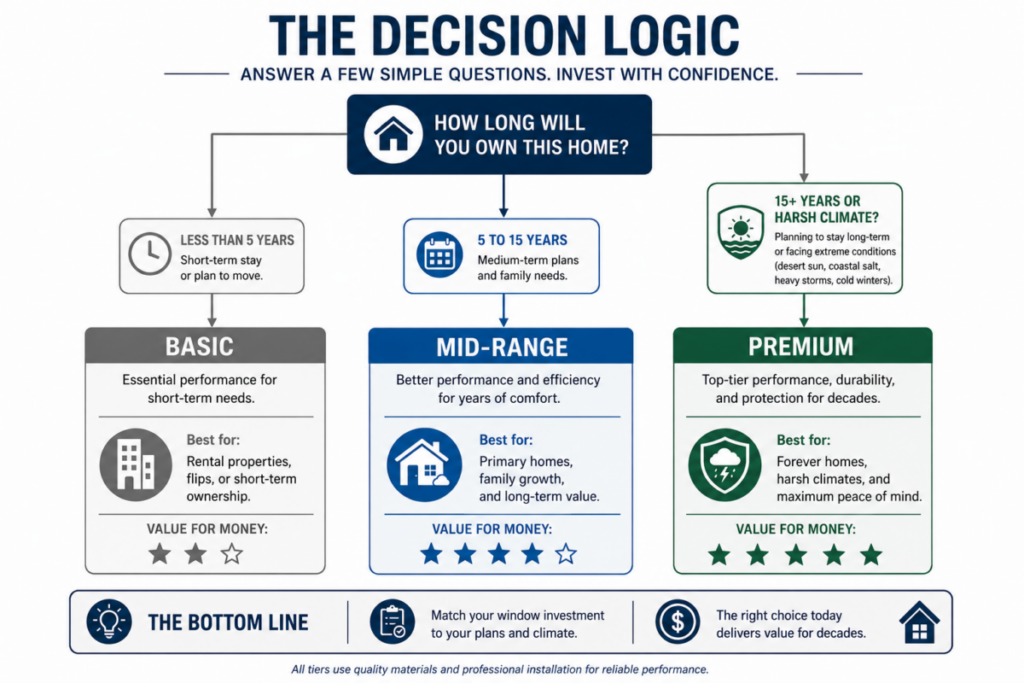
When Premium Makes Sense
Premium options are often justified when:
- You plan to stay in the home long-term
- The environment puts stress on materials (heat, sun, expansion)
- You want consistency over 10–20+ years
When Premium Does NOT Make Sense
This is important—and often not discussed.
Premium may not be necessary when:
- You’re moving in a few years
- The home value doesn’t support the investment
- The performance difference won’t significantly impact your situation
The Key Insight
Spending more only makes sense if the additional performance benefits actually matter in your situation.
Putting It All Together
At this point, your decision should feel more structured.
Instead of guessing, you should be able to answer:
- Do I actually need replacement?
- What type of window fits my environment?
- What level of product aligns with my goals?
Once you have those answers:
- Comparing quotes becomes much easier
- Sales pressure becomes easier to ignore
- The decision becomes clearer
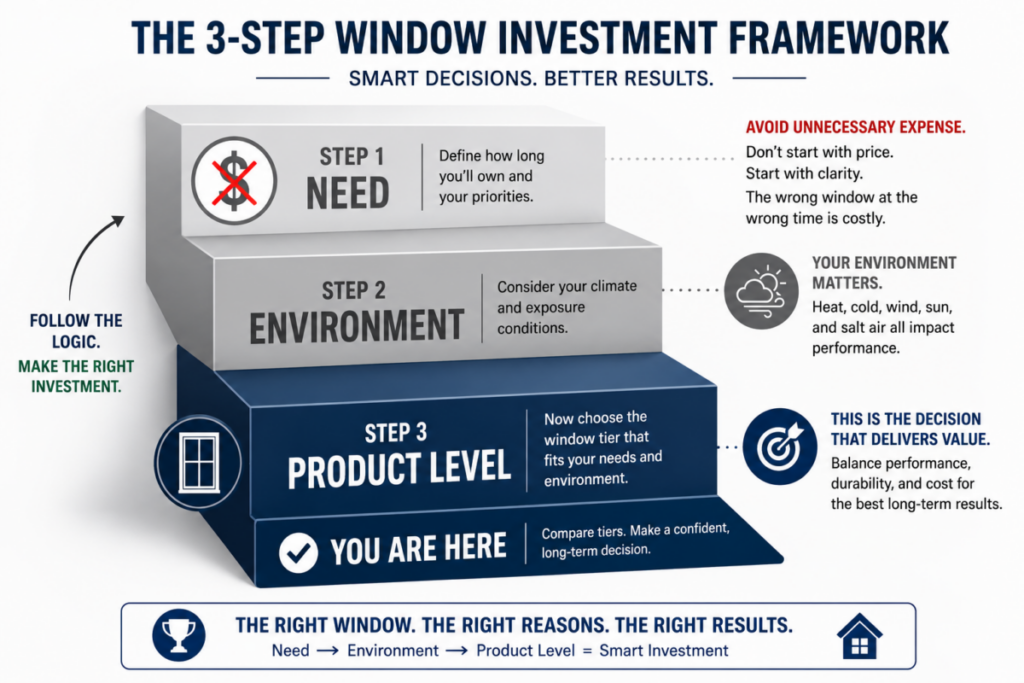
The 3-Step Window Decision Framework
| Step | Question to Answer | Why It Matters |
| Step 1 | Do I need to replace my windows? | Avoid unnecessary expense |
| Step 2 | What fits my home and environment? | Ensures proper long-term performance |
| Step 3 | What level of product makes sense? | Aligns cost with value and goals |
Important: – Most mistakes happen when homeowners skip Step 1 and jump straight to comparing products and prices.
SECTION 5 — PRICING REALITY: WHY WINDOW QUOTES ARE SO CONFUSING
By the time most homeowners get to pricing, they’re already overwhelmed.
They’ve:
- Heard different presentations
- Seen different products
- Been told different things
And now they’re looking at quotes that don’t seem to line up.
One is $12,000.
Another is $18,000.
Another is over $20,000.
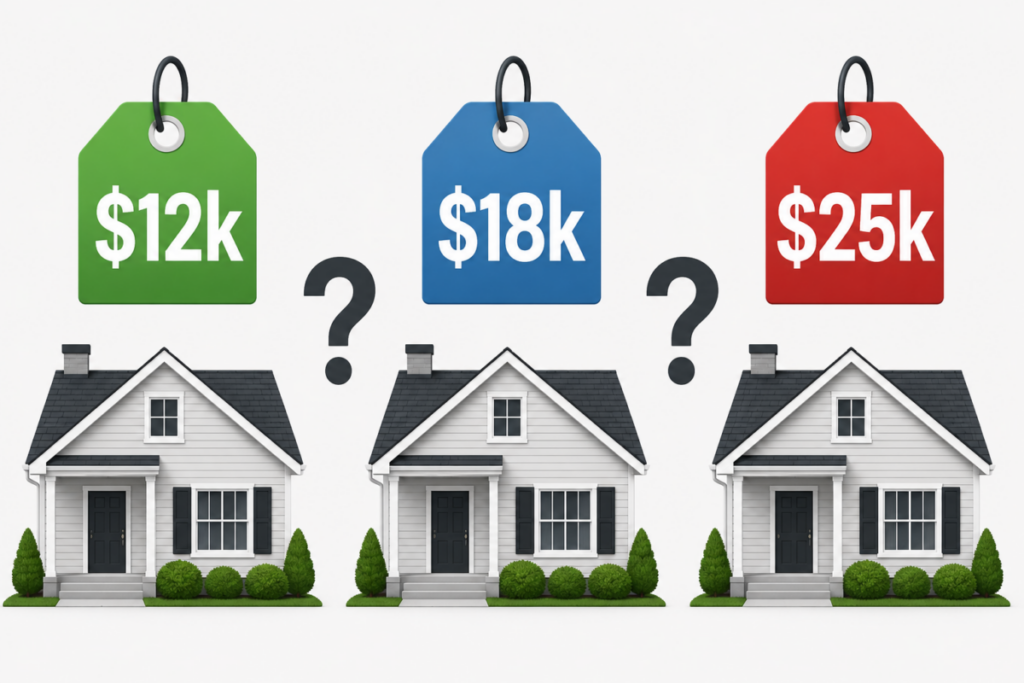
And the natural reaction is:
“Why is there such a big difference?”
That’s the right question.
But most homeowners never get a clear answer.
Why Pricing Feels Confusing
On the surface, all the quotes sound similar:
- “Energy-efficient windows”
- “Professional installation”
- “High-quality materials”
But those phrases don’t define the project.
They summarize it.
And that’s where confusion begins.
Because two quotes can use the same language—and still represent completely different work.
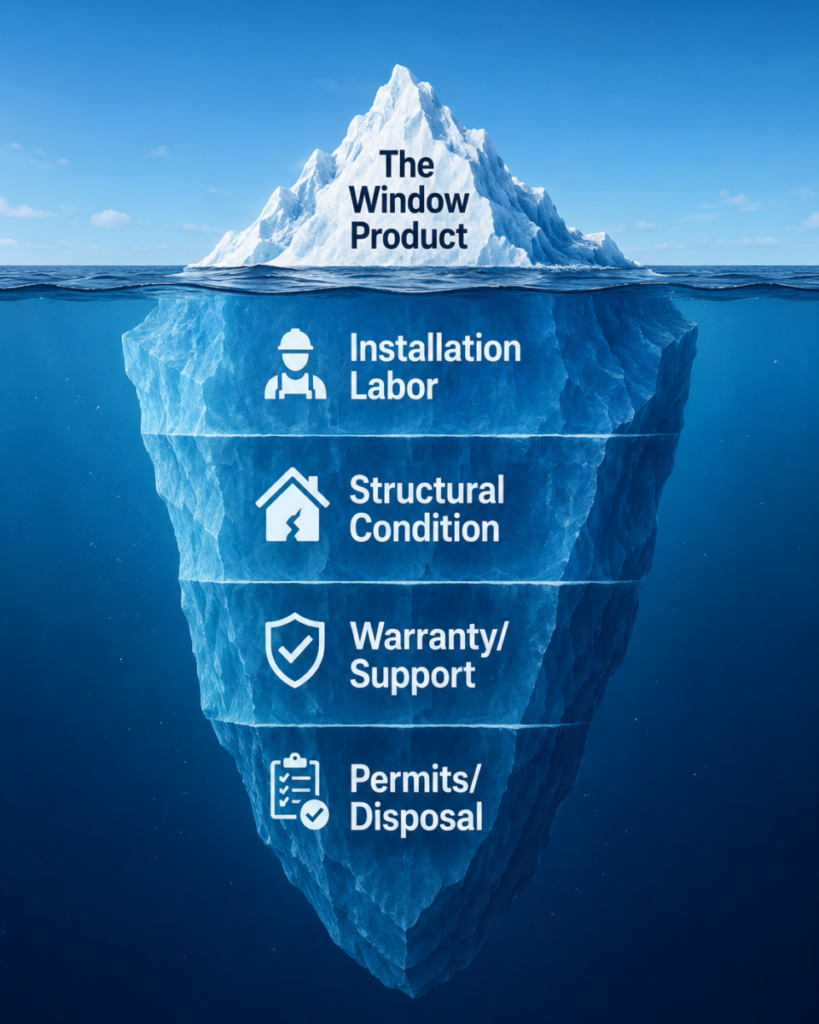
What a Window Price Actually Includes
When you get a quote, you’re not just paying for a window.
You’re paying for a combination of:
- The product itself (frame, glass, hardware)
- The installation method
- The labor required
- The condition of the opening
- Any exterior or interior finishing work
And each of those can vary significantly.
Typical Installed Cost (Reality, Not Marketing)
While pricing varies by region and home, most projects fall into general ranges:
Per Window Installed
| Level | Typical Range |
| Entry-Level | $700 – $1,000 |
| Mid-Range | $1,000 – $1,800 |
| Premium | $1,800 – $3,000+ |
Full Project Example
| Number of Windows | Approximate Range |
| 10 windows | $10,000 – $25,000+ |
| 15 windows | $15,000 – $35,000+ |
These are not exact numbers—but they give you a realistic frame of reference.
What Actually Drives the Cost
This is where clarity starts to come in.
Price differences are not random—they are driven by specific factors.
1. WINDOW SIZE
Larger windows:
- Require more material
- Are heavier
- Take more labor to install
This increases both product and labor cost.
2. FRAME MATERIAL
As we covered earlier:
- Vinyl ? typically lower cost
- Fiberglass / composite ? higher cost
- Aluminum ? varies by application
Material affects:
- Durability
- Stability
- Long-term performance
3. GLASS PACKAGE
This includes:
- Number of panes
- Gas fill (argon)
- Glass thickness
- Spacer system
Higher-performance glass systems:
- Cost more
- Perform more consistently over time
4. INSTALLATION METHOD (Major Cost Driver)
This is one of the biggest differences between quotes.
Insert Installation
- Faster
- Less labor
- Lower cost
Full Frame Replacement
- More labor-intensive
- Includes removal and rebuild of opening
- Higher cost
This alone can create thousands of dollars difference in a project.
5. LABOR COMPLEXITY
Every home is different.
Factors include:
- Accessibility
- Wall construction
- Condition of existing frames
- Need for repairs
More complexity = more labor = higher cost
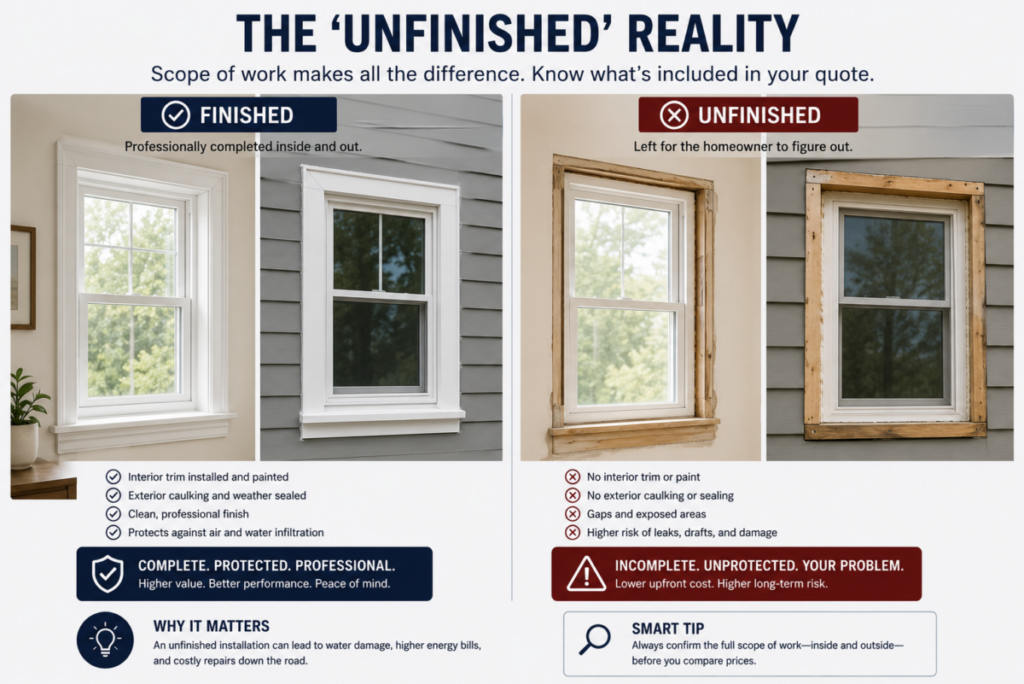
6. EXTERIOR AND INTERIOR WORK
This is often overlooked.
Some projects include:
- Stucco repair or tie-in
- Trim work
- Painting or finishing
Others do not.
That difference alone can significantly impact price.
Why Quotes Vary So Much (The Real Reason)
At this point, you can start to see the pattern.
Quotes vary because they are often:
- Different products
- Different installation methods
- Different scopes of work
What Most Homeowners Do (And Why It Backfires)
Most people look at the bottom line and think:
“This one is cheaper, so it’s the better deal.”
But if the cheaper quote includes:
- Less work
- Different materials
- A simpler installation
Then it’s not the same project.
This Is the Core Problem
You cannot compare price until you understand what’s included.
Without that, the comparison isn’t real.
It’s just a guess.
A Simple Example
Here’s how two quotes can look similar—but aren’t:
Quote Comparison Example
| Category | Company A | Company B |
| Installation Type | Insert | Full Frame |
| Frame Material | Vinyl | Fiberglass |
| Glass Package | Standard | Upgraded (thicker glass) |
| Exterior Work | Minimal | Full stucco tie-in |
| Total Price | $14,000 | $19,500 |
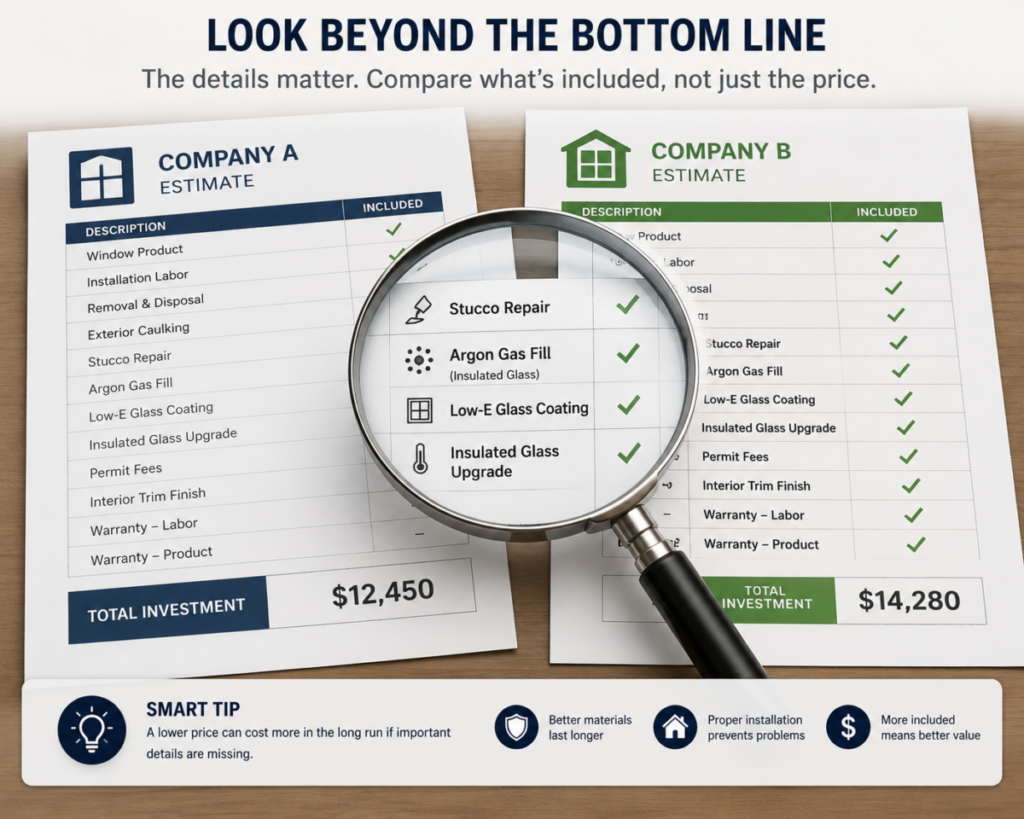
At first glance:
- Company A looks like the better deal
But in reality:
- Company B is offering a completely different level of work and quality
The Right Way to Look at Price
Instead of asking:
“Which one is cheaper?”
Ask:
“What am I getting for this price—and how will it perform over time?”
The Bottom Line
Window pricing feels confusing because:
- The details are often simplified
- The scope is not always clearly explained
- And the differences are not obvious at first glance
But once you understand:
- What drives cost
- What’s included
- And how installation affects everything
The numbers start to make sense
What You’re Really Paying For
| Category | What It Impacts |
| Frame Material | Durability and stability |
| Glass Package | Comfort and efficiency |
| Installation Type | Longevity and performance |
| Labor | Quality and execution |
| Scope of Work | What is actually completed |
- Important: – The lowest price is often tied to the simplest scope of work—not the best long-term outcome.
- “I’ve seen homeowners focus on price first, only to realize later they weren’t comparing the same project.”

SECTION 6 — THE INSTALLATION TRAP: WHERE GOOD WINDOWS GO BAD
Most homeowners believe the quality of the window determines the outcome of the project.
It doesn’t.
The outcome is determined by something much less visible—and much more important:
How the window is installed into the home.
Why Installation Matters As Much As the Window
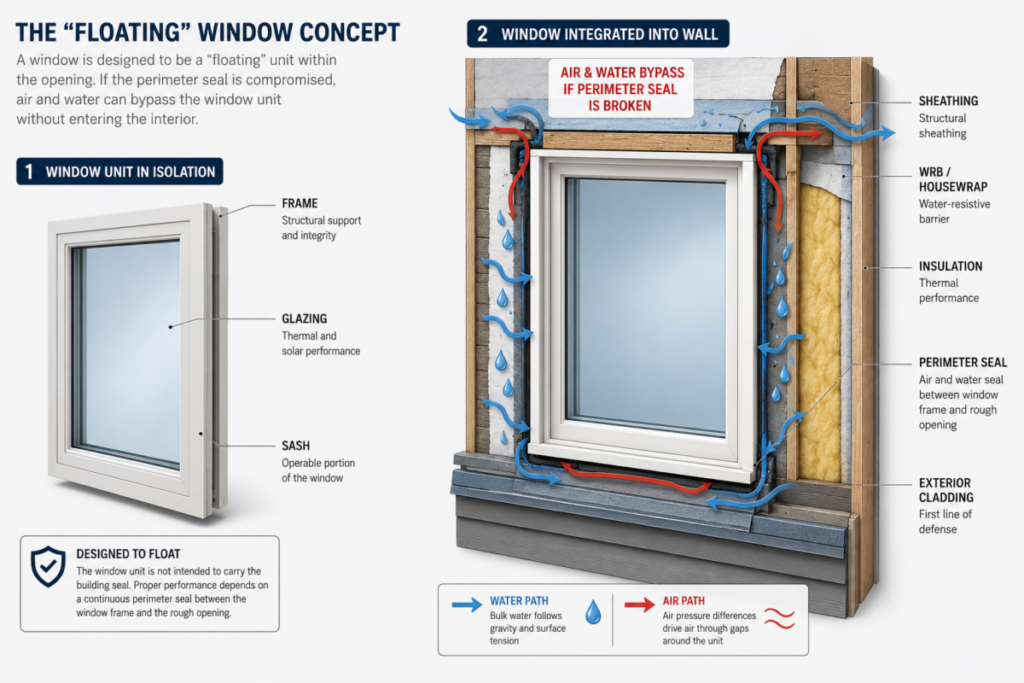
It’s easy to focus on the product.
You can see it.
You can touch it.
You can compare brands, materials, and features.
But once the window is installed, what actually determines performance is:
- How well it is sealed
- How it connects to the structure of the home
- How water is managed around it
- How air movement is controlled
A Hard Truth Most Homeowners Don’t Hear
You can take a high-end, well-built window…
…and if it’s installed poorly, it can:
- Leak air
- Allow water intrusion
- Fail earlier than expected
- Cause damage to surrounding materials
On the other hand:
You can take a mid-range window…
…and if it’s installed correctly, it can:
- Perform consistently
- Last longer
- Maintain comfort and efficiency
The Key Insight
The window is only as good as the installation it’s placed into.
What You’re Actually Installing Into
This is where most homeowners don’t have a clear picture.
When a window is removed, what’s left behind is the opening in the wall.
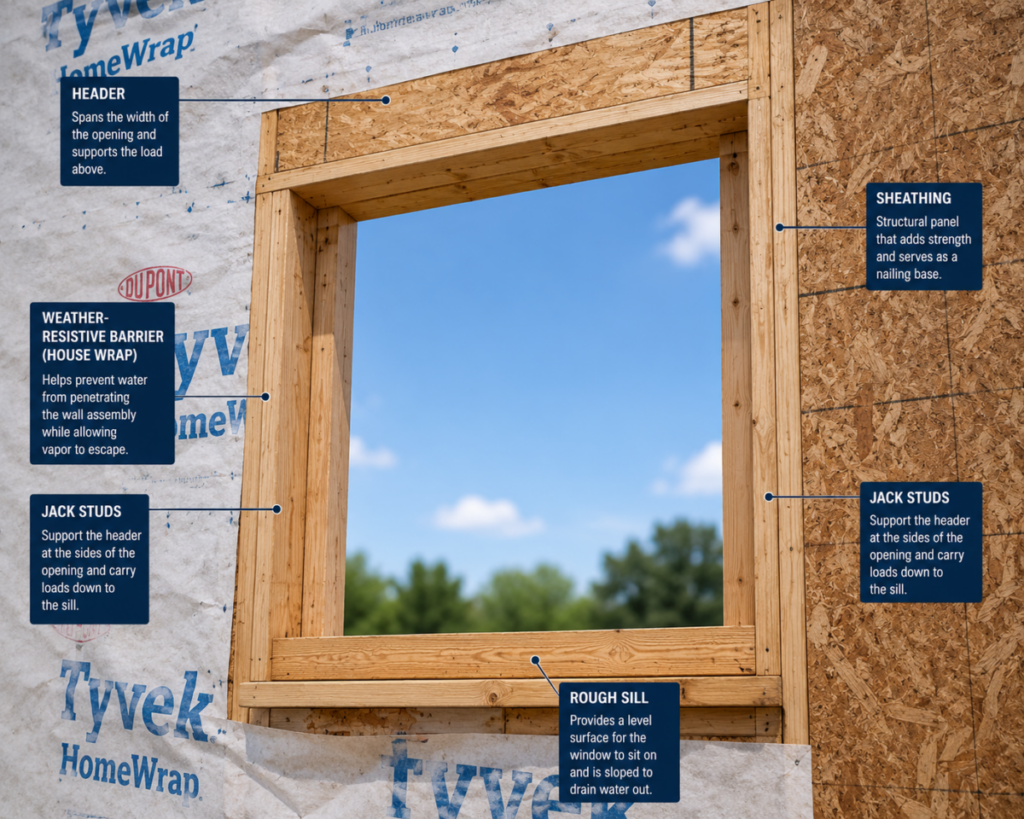
That opening includes:
- Framing (wood structure)
- Sheathing
- Weather barriers (if present)
- Exterior finish (stucco, siding, etc.)
This opening has been exposed to:
- Years of heat
- Possible moisture
- Structural movement
And it may not be perfect.
Why This Matters
If the new window is installed into:
- A compromised frame
- An uneven opening
- Or an improperly sealed surface
Then the problems don’t go away.
They get covered up.
What Proper Installation Actually Includes
A proper installation is not just placing a window into a hole.
It’s a process of rebuilding and sealing the opening correctly.
1. Correct Removal of Existing Materials
This means:
- Removing what needs to be removed
- Inspecting the opening
- Identifying any damage or issues
In a full frame replacement, this includes:
- Removing the entire existing window and frame
2. Preparing the Opening
Before the new window goes in:
- The opening should be clean and structurally sound
- Any issues should be addressed—not ignored
- The surface should be ready to accept proper sealing
3. Sealing and Insulation
This is where performance is built.
Proper installation includes:
- Sealing gaps to prevent air infiltration
- Insulating around the frame
- Creating a tight, consistent barrier
This is what prevents:
- Drafts
- Energy loss
- Dust infiltration
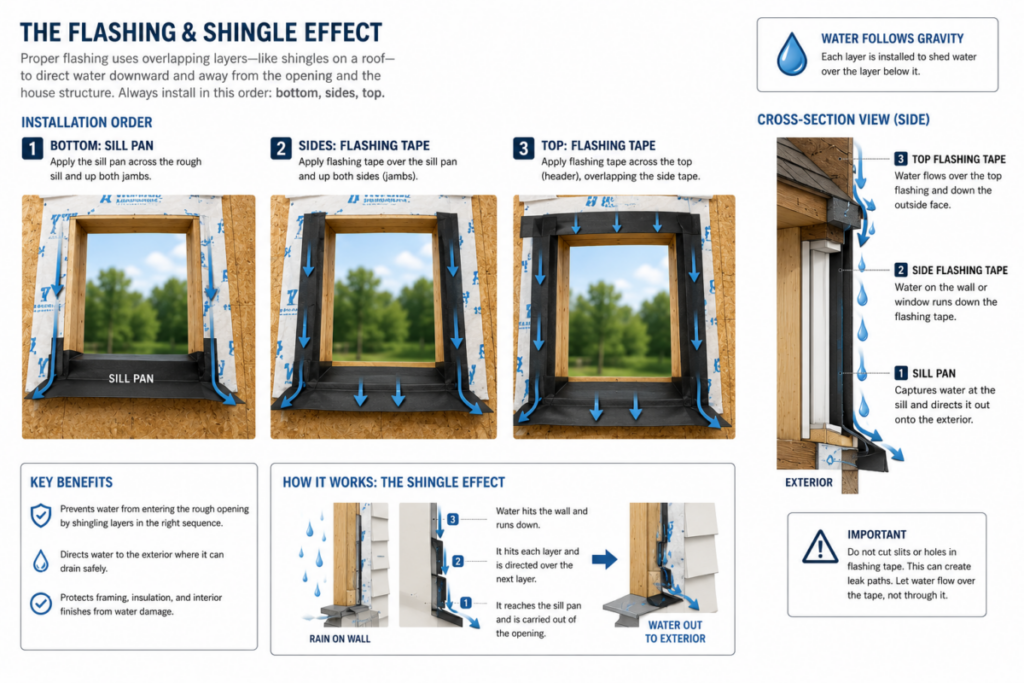
4. Water Barrier and Flashing (Critical)
This is one of the most important—and most overlooked—parts of the process.
A proper installation includes:
- Flashing materials that direct water away from the opening
- A water-resistant barrier integrated into the structure
Because no matter how good the window is:
? Water will always try to find a way in
The goal is not to “stop” water.
The goal is to control and redirect it safely.
5. Exterior Integration (Stucco, Trim, Finishing)
This is where the window meets the outside of the home.
A proper installation ensures:
- The exterior finish is tied back into the window correctly
- There are no exposed gaps or weak points
- The transition between window and wall is sealed and protected
In stucco homes especially:
- This step can make a major difference in long-term durability
What Poor Installation Looks Like
Poor installation doesn’t always look bad at first.
In fact, it often looks clean and finished.
But underneath, problems are being hidden—not solved.
Common Signs of Poor Installation
- Excessive reliance on caulking
(caulking used as the primary seal instead of proper barriers) - No visible flashing or water management system
- Gaps covered instead of corrected
- Minimal exterior work
(no real integration with stucco or siding) - Rushed installation process
Why Caulking Alone Is Not Enough
Caulking:
- Dries out
- Cracks over time
- Is not a permanent solution
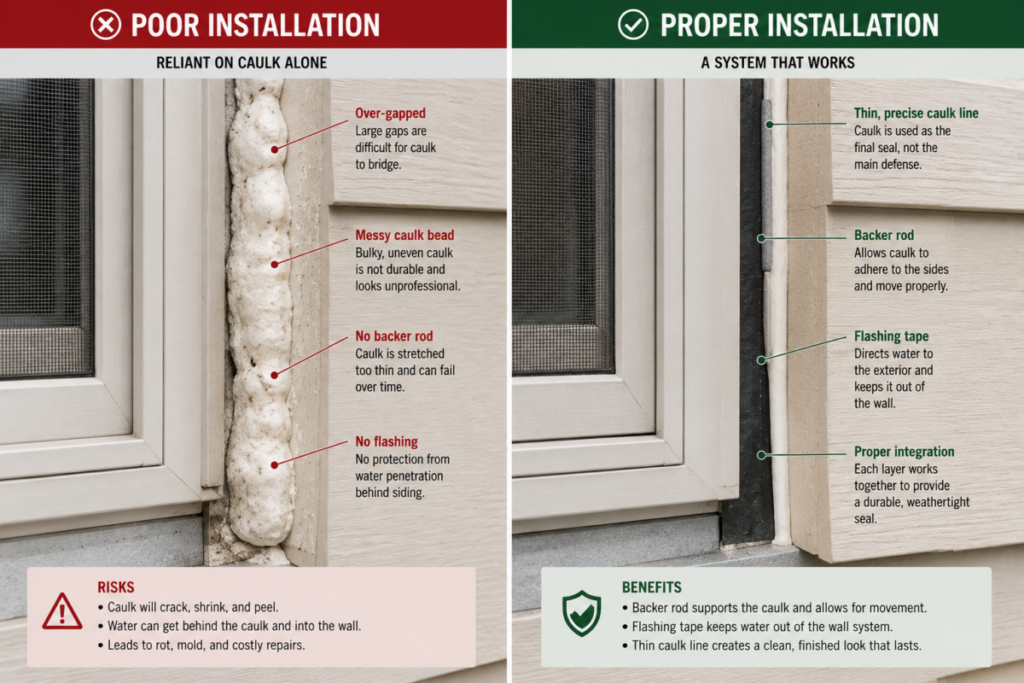
If caulking is doing all the work, the system is already compromised.
What Happens Over Time with Poor Installation
This is where issues begin to show up.
Not immediately—but gradually.
Early Signs
- Slight drafts
- Minor temperature differences
- Subtle air movement
Mid-Term Signs
- Increased energy loss
- More noticeable drafts
- Dust entering around the window
Long-Term Risks
- Moisture intrusion
- Damage to framing or surrounding materials
- Reduced lifespan of the window
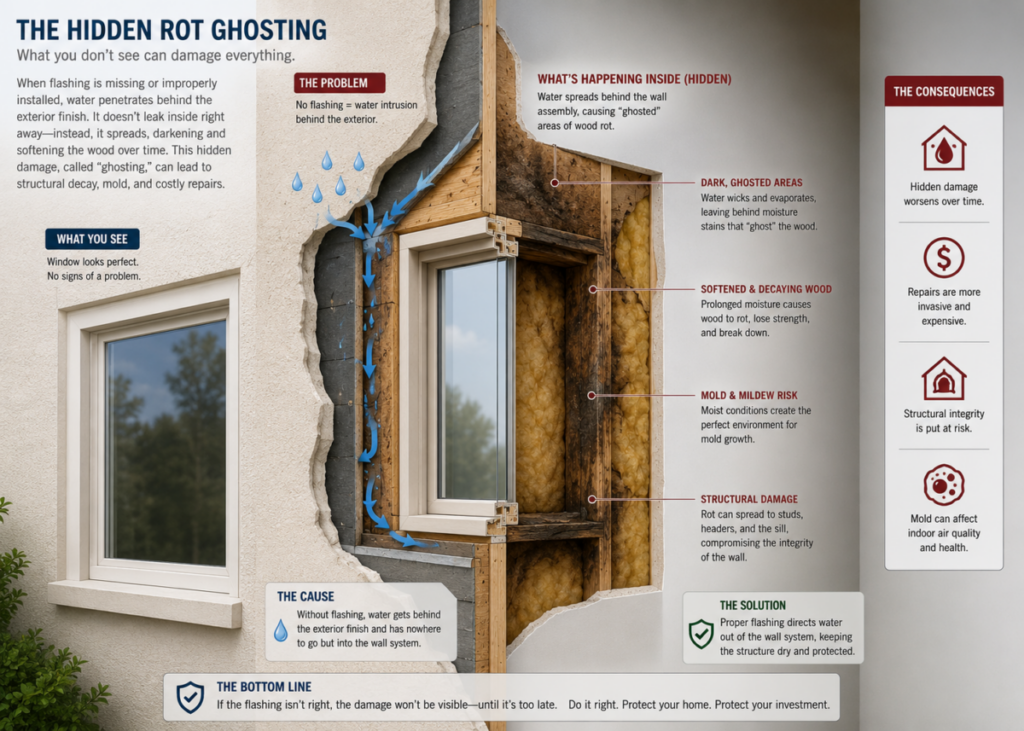
Why Homeowners Miss This
Because most of the work:
- Happens behind the scenes
- Is covered up once complete
- Is difficult to evaluate after installation
So the homeowner is left judging based on:
- Appearance
- Cleanliness
- First impressions
Not long-term performance.
The Better Way to Think About Installation
Instead of asking:
“Does this look good when it’s done?”
Ask:
“What was done before it was covered up?”
That’s where the real quality is.
Questions You Should Be Asking
Before agreeing to any project, you should be able to get clear answers to:
- What type of installation is being done (insert or full frame)?
- What happens to the existing frame?
- How is the opening sealed?
- What water barrier or flashing is being used?
- How is the exterior tied back into the home?
If those answers are vague, that’s a problem.
The Bottom Line
Most homeowners focus on:
- Window brand
- Glass package
- Price
But the biggest factor in long-term success is:
How the window is installed into the home
Get that part right, and the window has a chance to perform well.
Get it wrong, and even a great window won’t save you.
Proper vs Poor Installation
| Category | Proper Installation | Poor Installation |
| Sealing | Multi-layer sealing system | Caulking only |
| Water Protection | Flashing + barrier integration | Little or none |
| Frame Prep | Cleaned and corrected opening | Existing issues left in place |
| Exterior Finish | Fully integrated | Minimal or cosmetic only |
| Long-Term Outcome | Stable, consistent performance | Gradual failure over time |
- Important: You won’t see most installation mistakes when the job is finished—but you will feel them later.
- “In many homes, especially stucco construction, how the exterior is tied back into the window during installation can make the difference between long-term performance and hidden problems.”
SECTION 7 — WARRANTIES: WHAT HOMEOWNERS THINK THEY HAVE VS WHAT THEY ACTUALLY HAVE
This is one of the most misunderstood parts of the entire window replacement process.
Most homeowners hear:
“It has a lifetime warranty.”
…and immediately feel reassured.
It sounds safe.
It sounds comprehensive.
It sounds like they’re protected.
But what most people don’t realize is this:
A window project usually involves TWO completely different warranties
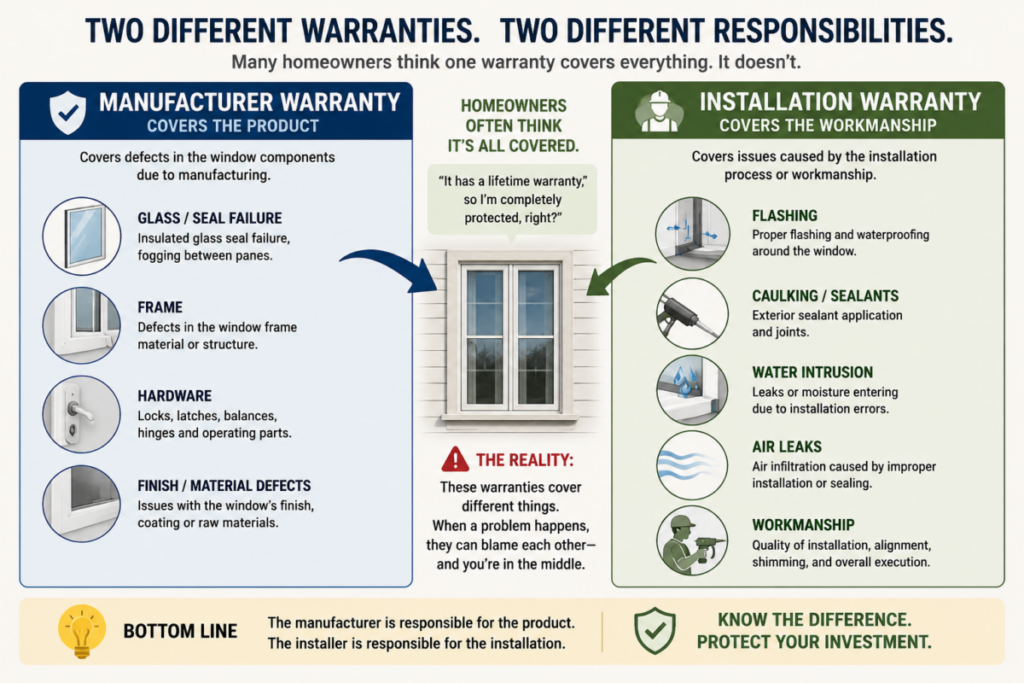
And they are not the same thing.
THE TWO WARRANTIES YOU MUST UNDERSTAND
When you replace your windows, you are typically dealing with:
- The Manufacturer Warranty (Product only)
- The Installation / Labor Warranty
WHY THIS MATTERS
This is critical because:
A manufacturer may cover the product…
…but NOT:
- Installation problems
- Water intrusion
- Air leaks
- Damage caused by improper installation
And the installer may:
- Cover labor for a short period
- Or disappear entirely even months later
PART 1 — THE MANUFACTURER WARRANTY
This covers:
- The window product itself
- Materials
- Glass unit failure
- Hardware
- Certain defects
WHAT HOMEOWNERS THINK THIS MEANS
Most people hear:
“Limited Lifetime Warranty”
…and think:
“Everything is covered forever.”
That is usually NOT what it means.
WHAT “LIMITED LIFETIME WARRANTY” ACTUALLY MEANS
This is one of the most important phrases to understand.
“Lifetime” Usually Does NOT Mean:
- Forever
- Unlimited coverage
- Full replacement no matter what happens
It Usually Means Something Closer To:
- Coverage for the original purchaser
- Coverage under certain conditions
- Coverage that decreases over time
- Coverage with exclusions and limitations
THE WORD THAT MATTERS MOST ISN’T “LIFETIME”
It’s LIMITED
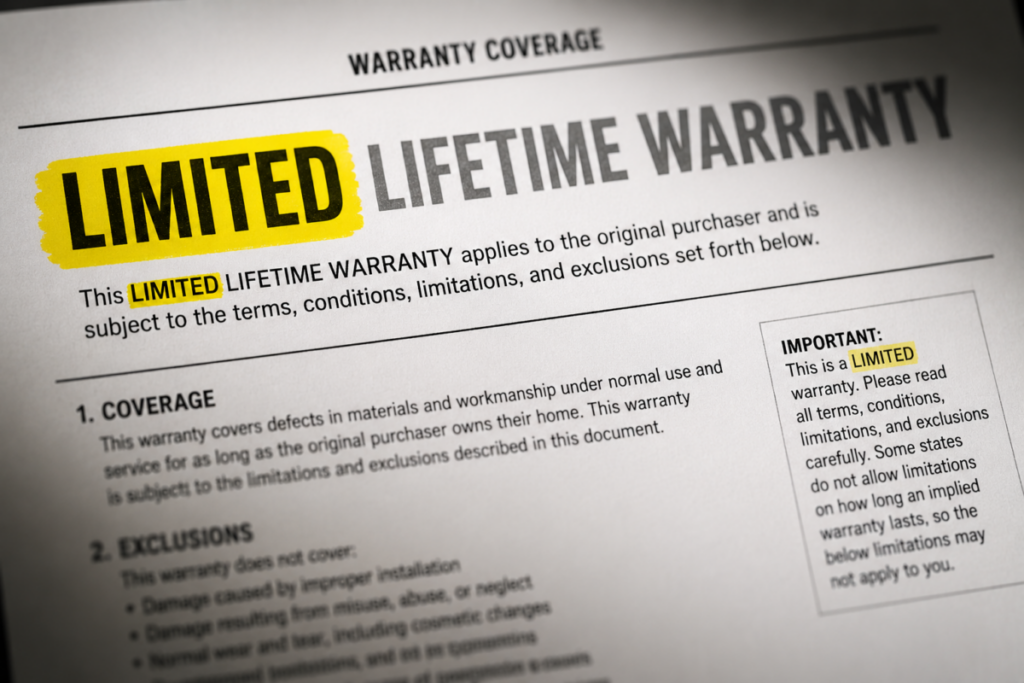
That single word is where:
- Restrictions
- Conditions
- Exclusions
usually live.
WHAT MANUFACTURER WARRANTIES TYPICALLY COVER
Common Coverage Areas
| Covered Item | Typical Coverage |
|---|---|
| Seal failure / fogging | Yes |
| Hardware defects | Often |
| Frame defects | Often |
| Glass breakage | Sometimes |
| Finish defects | Limited |
WHAT WARRANTIES OFTEN DO NOT COVER
This is where homeowners get surprised.
Common Exclusions
| Common Exclusion | Why It Matters |
|---|---|
| Improper installation | Very common denial reason |
| Extreme climate exposure | Especially in desert regions |
| Caulking failure | Often excluded |
| Normal wear and tear | Broad interpretation |
| Acts of nature | Storms, settling, etc. |
| Color fading | Often prorated or excluded |
| Condensation | Frequently excluded |
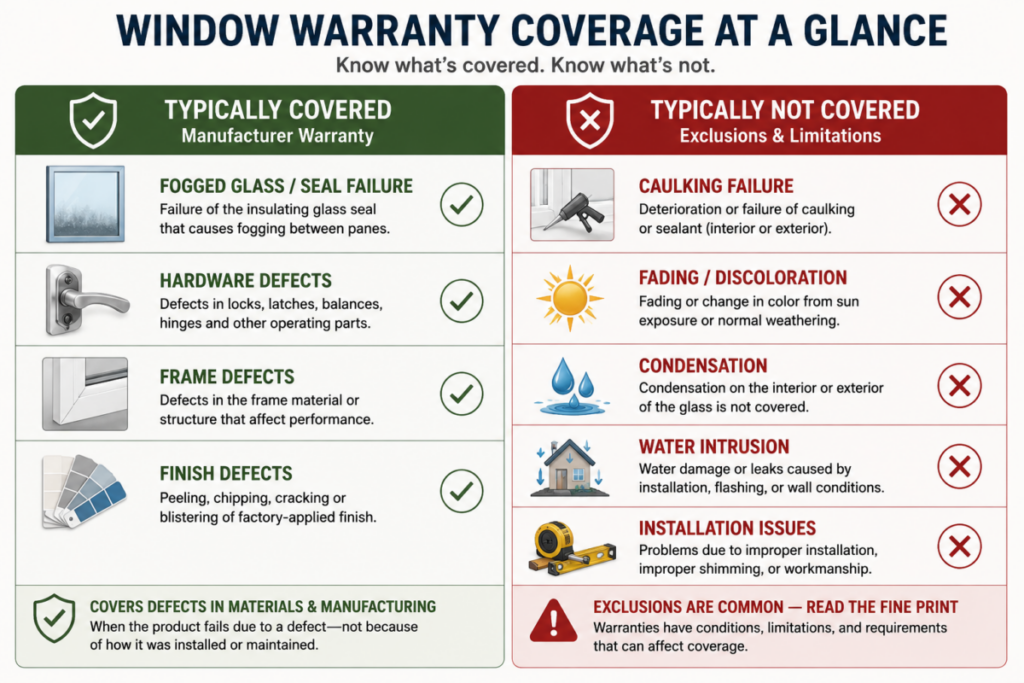
THE INSTALLATION LOOPHOLE
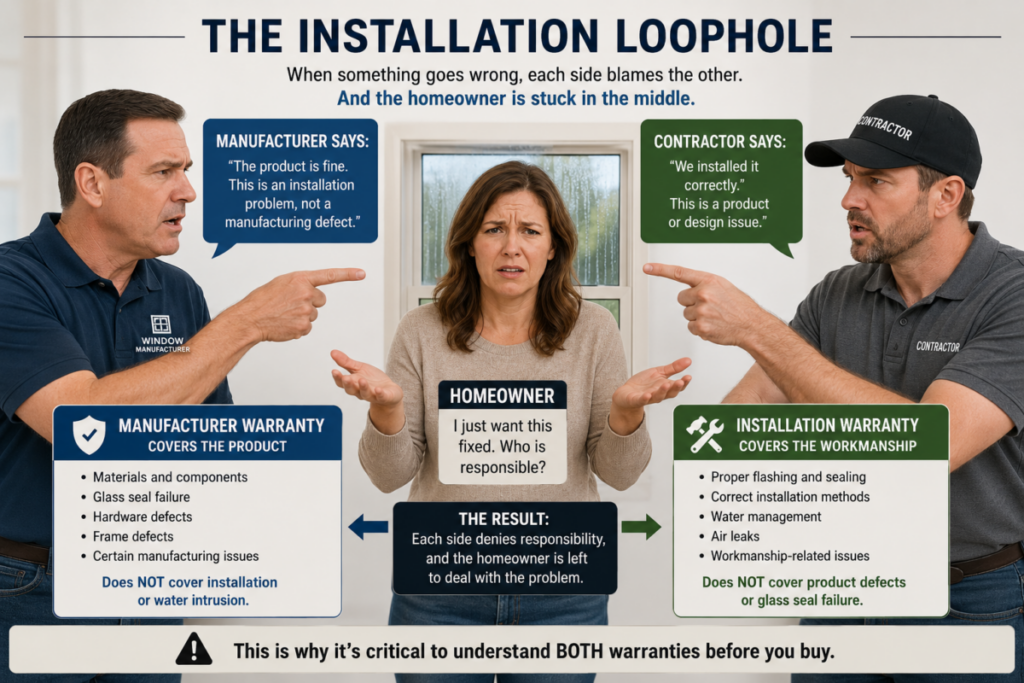
This is one of the biggest issues homeowners run into.
The manufacturer says:
“The product didn’t fail because of manufacturing—it failed because of installation.”
At that point – Responsibility shifts away from them
WHY THIS BECOMES A PROBLEM
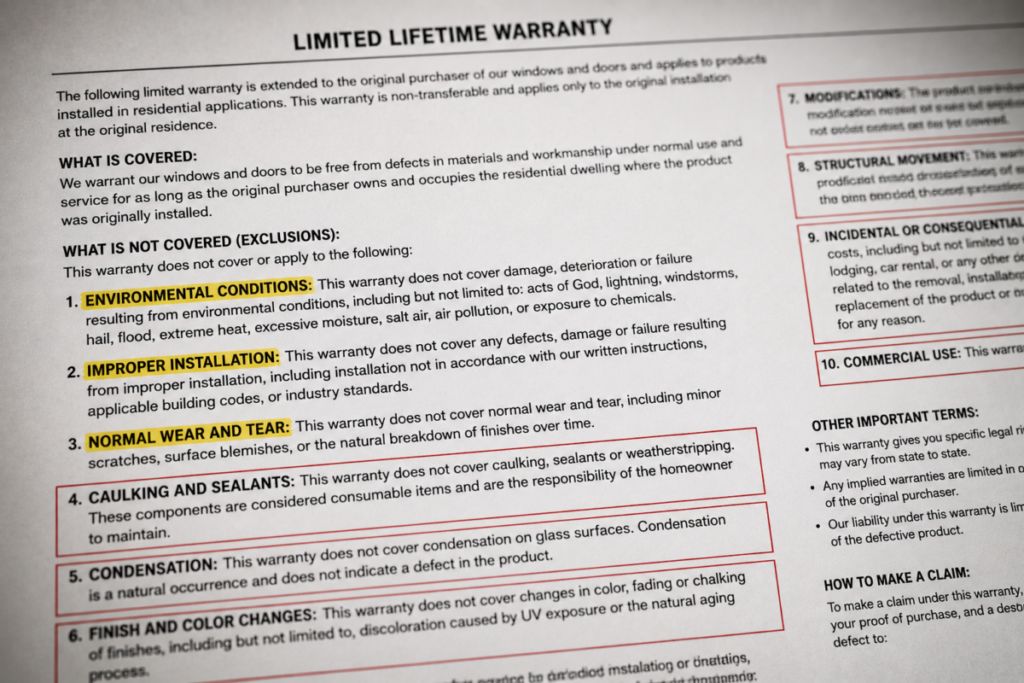
The homeowner is now stuck between:
- Manufacturer
- Contractor
And each may blame the other.
REAL-WORLD EXAMPLE
I’ve seen situations where:
- A window developed air leakage
- The homeowner assumed “it’s under warranty”
But the manufacturer argued:
- The issue was installation-related
Meanwhile:
- The contractor’s labor warranty had already expired
That leaves the homeowner caught in the middle.
WHAT TO LOOK FOR IN A MANUFACTURER WARRANTY
GOOD SIGNS
- Clear language
- Transferable coverage
- Non-prorated periods
- Specific seal failure terms
- Glass coverage clearly explained
WARNING SIGNS
- Vague wording
- Broad “environmental conditions” exclusions
- Heavy prorating after a few years
- Difficult claim procedures
- Labor not included
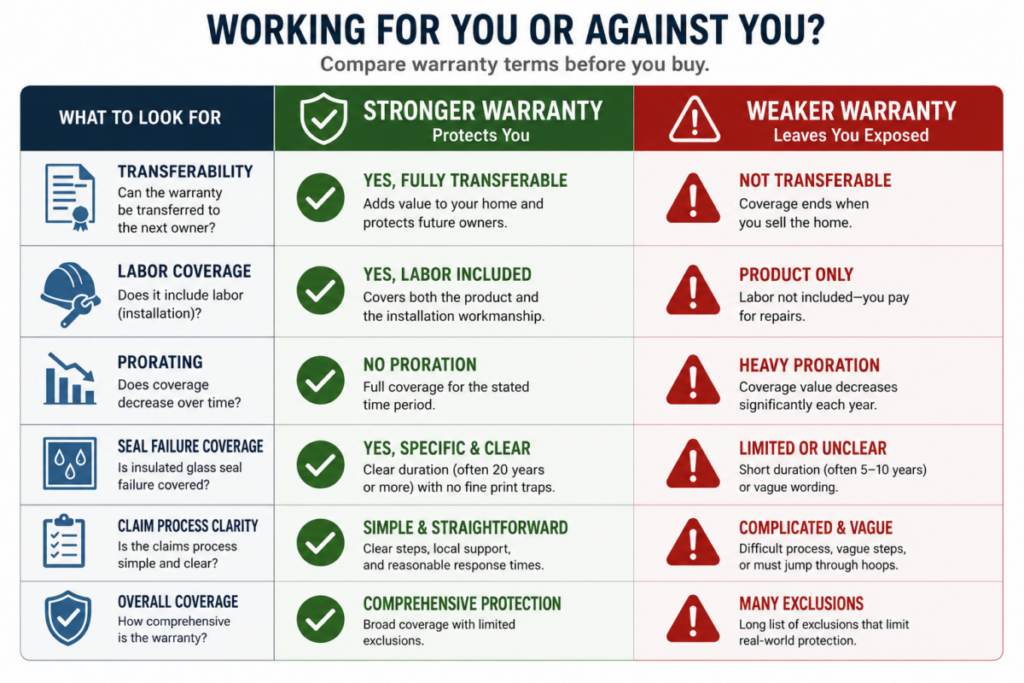
TABLE — STRONGER VS WEAKER WARRANTIES
| Stronger Warranty | Weaker Warranty |
|---|---|
| Clear coverage terms | Vague language |
| Seal failure specifically covered | Broad exclusions |
| Transferable | Original owner only |
| Non-prorated periods | Coverage decreases rapidly |
| Labor included | Product only |
PART 2 — THE INSTALLATION / LABOR WARRANTY
This is completely separate.
And it’s just as important.
WHAT IT COVERS
The labor warranty typically covers:
- Installation workmanship
- Air leaks
- Water intrusion caused by installation
- Adjustment issues
- Installation-related problems
WHY THIS WARRANTY MATTERS SO MUCH
Because even:
A premium window can perform poorly if installed incorrectly.
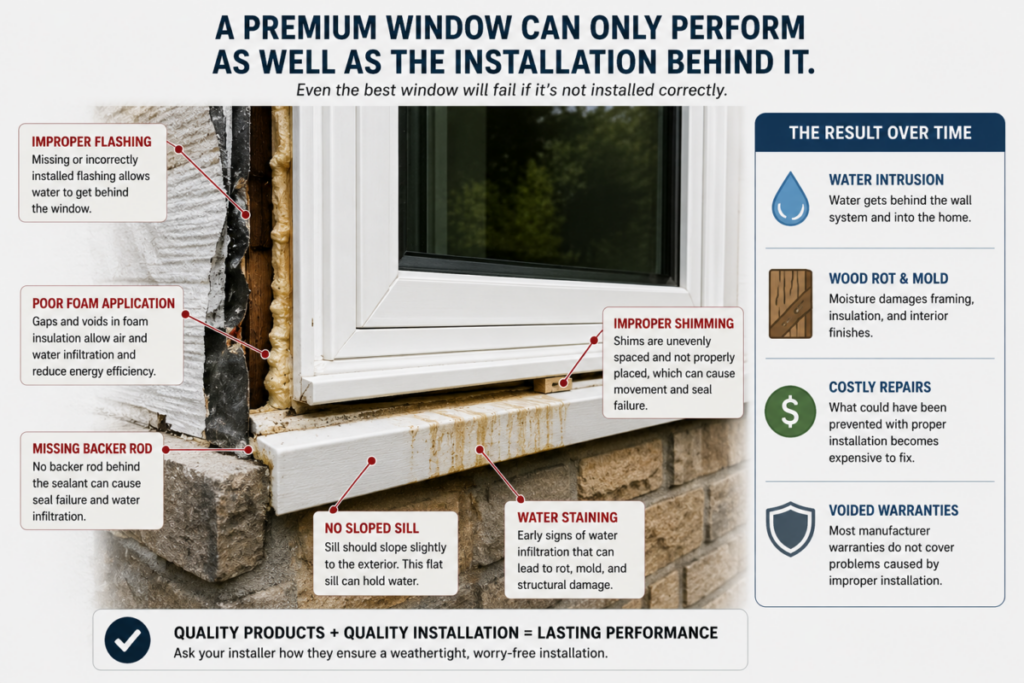
And manufacturers often will NOT cover:
- Installation mistakes
- Water management issues
- Flashing failures
That responsibility falls on the contractor
THE BIG QUESTION MOST HOMEOWNERS NEVER ASK
“How long does the labor warranty last?”
REALITY CHECK
Labor warranties vary dramatically.
COMMON LABOR WARRANTY RANGES
| Warranty Type | Typical Length |
|---|---|
| Basic | 1 year |
| Mid-Level | 2–5 years |
| Stronger | 10+ years |
| Premium Contractors | Lifetime workmanship |
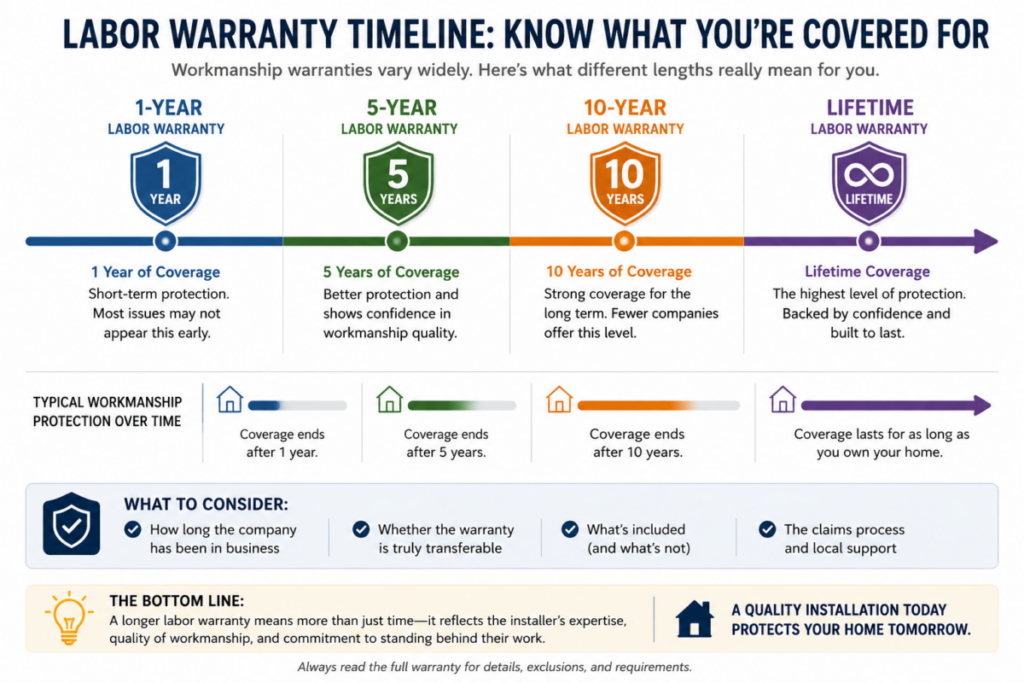
WHAT HOMEOWNERS SHOULD WORRY ABOUT
A long product warranty means very little if:
- The installer disappears
- The company changes ownership
- The labor warranty is short
WHY THIS MATTERS LONG TERM
Most serious problems:
- Don’t show up immediately
- Take years to develop
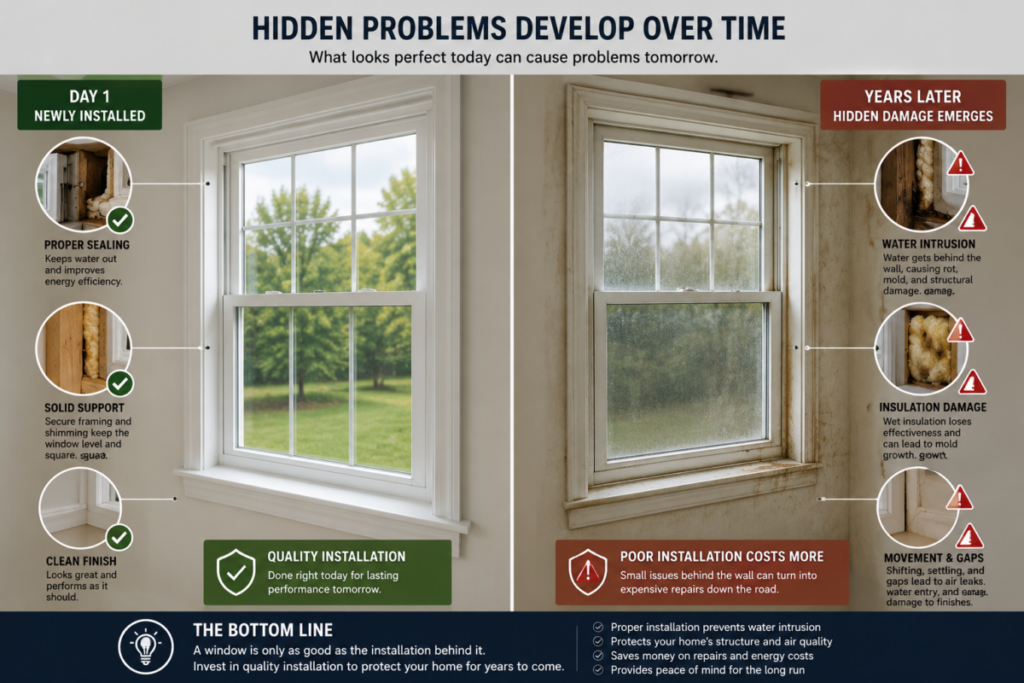
Especially:
- Water intrusion
- Seal stress
- Structural movement
QUESTIONS YOU SHOULD ASK
Before signing anything, ask:
- What exactly does the labor warranty cover?
- Is water intrusion covered?
- Is exterior finish work covered?
- Is there a charge for warranty service calls?
- Is the warranty transferable?
- What voids the warranty?

WHAT CAN VOID A WARRANTY
This is another area homeowners rarely understand.
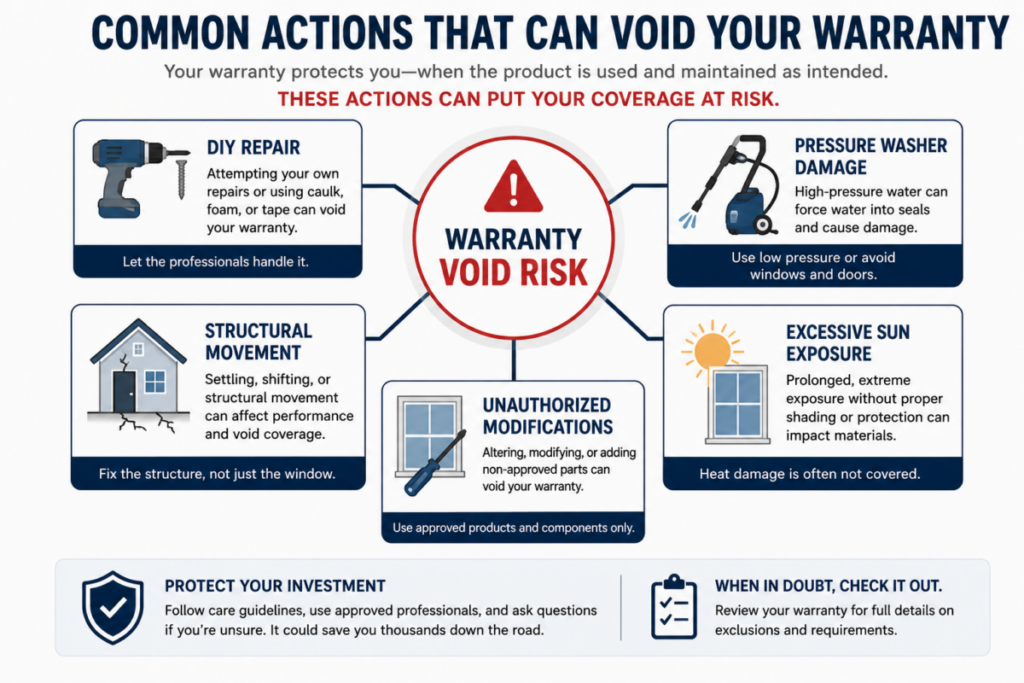
Common Warranty Void Triggers
| Potential Void Issue | Why It Matters |
|---|---|
| Improper maintenance | Common clause |
| Unauthorized modifications | Can void coverage |
| Structural movement | Often excluded |
| Excessive heat exposure | Sometimes cited |
| DIY repairs | Frequently voids coverage |
HOW SOME MANUFACTURERS AVOID WARRANTY CLAIMS
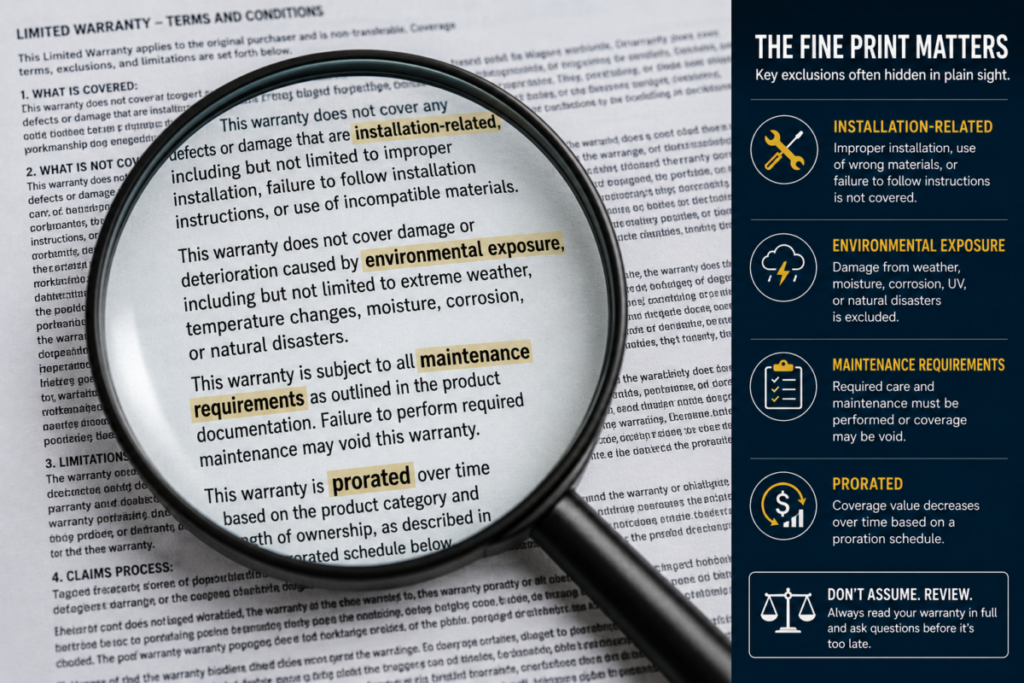
This is important to understand realistically—not emotionally.
Most manufacturers don’t openly refuse valid claims.
Instead, they often rely on:
- Narrow definitions
- Technical exclusions
- Installation disclaimers
THE MOST COMMON STRATEGY
Shift blame to installation
This is why:
- Product quality matters
- Installation quality matters
- Contractor reputation matters
THE BIGGEST WARRANTY MYTH
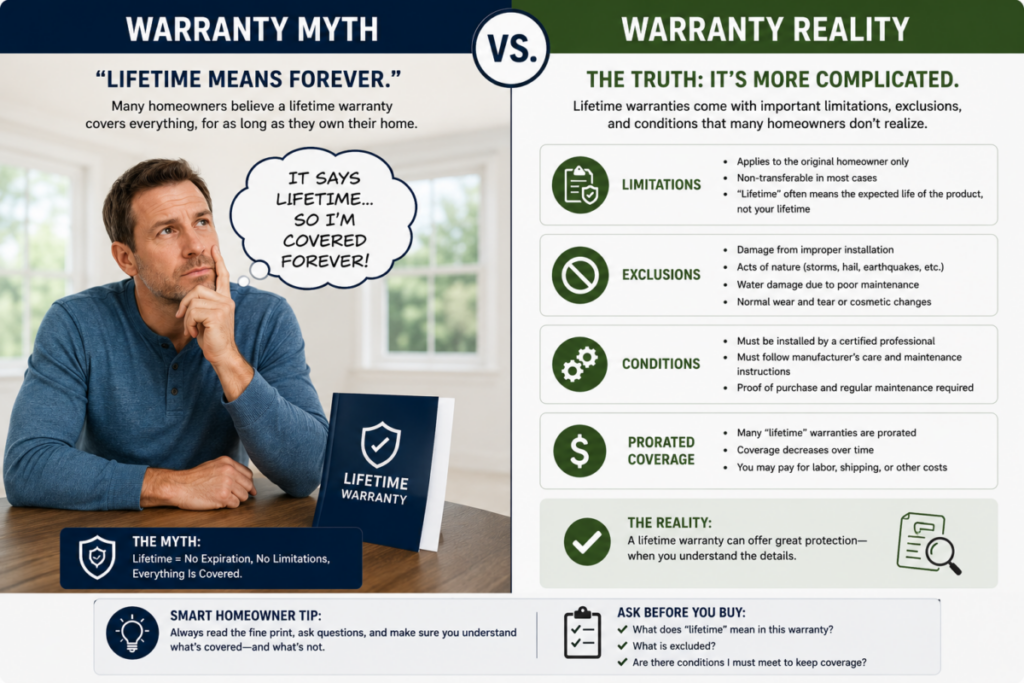
“Lifetime warranty means I never have to worry.”
That is simply not true.
A warranty is only valuable if:
- The issue is covered
- The company still exists
- The claim is honored
- The exclusions don’t eliminate coverage
THE BETTER WAY TO THINK ABOUT WARRANTIES
Instead of asking:
“Does it have a lifetime warranty?”
Ask:
“What specifically is covered, for how long, and under what conditions?”
THE BOTTOM LINE
A warranty should never be the primary reason you buy a window.
Because:
The best outcome is needing the warranty as little as possible.
That comes from:
- Stable materials
- Strong glass systems
- Proper installation
FINAL WARRANTY CHECKLIST
Before signing:
Manufacturer warranty reviewed
Labor warranty explained
Seal failure coverage confirmed
Installation exclusions understood
Warranty length clarified
Transferability explained
Void conditions understood

KEY TAKEAWAY
A warranty does not eliminate risk
It only defines how problems may be handled later
And understanding that difference can prevent major disappointment years down the road.
SECTION 8: – HOW TO EVALUATE THE ISNTALLING CONTRACTOR
THE MOST IMPORTANT DECISION MOST HOMEOWNERS UNDERESTIMATE
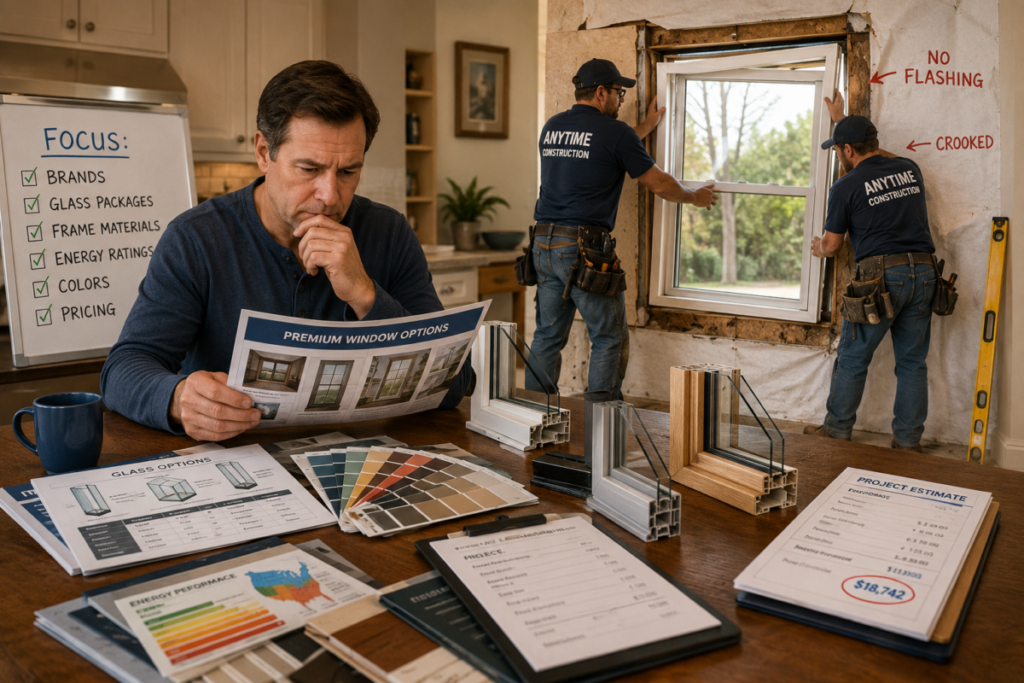
Many homeowners spend weeks comparing:
- Window brands
- Glass packages
- Frame materialse
- Energy ratings
- Colors
- Pricing
Yet they spend almost no time evaluating the company actually installing the windows.
That is a major mistake.
A replacement window project is not just a product purchase.
IT IS:
- Structural work
- Waterproofing work
- Air sealing work
- Finish carpentry
- Exterior integration
- Long-term service support
Even an excellent window can perform poorly if installed incorrectly.
In many cases:
- Air leaks
- Water intrusion
- Operational problems
- Trim cracking
- Premature seal failures
- Warranty disputes
are caused more by installation quality than by the window itself.
The installing contractor matters enormously.
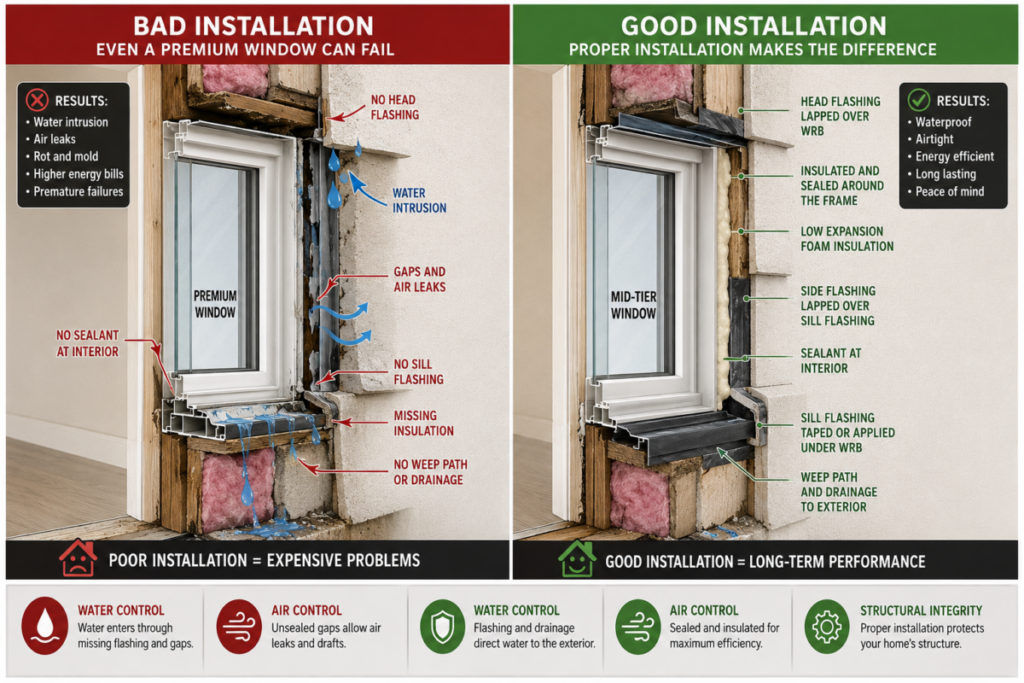
WHY THE INSTALLING CONTRACTOR MATTERS SO MUCH
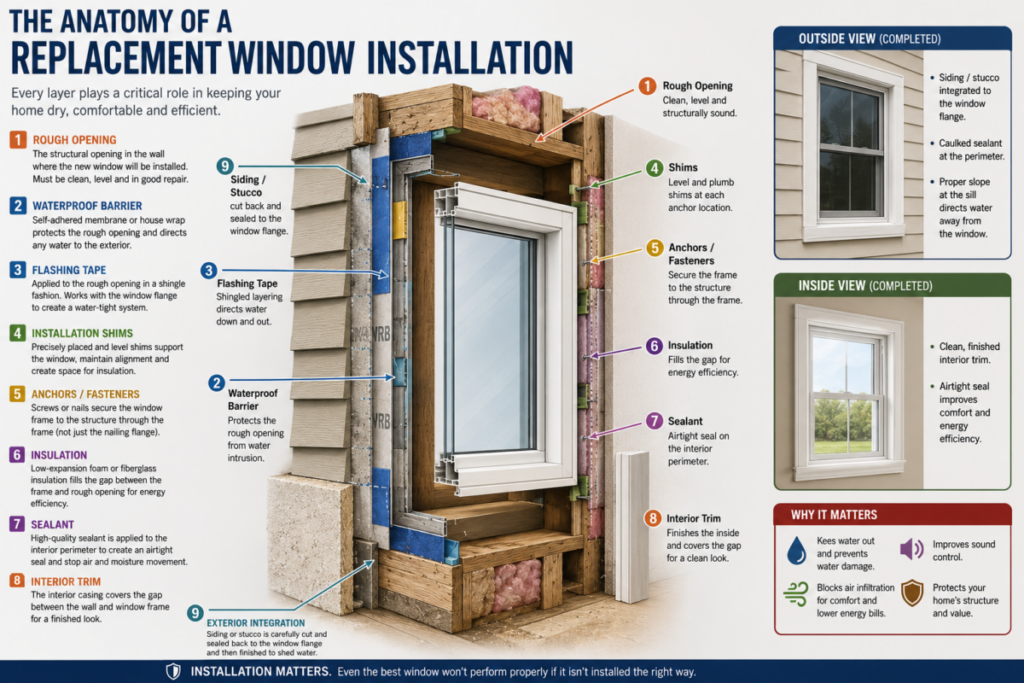
Replacement windows are integrated directly into the structure of your home.
During installation, the contractor may:
- Remove old frames
- Cut stucco or siding
- Expose rough openings
- Integrate waterproofing systems
- Anchor new units
- Seal against water and air infiltration
- Repair surrounding finishes
- Adjust operation and alignment
A poor installation can create problems that may not show up for:
- Months
- Years
- Or even after the labor warranty expires.
That is why evaluating the contractor is just as important as evaluating the window itself.
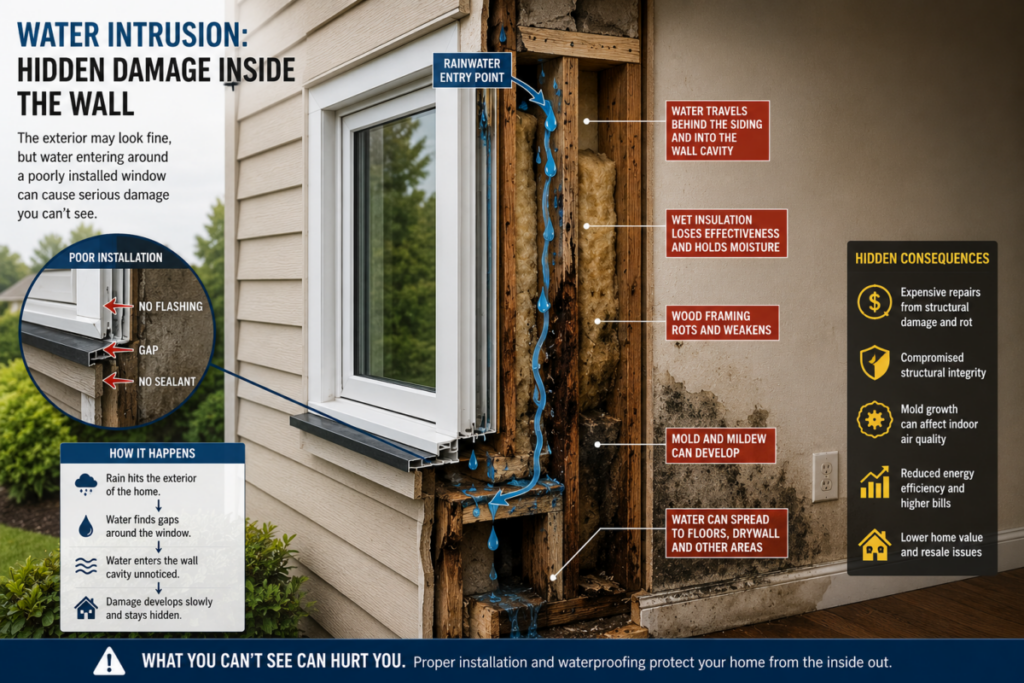
START WITH COMPANY STABILITY AND LONGEVITY
HOW LONG HAS THIS COMPANY EXISTED?
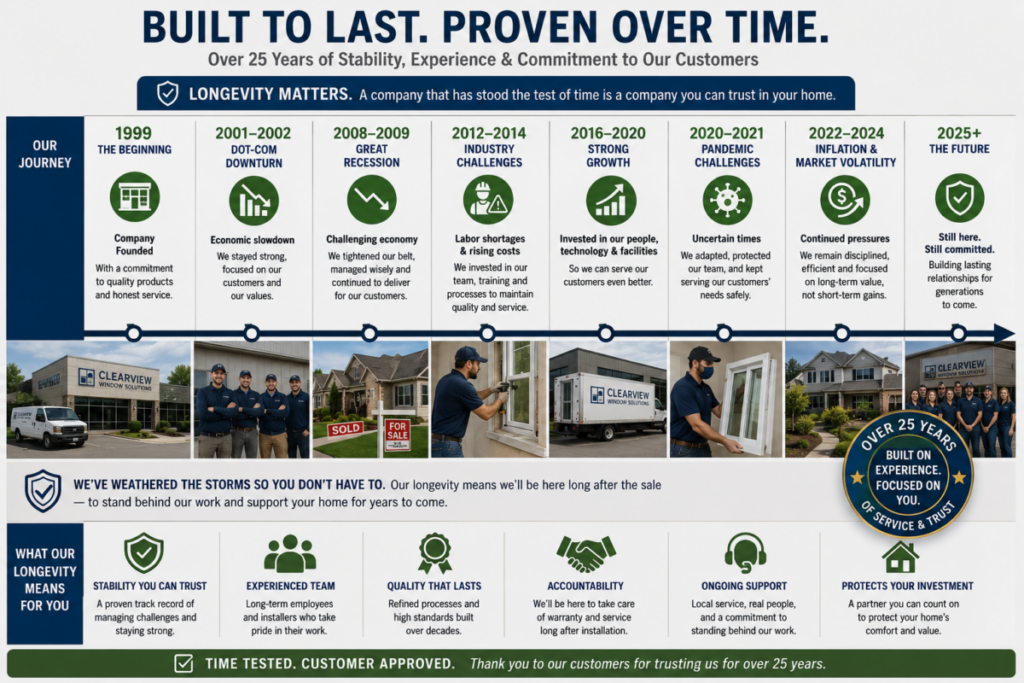
Ask specifically:
“How long has this exact company been operating under this exact name?”
This is important because some companies:
- Shut down and reopen under new names
- Rebrand after lawsuits or complaints
- Reorganize ownership to escape reputation problems
- Change names after licensing or warranty issues
A company that has operated continuously for:
- 10 years
- 20 years
- 30 years
Has generally survived:
- Economic downturns
- Warranty claims
- Labor shortages
- Market competition
- Customer scrutiny
Longevity alone does NOT guarantee quality.
But instability is often a major warning sign.
LOOK FOR SIGNS OF AN EXTABLISHED OPERATION

Strong Signs
- Long operating history
- Physical office location
- Local warehouse or service center
- Long-term employees
- Dedicated installation crews
- Dedicated service department
- Consistent online presence over many years
- Reviews spread across many years
- Branded vehicles and equipment
- Organized communication systems
Warning Signs
- Recently formed LLC
- Frequent company name changes
- No physical office
- Only a PO Box
- Extremely vague company history
- Few reviews older than 1–2 years
- Poor communication during the sales process
- High-pressure sales tactics
- Difficulty verifying licensing or insurance
ARE THE INSTALLERS EMPOYEES OR SUBCONTRACTORS?
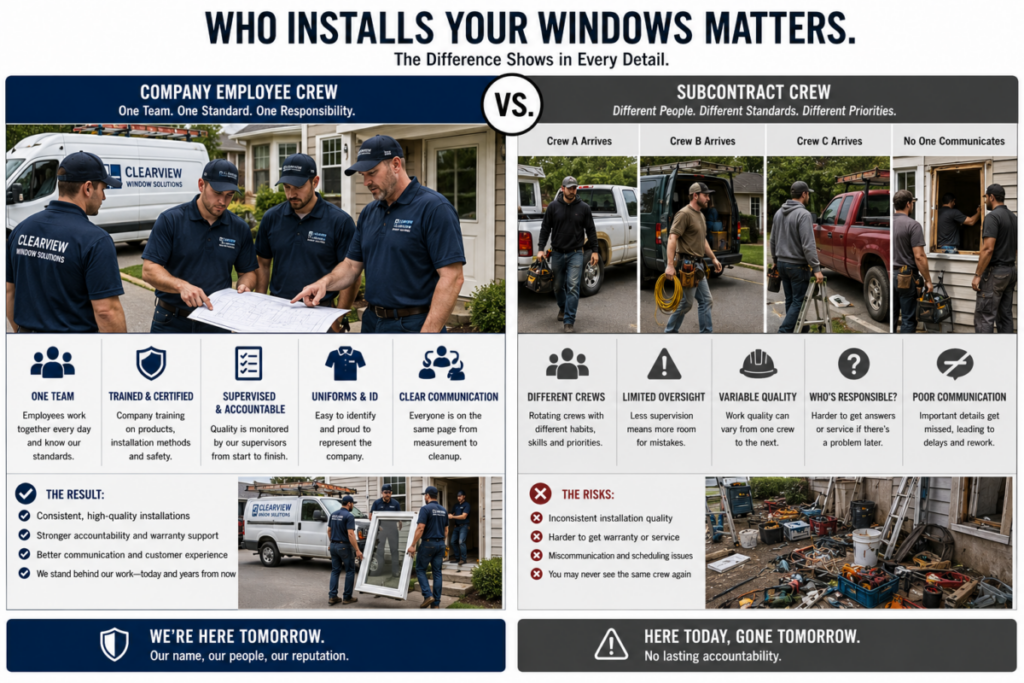
ONE OF THE MOST IMPORTANT QUESTIONS YOU CAN ASK
Ask directly:
“Who actually installs the windows?”
Then ask:
“Are the installers company employees or subcontractors?”
Most homeowners never ask this question.
They should.
WHY THIS MATTERS
Some companies use:
- Fully trained in-house installation crews
Others use:
- Independent subcontractors
Some companies use a combination of both.
Subcontracting is not automatically bad.
There are excellent subcontractors in the industry.
However, subcontract-heavy companies often create more variability in:
- installation quality
- accountability
- training consistency
- communication
- warranty service
POTENTIAL RISKS WITH HEAVY SUBCONCONTRACTING
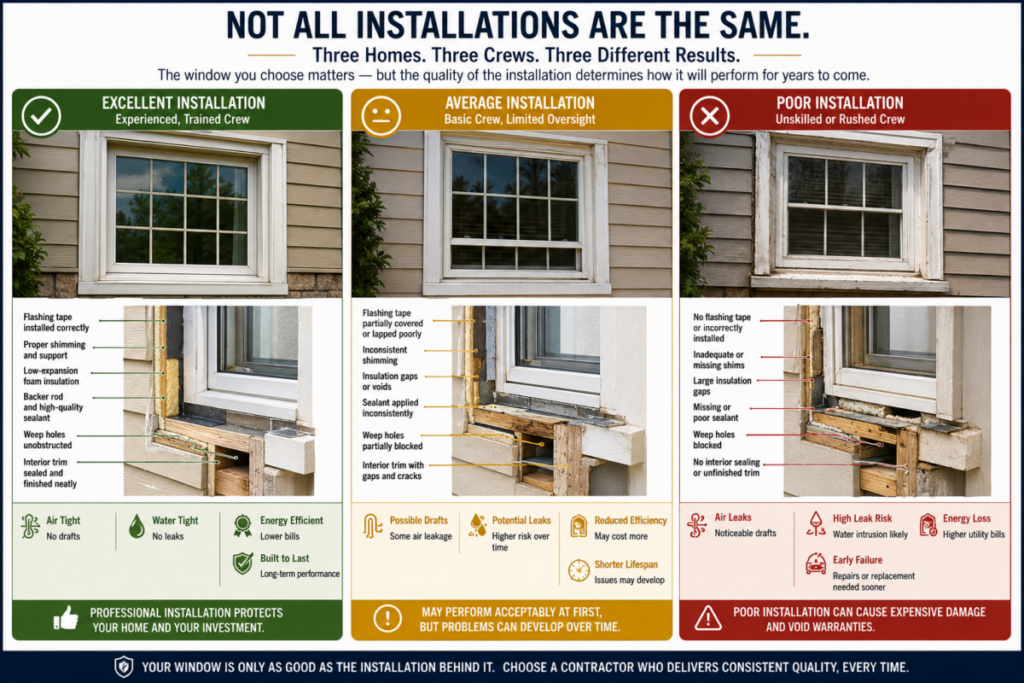
Common Problems Include:
- Different crews performing work differently
- Less oversight from management
- Inconsistent training standards
- Crews rushing jobs for volume
- Warranty responsibility confusion
- Difficulty getting service later
- Installers unfamiliar with specific products
- Communication breakdowns
Some subcontract crews may work for:
- Multiple competing companies
- Whichever contractor offers work that week
That does not always create problems.
But homeowners should understand how the system works.
ADVANTAGES OF DEDICATED EMPLOYEE INSTALLATION CREWS

Companies using long-term employee crews often have:
- More standardized installation methods
- More oversight
- More product-specific training
- Stronger accountability
- More consistency between projects
- Better long-term service coordination
Employee crews are usually easier for the company to:
- Supervise
- Retrain and retain
- Discipline
- Evaluate for quality control
IMPORTANT FOLLOW-UP QUESTIONS
ASK:
- How long have your crews worked for the company?
- Are crews certified on this specific product?
- Do the same crews perform both installation and warranty service?
- Who supervises installation quality?
- Are crews trained specifically for fiberglass, vinyl, or wood products?
- How are installation problems handled?
The answers often reveal how organized the company truly is.
IS THE CONTRACTOR LICENSED, BONDED, AND INSURED?
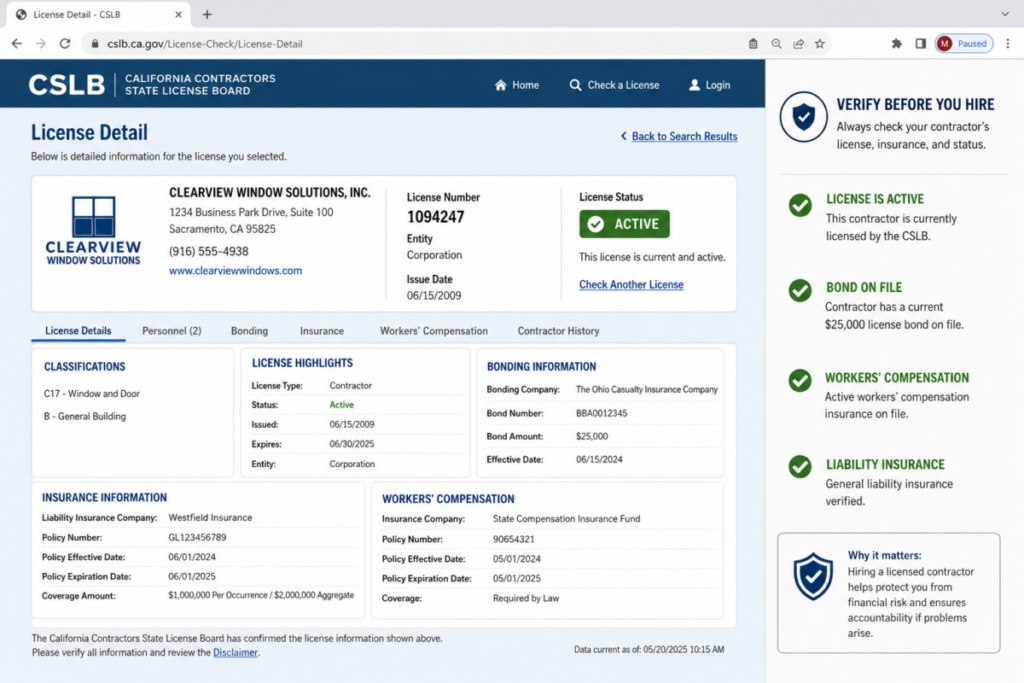
NEVER ASSUME – VERIFY IT YOURSELF
Do not simply accept verbal assurances.
Verify everything independently.
Ask for:
- Contractor license number
- Proof of insurance
- Proof of bonding if applicable
Then verify the information through your state contractor licensing board.
WHY LICENSING MATTERS
A valid contractor license generally means the company has met minimum state requirements involving:
- Testing
- Registration
- Financial responsibility
- Legal compliance
Licensing also provides homeowners with some degree of consumer protection.
An unlicensed contractor can create major risks involving:
- Liability
- Code compliance
- Permits
- Warranty disputes
- Resale complications
WHY INSURANCE MATTERS
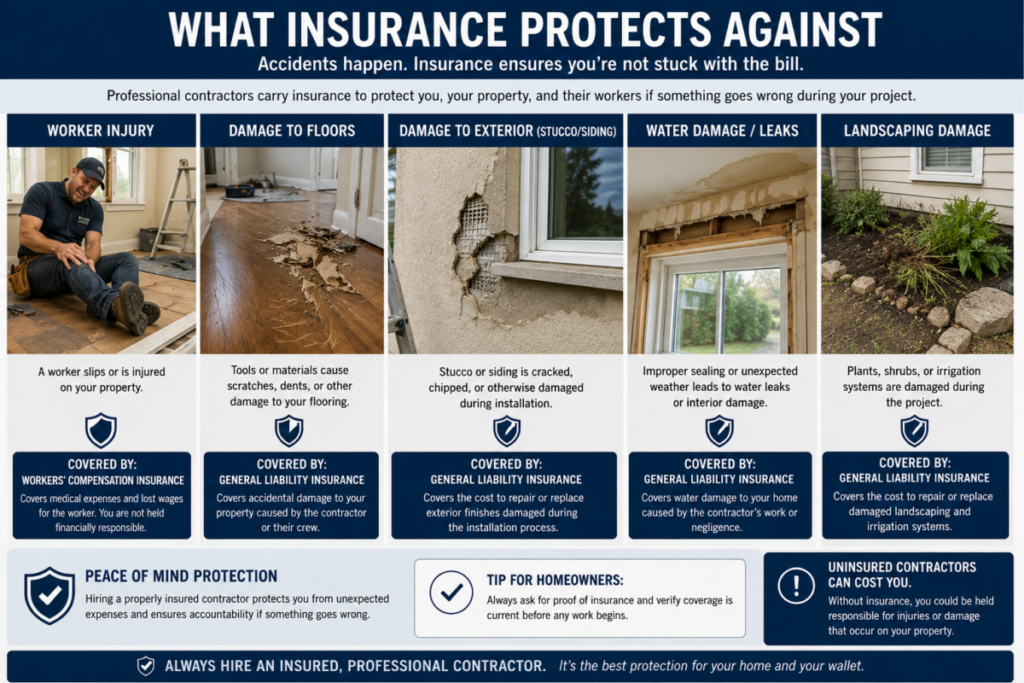
Ask for proof of:
- General liability insurance
- Worker’s compensation insurance
This protects both the homeowner and the contractor.
Without proper insurance, you may face serious complications if:
- A worker is injured
- Property damage occurs
- Water damage develops
- Stucco or drywall is damaged
- Tools damage flooring or landscaping
WHY BONDING MATTERS
Bonding requirements vary by state.
A contractor bond is generally intended to provide a level of financial protection if the contractor:
- Violates licensing laws
- Fails to complete work properly
- Fails to meet contractual obligations
Bonding is not a guarantee against problems.
But lack of bonding where required should be considered a warning sign.
EVALUATE THE CONTRACTOR’S INSTALLATION PROCESS
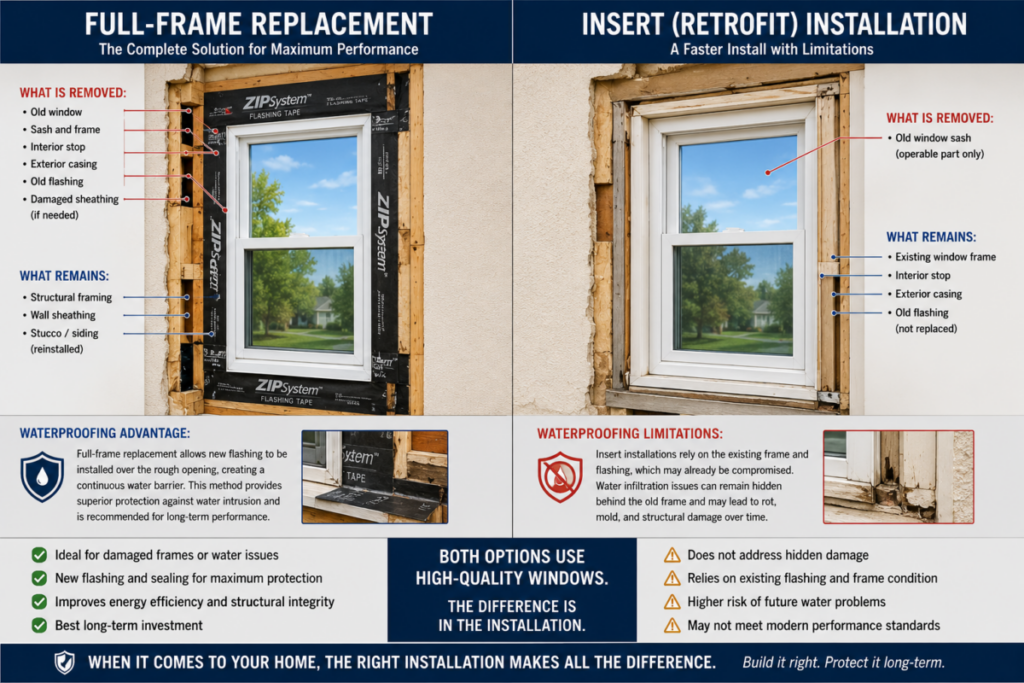
ASK HOW THE WINDOWS ARE INSTALLED
Many homeowners focus entirely on:
- The window brand
- The glass package
- The price
while never asking:
“How exactly will the installation be performed?”
That is a major oversight.
IMPORTANT QUESTIONS TO ASK
Installation Method
- Is this a full-frame replacement?
- Is this an insert installation?
- Is this a retrofit installation?
Waterproofing
- How is waterproofing handled?
- Will flashing be added or replaced?
- How is the rough opening inspected?
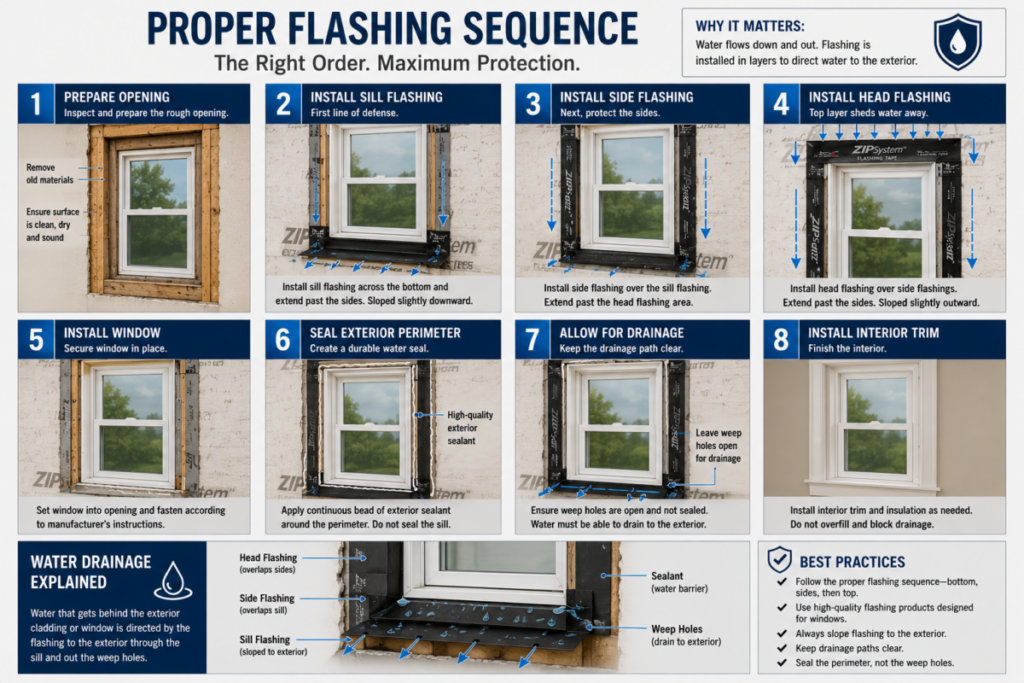
Structural Preparation
- Will damaged wood be identified?
- How are out-of-square openings handled?
- How are windows anchored?
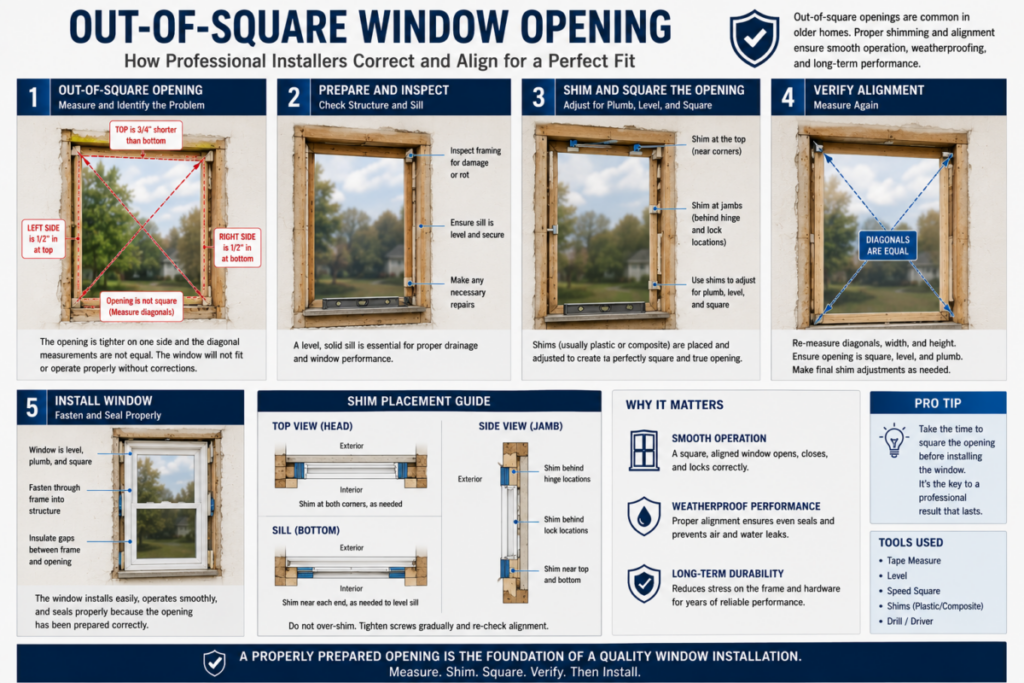
Sealing Methods
- What type of sealants are used?
- How is air sealing performed?
- How is expansion and contraction managed?
Finish Work
- Who repairs stucco?
- Who repairs drywall or trim?
- How is cleanup handled?
WHY TECHNICAL KNOWLEDGE MATTERS
Strong contractors can explain:
- Why they install windows a certain way
- Why certain methods perform better
- How climate affects installation
- How expansion and contraction are managed
- How water intrusion risks are minimized
Weak contractors often rely on:
- Vague answers
- Sales language
- Avoidance of technical detail
A contractor who cannot clearly explain their installation process may not fully control it.
EVALUATE COMMUNICATION AND PROFESSIONALISM
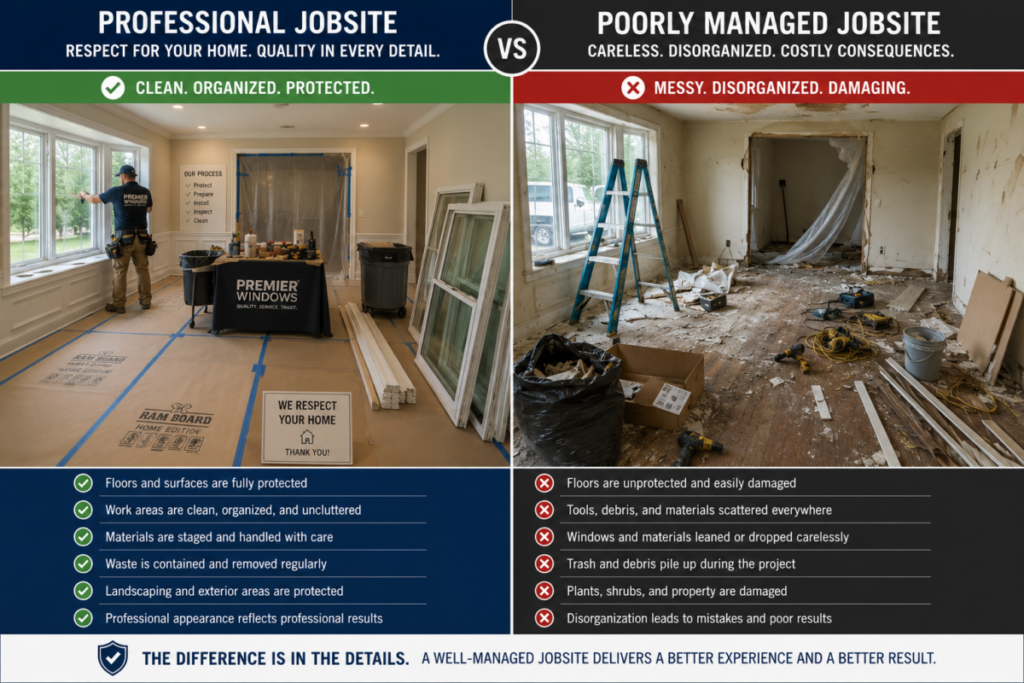
THE SALES PROCESS OFTEN PREDICTS THE INSTALLATION EXPERIENCE
Pay attention to:
- Responsiveness
- Punctuality
- Organization
- Professionalism
- Follow-through
If communication is poor before signing a contract, it often becomes worse afterward.
STRONG CONTRACTORS USUALLY HAVE
- Detailed written proposals
- Clear installation timelines
- Organized scheduling systems
- Defined communication procedures
- Realistic expectations
- Written warranty explanations
- Structured project management
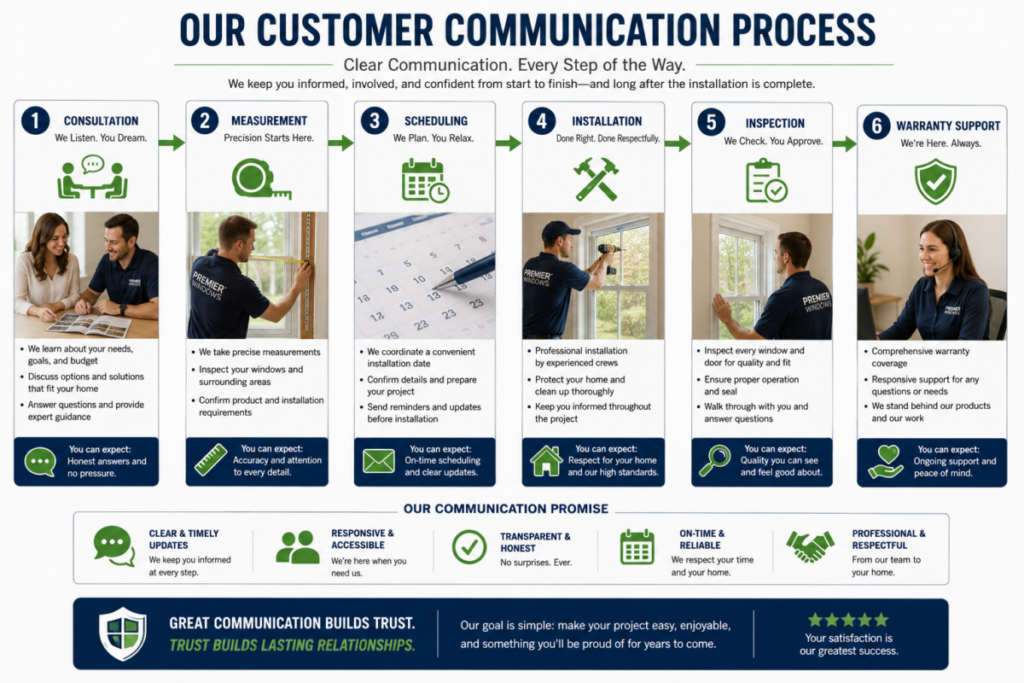
COMMON WARNING SIGNS
- Extremely delayed callbacks
- Vague pricing
- Confusing proposals
- Pressure to sign immediately
- Refusal to answer technical questions
- Frequent rescheduling
- Disorganized communication
- Large verbal promises not shown in writing
RESEARCH THE CONTRACTOR’S REPUTATION CORRECTLY
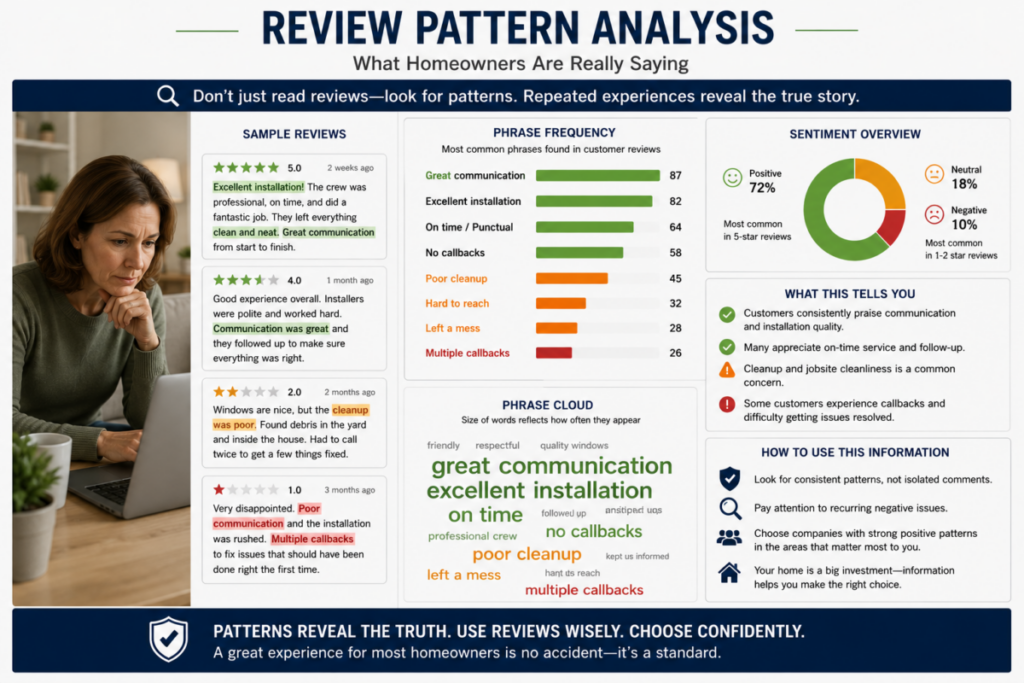
DO NOT JUST LOOK AT STAR RATINGS
Many homeowners make decisions based only on:
- Google star ratings
- Total review count
That is not enough.
Read the actual reviews carefully.
Look for patterns.
STRONG REVIEW PATTERNS
Look for reviews mentioning:
- Installation quality
- Professionalism
- cleanliness
- communication
- Long-term satisfaction
- Service after installation
- Warranty responsiveness
- Problem resolution
Detailed reviews are usually more useful than emotional one-sentence reviews. Also remember human nature. There are many people that no matter how much a company tries, simply cannot be satisfied, and this type of person is more likely to take the time to write a scathing review than a satisfied customer. Look for detailed patters as you read.
COMMON WARNING PATTERNS
Be cautious if reviews repeatedly mention:
- Installation damage
- Poor cleanup
- No callbacks
- Warranty frustration
- Scheduling chaos
- Rude crews
- Surprise charges
- Unresolved problems
- Disappearing service departments
Patterns matter more than isolated complaints.
THE MOST REVEALING REVIEWS ARE OFTEN THE MIDDLE REVIEWS
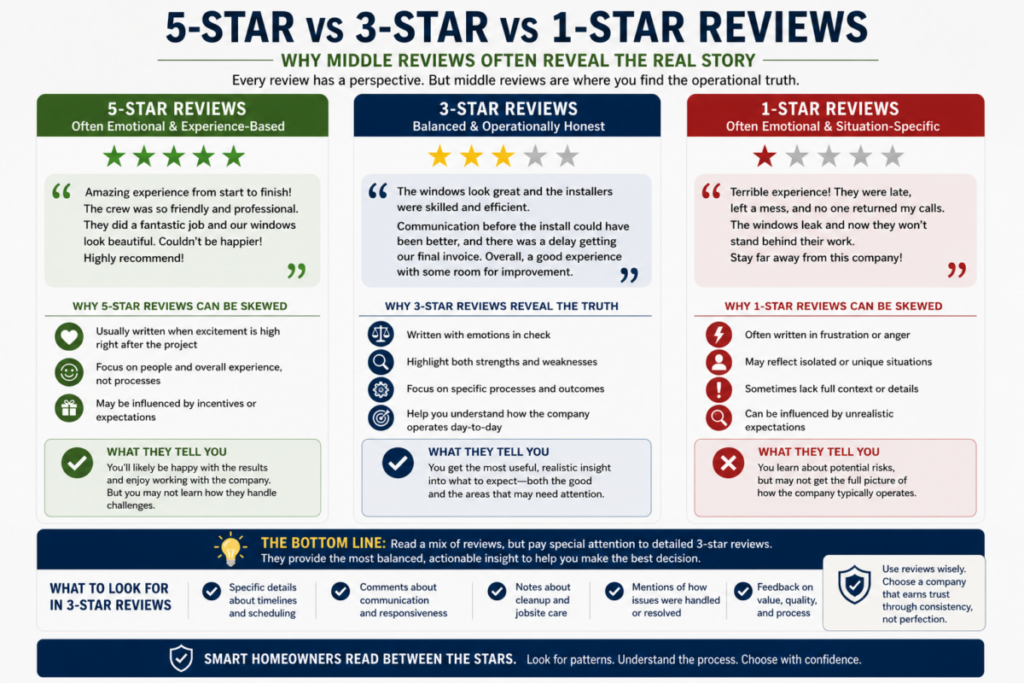
Five-star reviews can sometimes be emotional.
One-star reviews can sometimes be extreme.
Three-star reviews often reveal operational reality.
They frequently expose:
- Communication problems
- Scheduling issues
- Inconsistency between crews
- Warranty delays
- Management weaknesses
These reviews are often the most informative.
ASK ABOUT SERVICE AFTER THE INSTALLATION
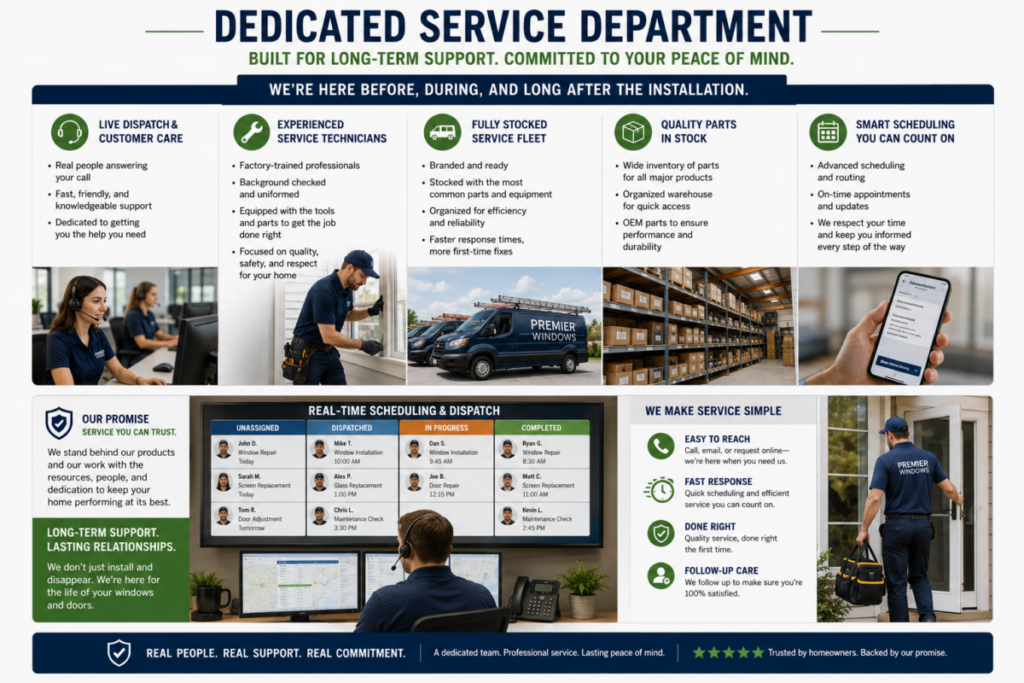
THIS IS WHERE MANY COMPANIES FAIL
Some contractors are excellent at:
- Selling
- Installing
but weak at:
- Long-term support
- Warranty follow-up
- Service responsiveness
This matters enormously because replacement windows are expected to last decades.
IMPORTANT QUESTIONS TO ASK
- Do you have a dedicated service department?
- Who handles warranty labor?
- How long does service usually take?
- Who do I call if there is a problem?
- Do the original installers return for service work?
- Is there a separate service crew?
- How are callbacks handled?

WHY LONG-TERM STABILITY MATTERS
A “lifetime warranty” means very little if:
- The installer disappears
- The company reorganizes
- The service department no longer exists
- Calls are ignored years later
The long-term stability of the contractor is critical.
BEWARE OF HIGH-PRESSURE SALES TACTICS
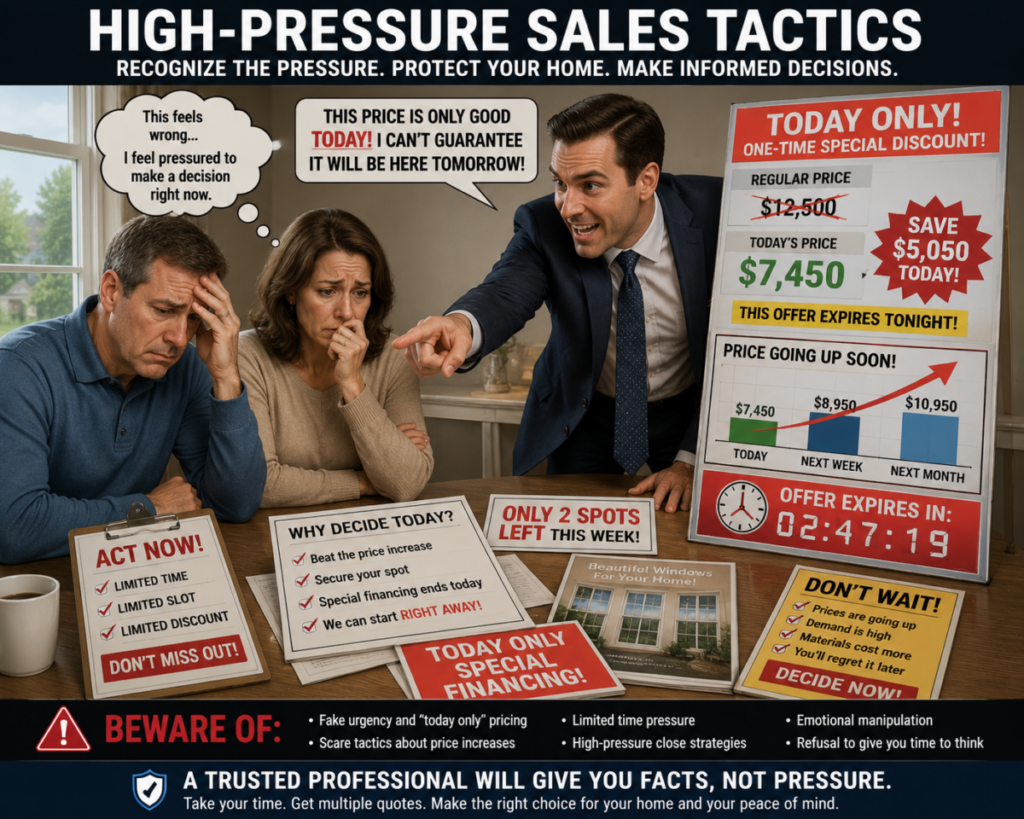
PRESSURE OFTEN REPLACES TRANSPARENCY
Be cautious of:
- “Today Only” pricing
- Massive fake discounts
- Dramatic manager phone calls
- Refusal to leave written pricing
- Emotional pressure tactics
- Insulting competitors instead of explaining differences
Strong contractors usually rely more on:
- Education
- Technical explanations
- Process transparency
- Reputation
- Installation quality
Rather than pressure.

CONTRACTOR EVALUATION CHECKLIST
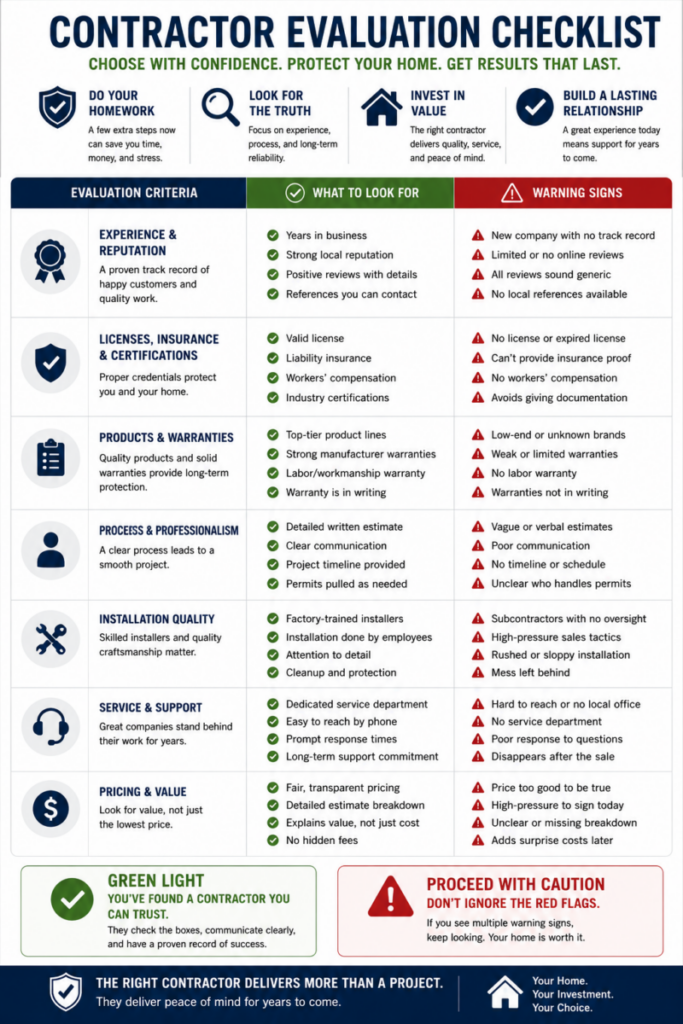
| Evaluation Category | What to Look For | Warning Signs |
|---|---|---|
| Company Longevity | 10+ years under same name | Constant rebranding |
| Installers | Long-term employee crews | Heavy revolving subcontractors |
| Licensing | Easily verified | Difficult to verify |
| Insurance | Liability + workers comp | Vague answers |
| Communication | Organized and responsive | Delayed callbacks |
| Reviews | Consistent long-term patterns | Repeated service complaints |
| Technical Knowledge | Detailed installation explanations | Vague answers |
| Service Department | Dedicated support team | No long-term support |
| Sales Process | Educational and transparent | High-pressure tactics |
| Reputation | Local projects and history | Few older reviews |
FINAL REALITY CHECK

A replacement window project is not simply about buying windows.
You are also choosing:
- The people entering your home
- The people modifying your structure
- The people responsible for waterproofing
- The people responsible for long-term support
The contractor you choose may affect:
- Comfort
- Energy efficiency
- Durability
- Resale value
- Maintenance costs
- Water intrusion risk
- Long-term satisfaction
The best contractor is RARELY the one with:
- The cheapest price
- The largest discount
- The most aggressive sales pitch
The best contractor is USUALLY the one with:
- Stable history
- Strong organization
- Experienced installation crews
- Clear communication
- Proper insurance and licensing
- Consistent installation standards
- Dependable long-term service support
A high-quality installation performed by a stable, experienced contractor is one of the most important parts of a successful replacement window project.
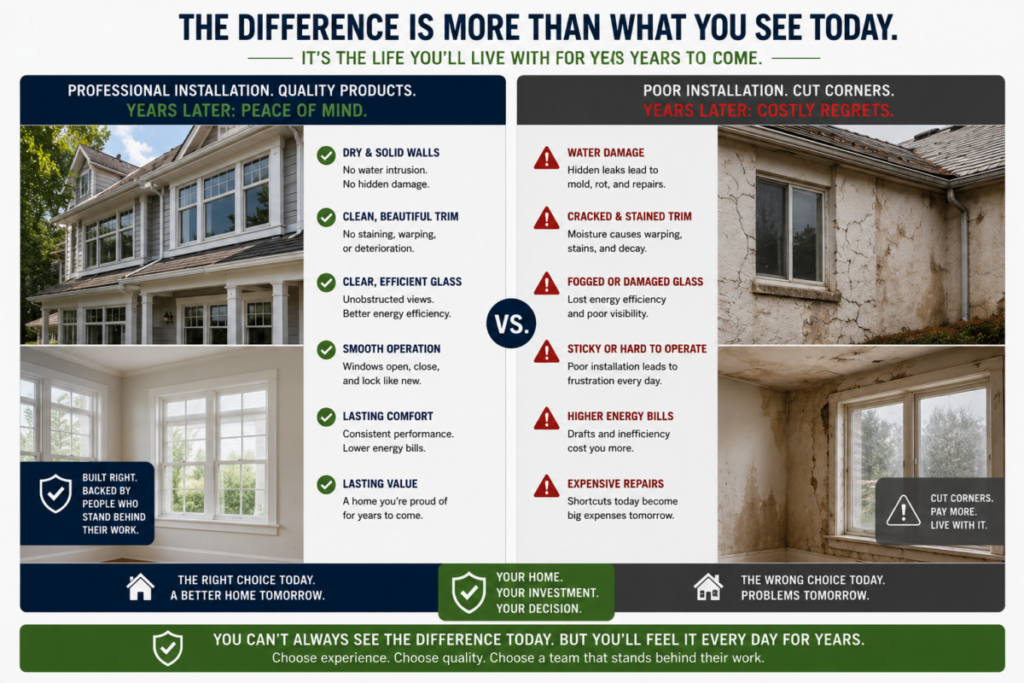
SECTION 9 — RED FLAGS: HOW TO KNOW WHEN SOMETHING ISN’T RIGHT
Most homeowners don’t realize something is off during a sales appointment.
Not because they aren’t paying attention.
But because everything is designed to feel:
- Professional
- Reassuring
- Straightforward
The presentation is smooth.
The information sounds complete.
The salesperson seems confident.
And yet, something isn’t quite clear.
That feeling matters.
Because in many cases, the biggest mistakes don’t come from what’s said.
They come from what’s:
- Not explained
- Rushed past
- Left vague
Why Red Flags Matter
A window replacement project is not a small purchase.
It’s:
- A long-term decision
- A structural change to your home
- A five-figure investment in most cases
You should feel:
- Clear
- Informed
- Comfortable taking time to decide
If you don’t, that’s your first signal to slow down.
Red Flag #1: Pressure to Sign Immediately
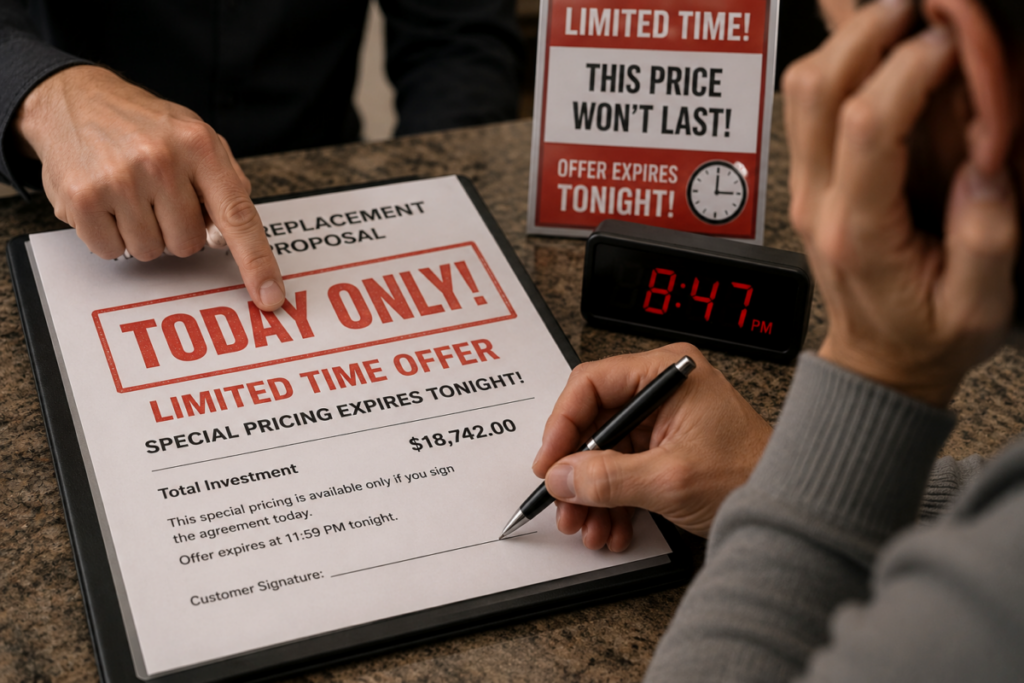
This is one of the most common—and most important—signals.
It usually sounds like:
- “This price is only good today”
- “We can offer this discount if you move forward now”
- “We have a promotion ending tonight”
What This Means

This isn’t about timing.
It’s about control of the decision.
When you’re pressured to act quickly:
- You have less time to think
- Less time to compare
- Less time to ask questions
The Reality
A legitimate project should:
- Hold up under review
- Make sense tomorrow—not just today
What to Do
A simple response:
“I don’t make decisions like this on the spot. I need time to review everything.”
If that creates tension, that tells you something.
Red Flag #2: Lack of Clear Explanation
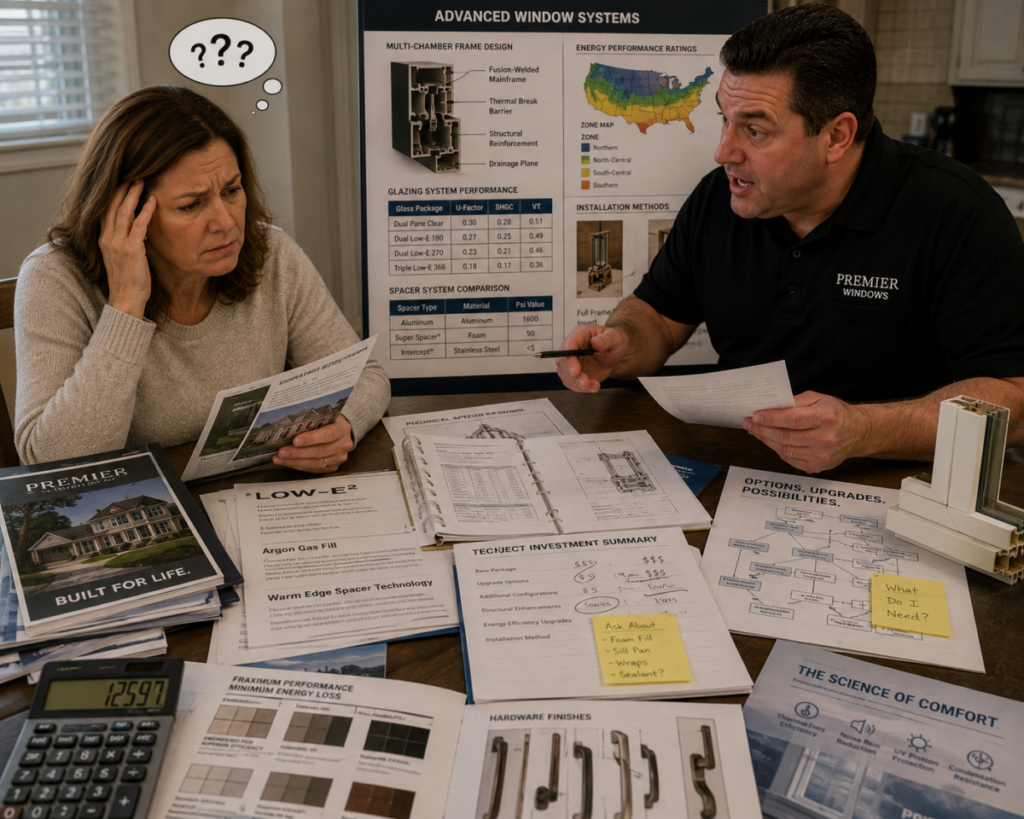
If you find yourself thinking:
“I’m not sure I fully understand what they’re doing…”
That’s a problem.
Where This Shows Up
- Installation details are glossed over
- Differences between options aren’t explained clearly
- Technical terms are used without explanation
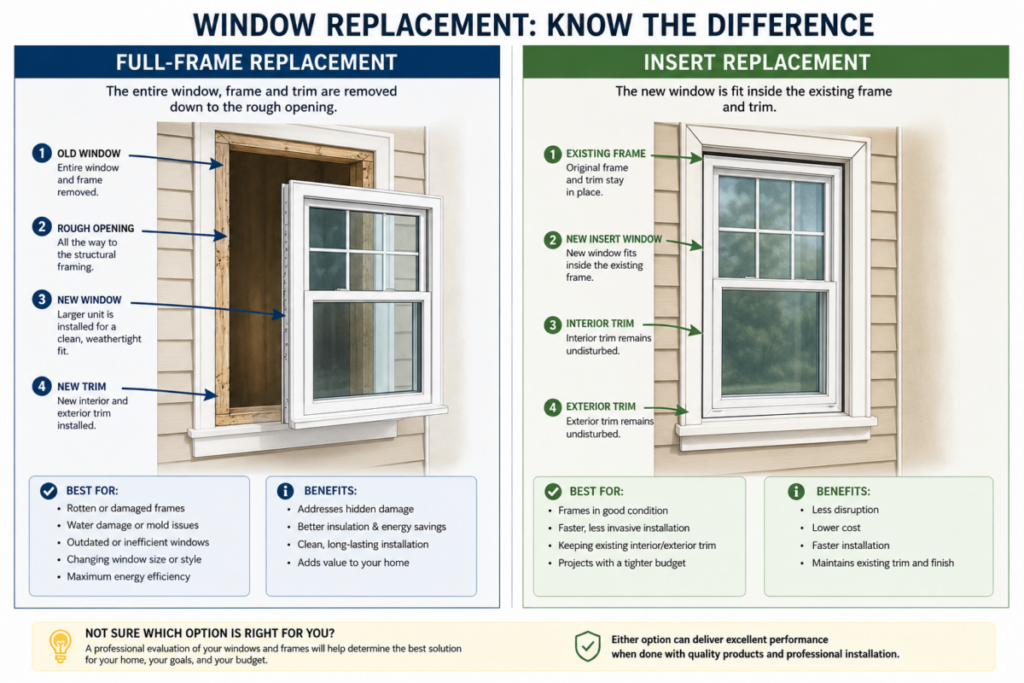
What This Means
Either:
- The explanation is being simplified too much
- Or the details are being avoided
In both cases, you’re not getting what you need to make a decision.
What to Do
Ask directly:
- “Can you walk me through exactly what will happen during installation?”
- “What is being removed—and what stays?”
If the answers remain unclear, don’t move forward.
Red Flag #3: No Written Scope of Work
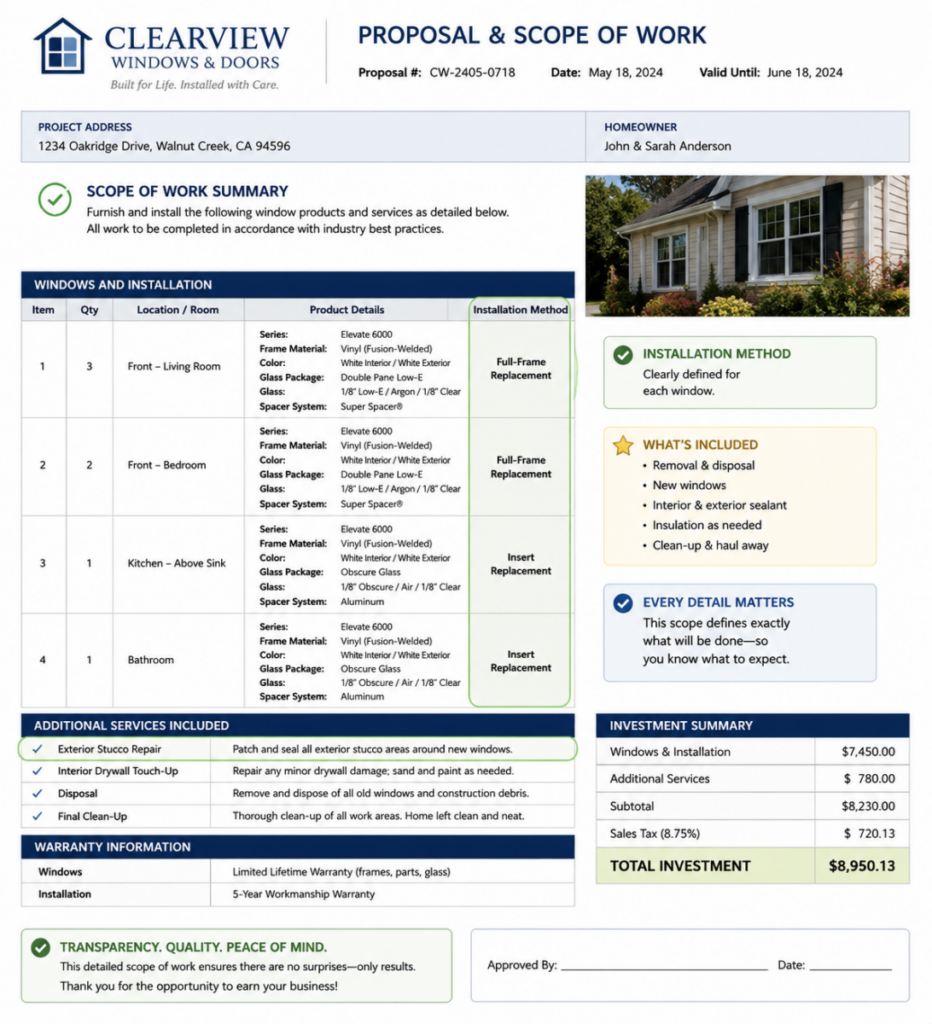
This is one of the most serious issues—and one of the most overlooked.
What Should Be Included
A proper proposal should clearly define:
- Installation type (insert vs full frame)
- Materials being used
- Glass package details
- Exterior work included
- Any potential additional costs
What Often Happens Instead
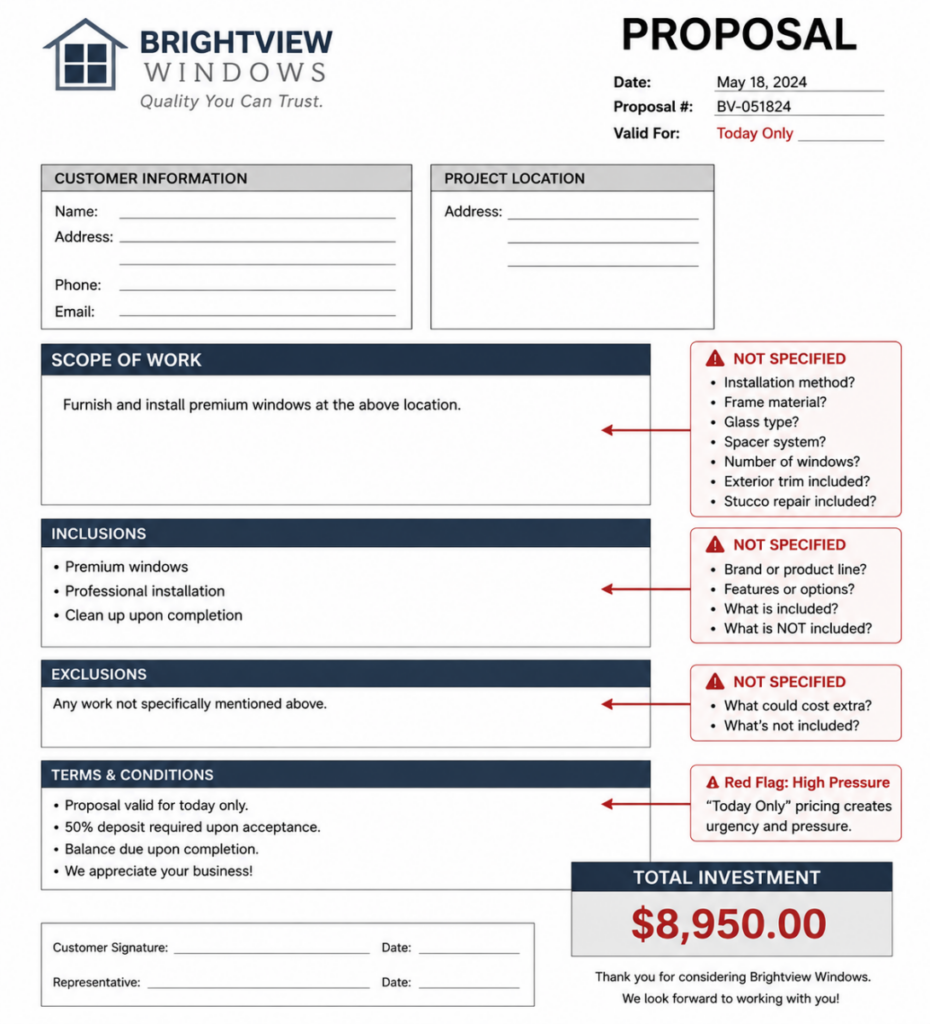
You get:
- A total price
- A general description
- Verbal explanations
But no detailed breakdown.
Why This Matters
If it’s not written down, it’s not guaranteed.
And once the project starts, expectations can differ from reality.
Red Flag #4: Vague Product Details
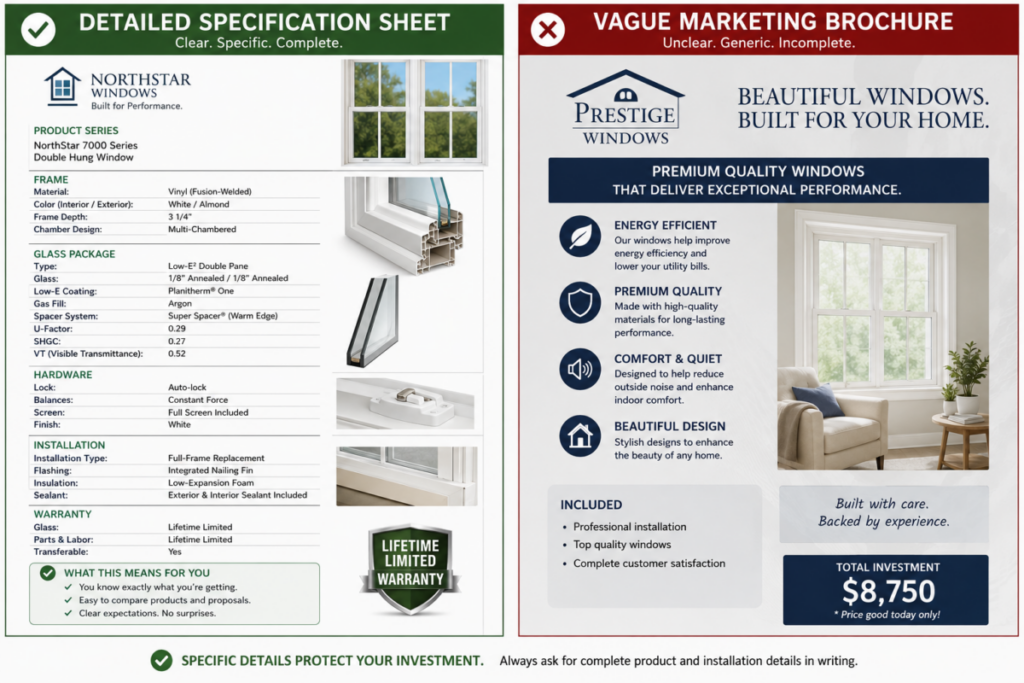
If the proposal says:
- “Energy-efficient glass”
- “High-quality windows”
- “Premium materials”
…but doesn’t specify:
- Frame material
- Glass type
- Spacer system
- Installation method
Then you don’t actually know what you’re buying.
What This Means
You’re being asked to trust general descriptions instead of specific details.
That makes comparison—and accountability—difficult.
What to Do
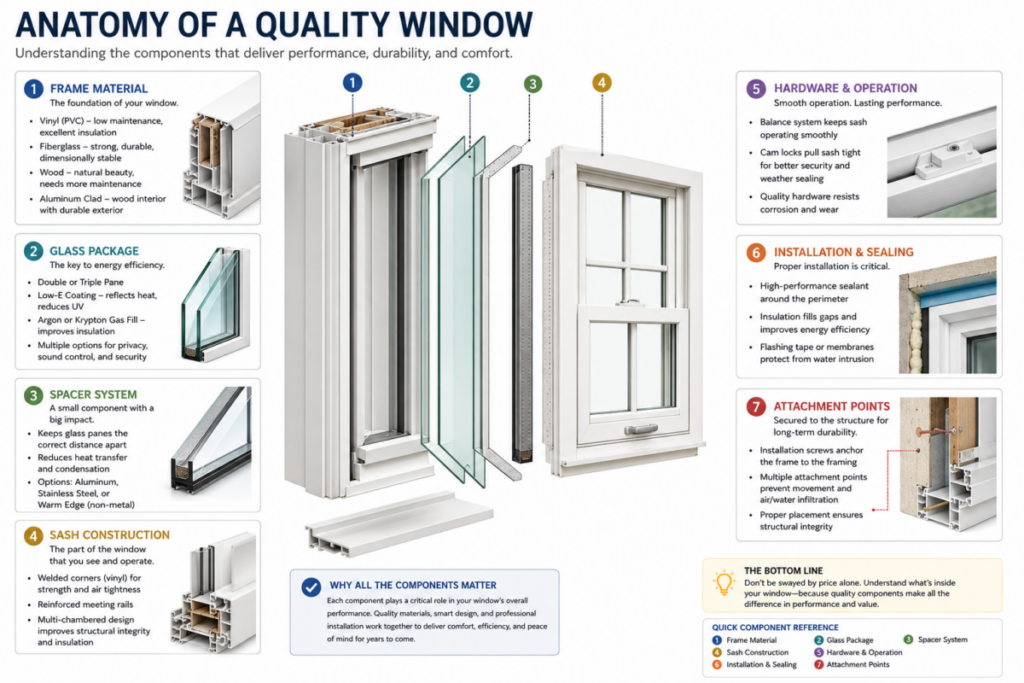
Ask:
- “What exact material is the frame?”
- “What type of spacer system is used?”
- “How is the glass mounted?”
You should get clear answers.
Red Flag #5: Pricing That Changes Dramatically
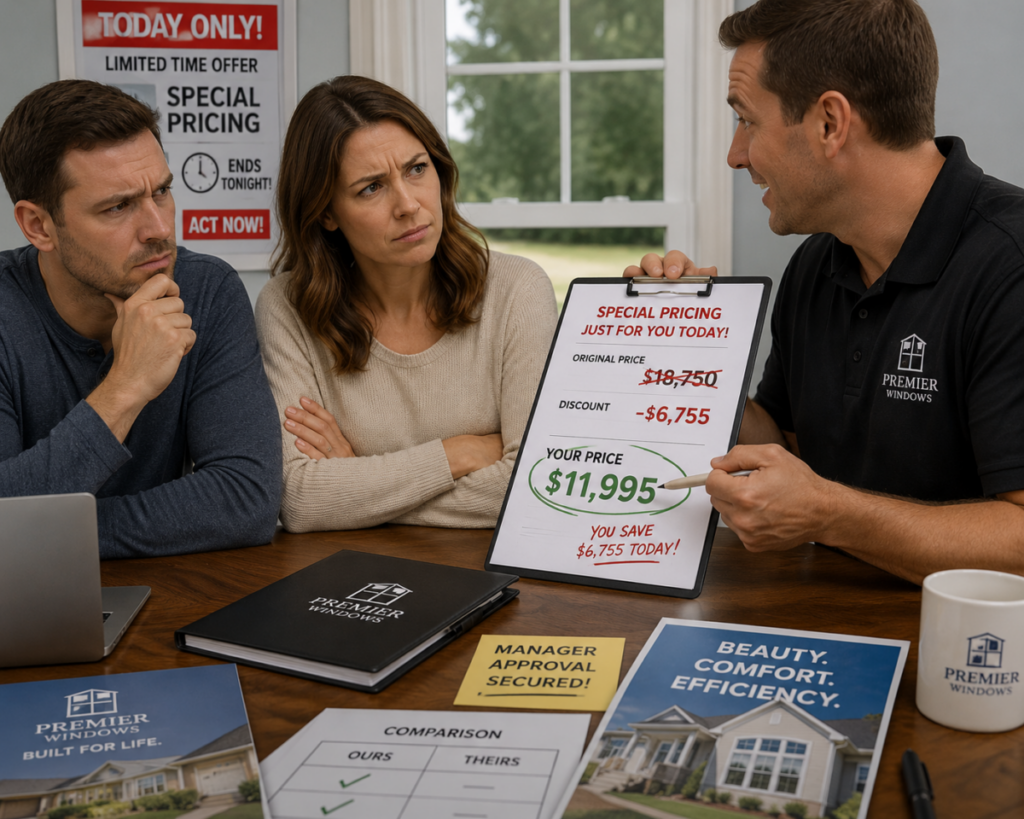
This is another common situation.
You’re given an initial price…
Then it changes.
Sometimes significantly.
How This Shows Up
- “Let me talk to my manager…”
- “We can apply an additional discount…”
- “If you sign today, we can reduce it further…”
What This Means
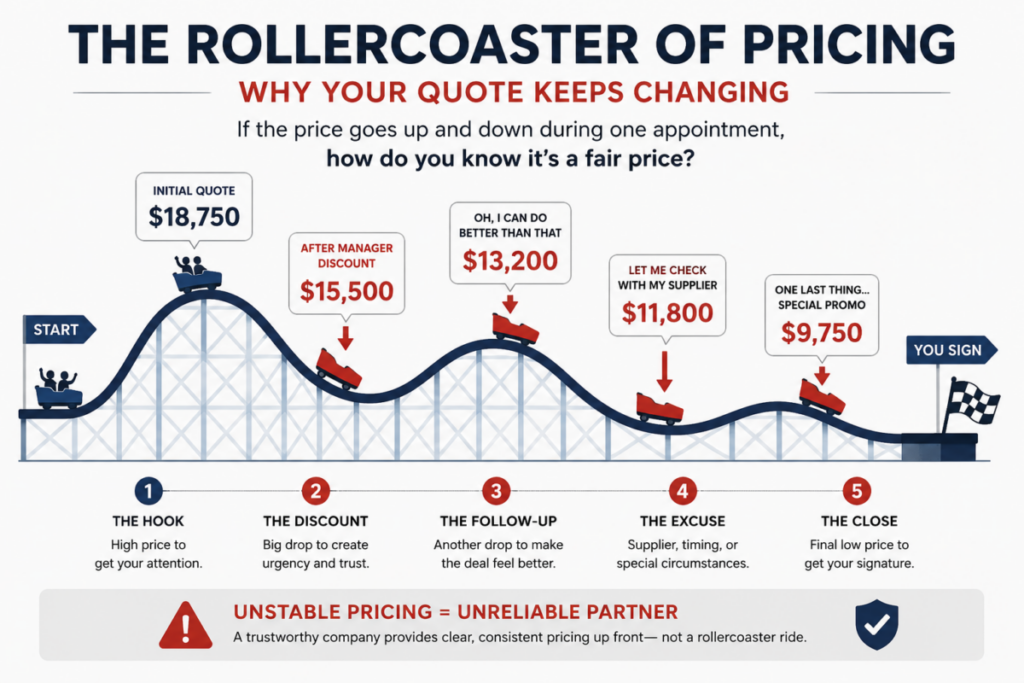
The pricing is not fixed.
It’s part of a negotiation structure.
Why This Matters
If pricing can change quickly, it raises questions about:
- How it was calculated
- What the real value is
- Whether the initial number was accurate
The Pattern Behind These Red Flags
Individually, one of these may not mean much.
But when you see several of them together, it usually points to the same issue:
You are being guided toward a decision—not informed for one.
What a Healthy Process Feels Like

A good experience should feel like:
- Clear explanations
- Specific details
- Written documentation
- No pressure to rush
- Time to think and compare
The Bottom Line
If you encounter any of these red flags:
Slow down. Ask questions. Take your time.
Because once you sign:
- The scope is set
- The price is locked in
- And your ability to change direction is limited

Red Flags vs What You Should Expect
| Red Flag | What You Should Expect Instead |
| Pressure to sign immediately | Time to review and decide |
| Vague explanations | Clear, detailed answers |
| No written scope | Full written breakdown |
| Generic product descriptions | Specific materials and specs |
| Changing pricing | Stable, transparent pricing |
- Important: If you feel rushed, unclear, or pressured, you are not ready to make a decision.
- “I’ve seen homeowners move forward simply because the situation felt urgent—not because they fully understood what they were agreeing to.”
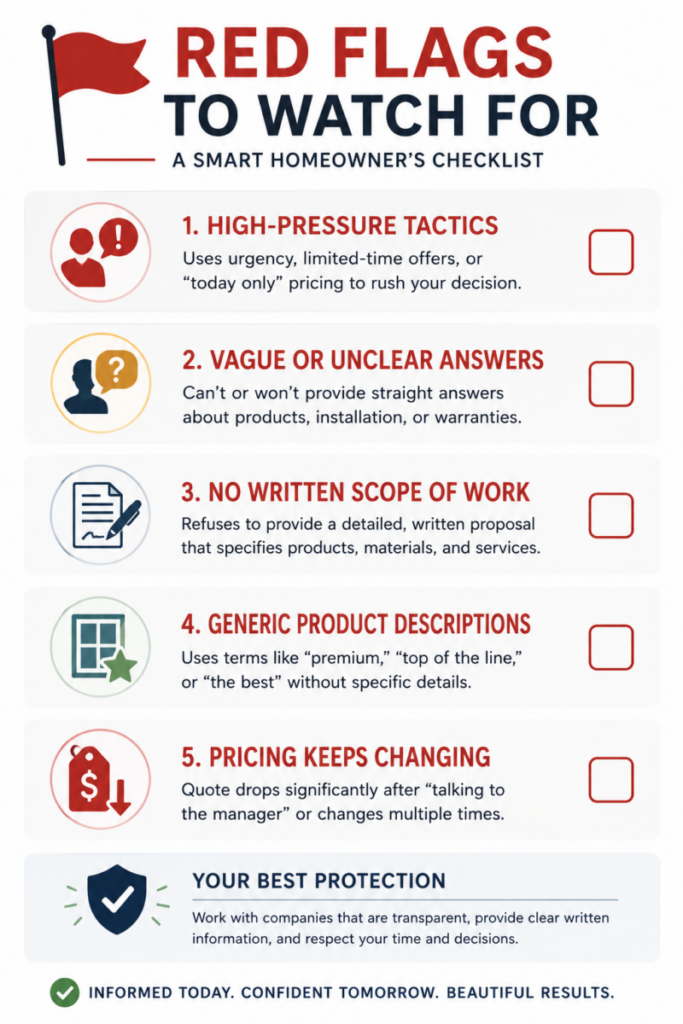

SECTION 10 — WHEN NOT TO BUY PREMIUM WINDOWS
By this point, you’ve seen how much goes into a window decision:
- Materials
- Glass systems
- Installation methods
- Long-term performance
It would be easy to conclude:
“I should just buy the best window I can afford.”
That sounds safe. It sounds logical.
But it’s not always the right decision.
A Common Assumption That Leads to Overspending

Many homeowners believe:
“If I spend more now, I’ll avoid problems later.”
That’s sometimes true.
But not always.
Because the value of a premium window depends on one key factor:
Whether you will actually benefit from what you’re paying for.
What “Premium” Really Means
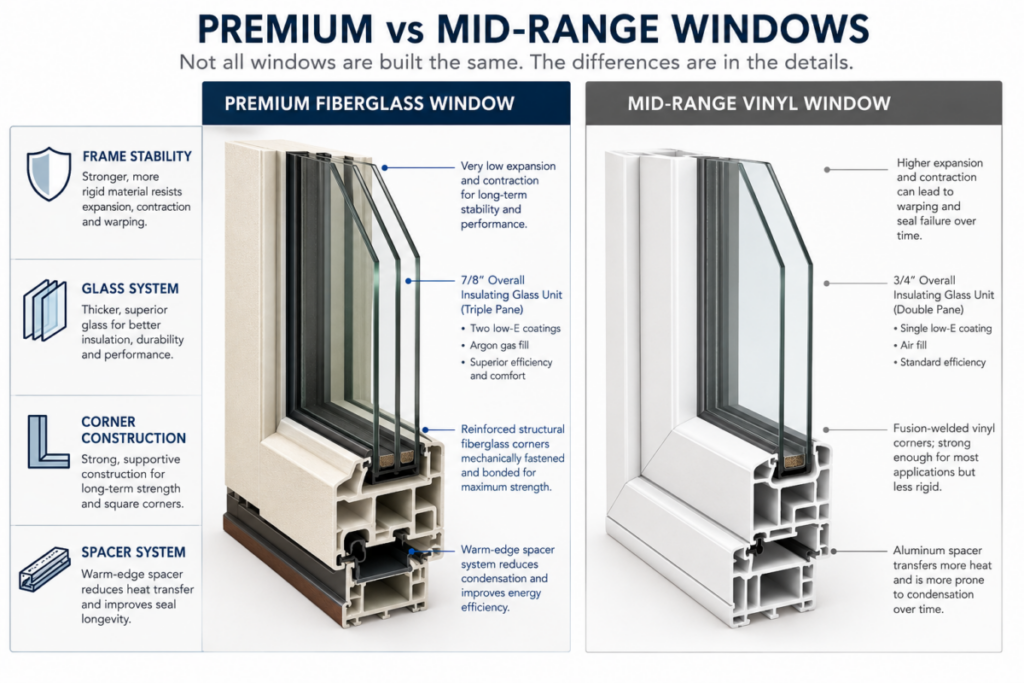
A premium window typically includes:
- More stable frame materials
- Higher-quality glass systems
- Better long-term durability
- More consistent performance over time
Those are real advantages.
But they only matter if:
- You’re going to live with those windows long enough to benefit from them
- Your environment puts enough stress on the system to justify the upgrade
When Premium Windows Usually Make Sense
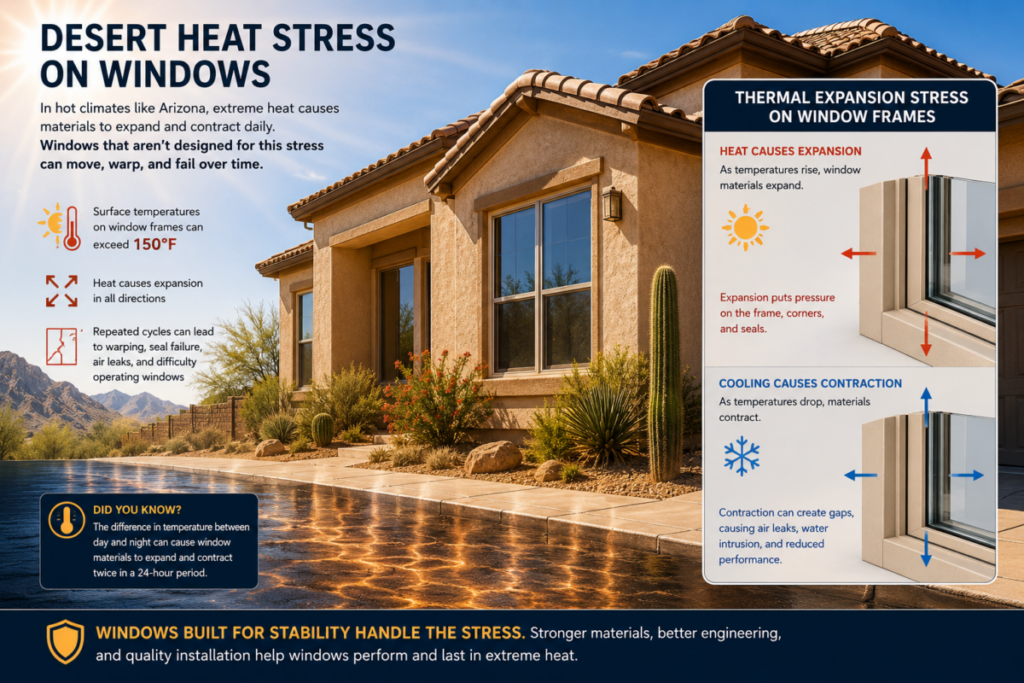
Before we talk about when NOT to buy them, it helps to understand when they do make sense.
Premium is often justified when:
- You plan to stay in the home long-term (10–20+ years)
- Your environment puts stress on materials (heat, sun, expansion cycles)
- You value long-term consistency over upfront cost
- You want to minimize future maintenance and replacement
In those situations, the added cost can align with real long-term value.
When Premium Windows Do NOT Make Sense
This is where most homeowners are not given clear guidance.
There are several situations where paying for premium may not be the best decision.
1. You Plan to Move in the Near Future
If you’re planning to sell your home in:
- 2 years
- 3 years
- Even 5 years
You may never fully benefit from:
- Long-term durability
- Extended lifespan
- Higher-end performance features
Why This Matters
Buyers:
- Rarely pay a premium for premium windows
- Often don’t understand the differences
- Focus more on appearance than construction
So while premium windows may improve the home:
- Theydon’t always return their cost at resale

2. The Home Value Doesn’t Support the Investment
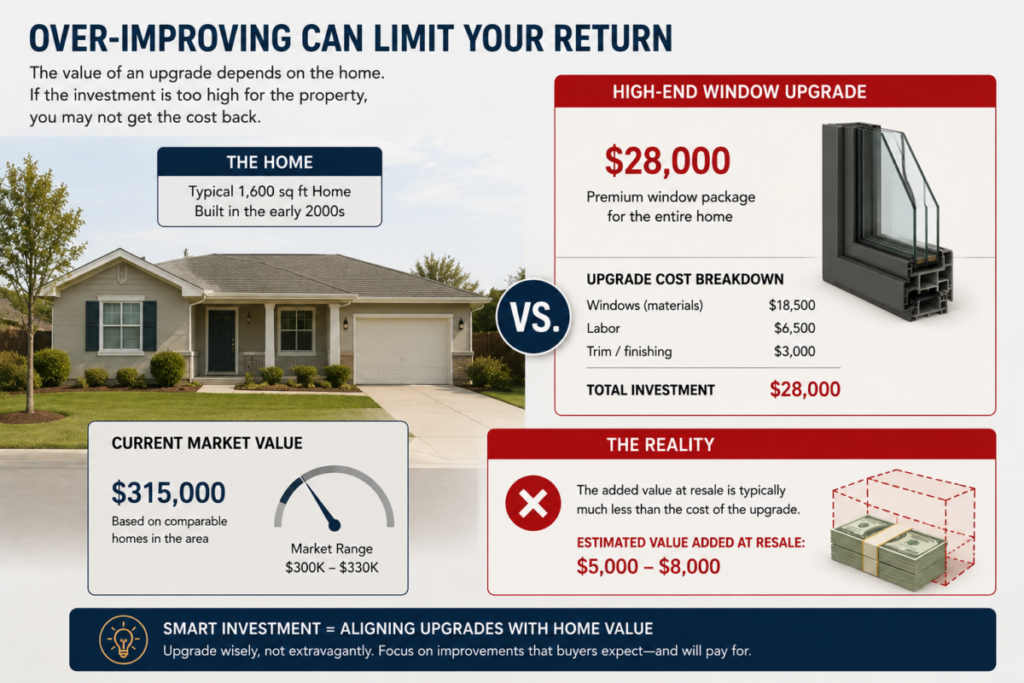
There needs to be alignment between:
- The level of upgrade
- The overall value of the home
If the investment significantly exceeds what the home can reasonably support:
The return becomes limited
Example
Installing a high-end window system in a home where:
- Buyers are not expecting it
- The surrounding features don’t match the upgrade
…may not create proportional value.
3. You Won’t Realize the Long-Term Benefits
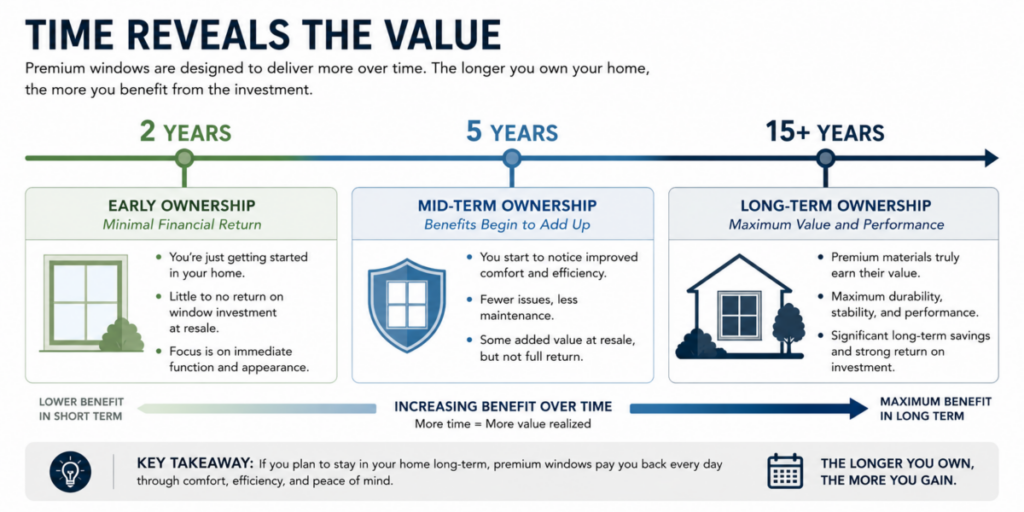
Premium windows are designed for:
- Stability over time
- Reduced material movement
- Longer-lasting seals and components
But if you:
- Don’t plan to stay long-term
- Won’t notice or prioritize those differences
Then you’re paying for benefits you may never experience.
4. Budget Constraints Require Trade-Offs
Sometimes the better decision is not:
“What is the best possible window?”
But:
“What is the best overall decision for my situation?”
If budget is limited, it may be smarter to:
- Choose a solid mid-range option
- Ensure proper installation
- Avoid overextending financially
A Critical Insight
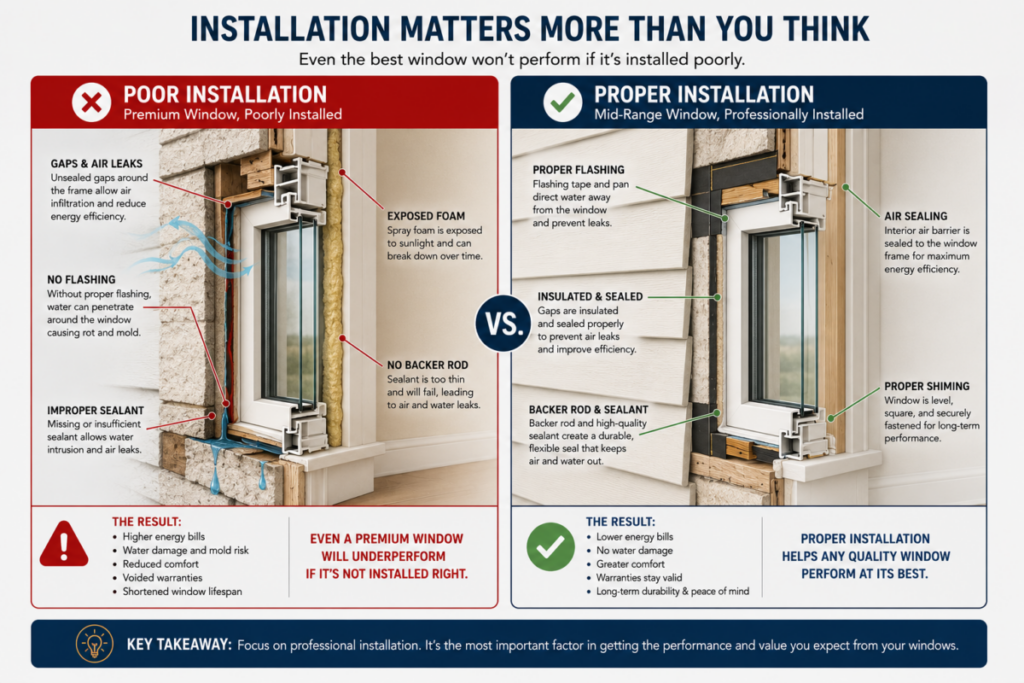
A well-installed mid-range window will almost always outperform a poorly installed premium window.
So if budget forces a choice:
- Prioritize installation quality over product tier
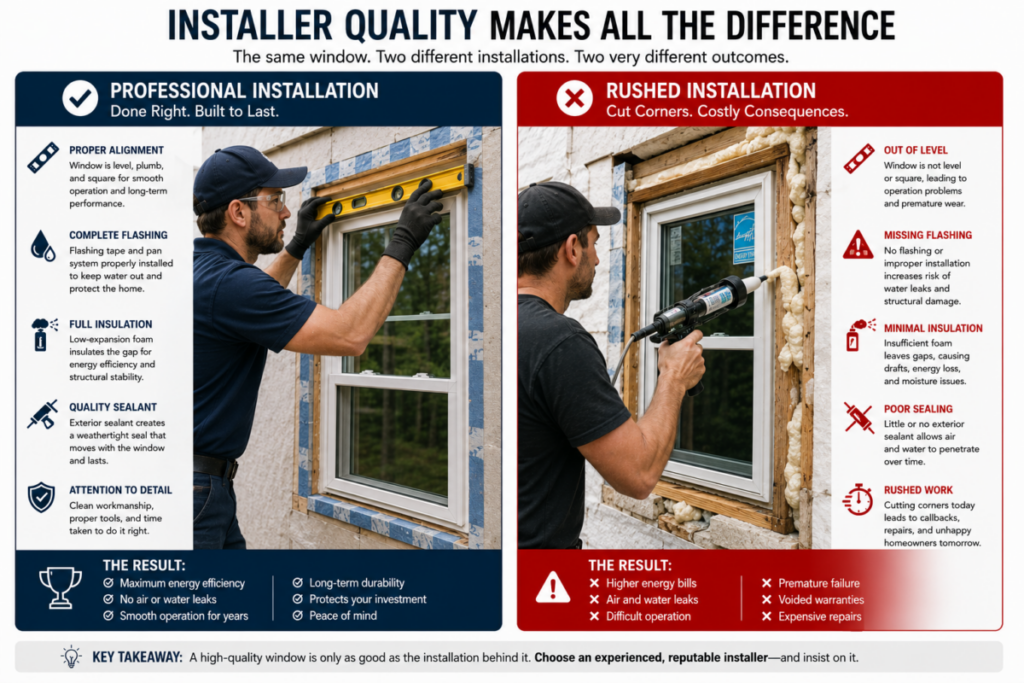
When Lower-Cost Options Make Sense
Lower-cost or mid-range windows may be the right decision when:
- The home is not a long-term residence
- Budget needs to be controlled
- The environment is less demanding
- You’re improving function rather than maximizing performance
The Real Goal
This is what matters most:
Align the level of product with your actual needs—not with assumptions or pressure.
A Better Way to Think About It
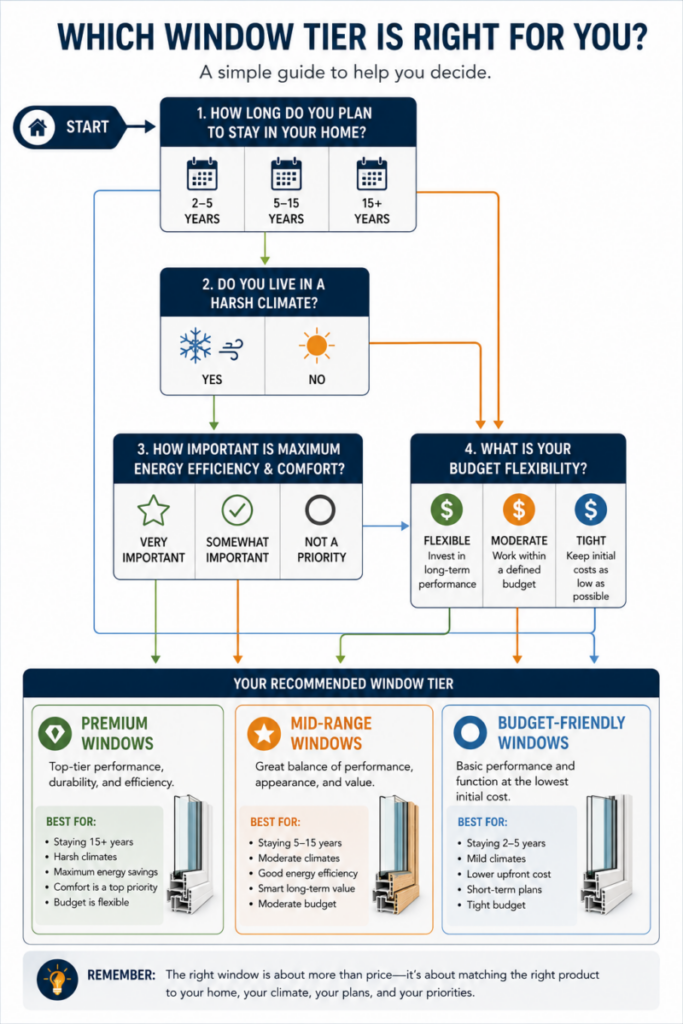
Instead of asking:
“Should I buy the best window available?”
Ask:
“What level of window makes sense for how long I’ll be in this home, and what I need it to do?”
Putting It All Together
At this point, your decision should feel more grounded:
- You understand materials
- You understand installation
- You understand pricing
- And now—you understand when more is not necessarily better
The Bottom Line
Premium windows are not “better” in every situation.
They are better when:
- The conditions justify them
- The timeline supports them
- The homeowner benefits from them
If those things aren’t true:
Spending more doesn’t automatically mean getting more value.
When Premium Makes Sense vs When It Doesn’t
| Situation | Premium Windows Make Sense | Lower-Cost Option May Be Better |
| Long-term ownership | X | |
| Short-term ownership | X | |
| Harsh climate (heat, sun) | X | |
| Moderate environment | X | |
| Budget flexibility | X | |
| Budget constraints | X |
- Important: Spending more only makes sense if you benefit from what you’re paying for.
- “I’ve seen homeowners spend more than they needed to—not because it was the right fit, but because they assumed higher price meant better decision.”
SECTION 11 — FINAL DECISION CHECKLIST: BEFORE YOU SIGN ANYTHING
At this point, you’ve seen how many factors go into a window replacement decision.
- Materials behave differently over time
- Glass systems can succeed—or fail—based on construction
- Installation determines long-term performance
- Pricing can vary based on what’s actually included
That’s a lot to process.
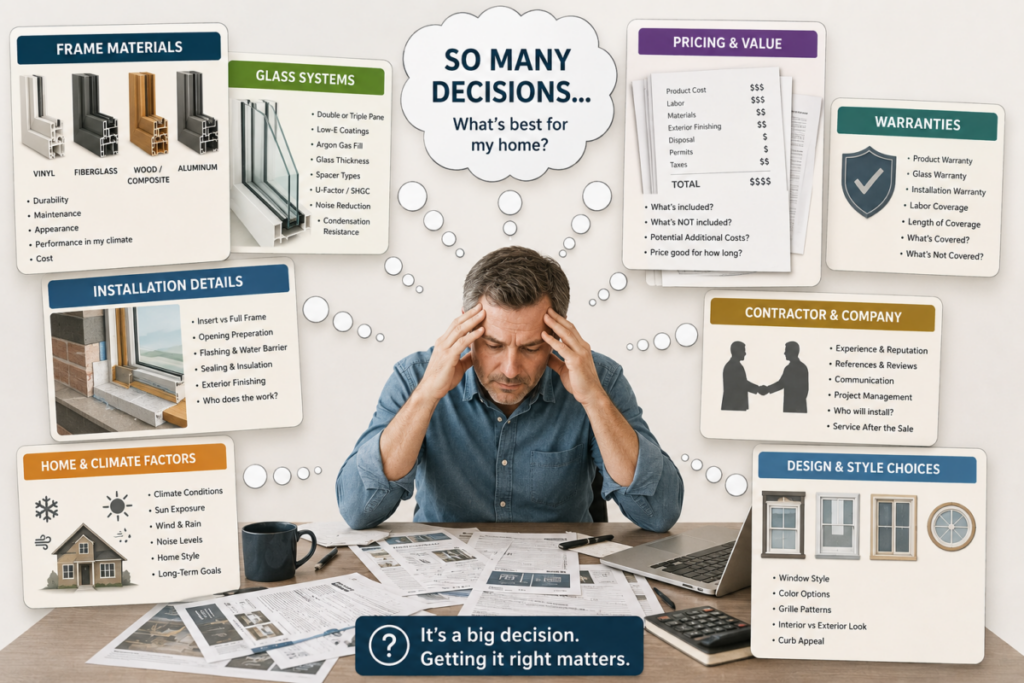
And when you’re sitting at the table, looking at a contract, it’s easy to forget what matters most.
This Checklist Solves That Problem
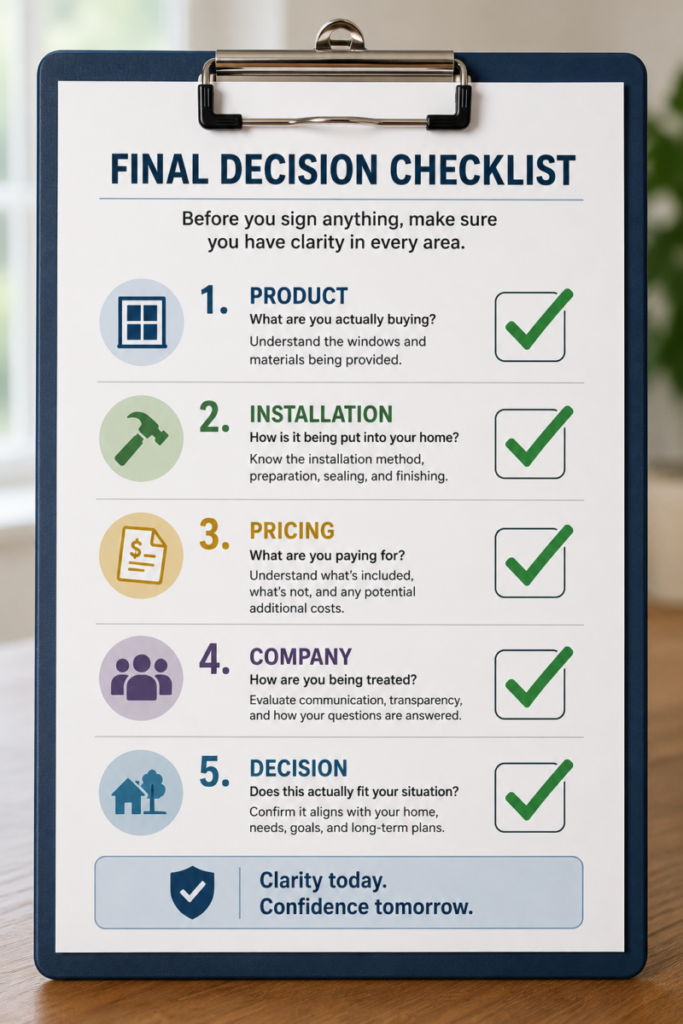
This is not meant to make the decision for you.
It’s designed to do something simpler—and more important:
Slow the decision down and make sure nothing important is missed.
Before you sign anything, you should be able to confidently answer every question below.
If you can’t:
- You’re not ready to move forward yet.
1. PRODUCT— What Are You Actually Buying?
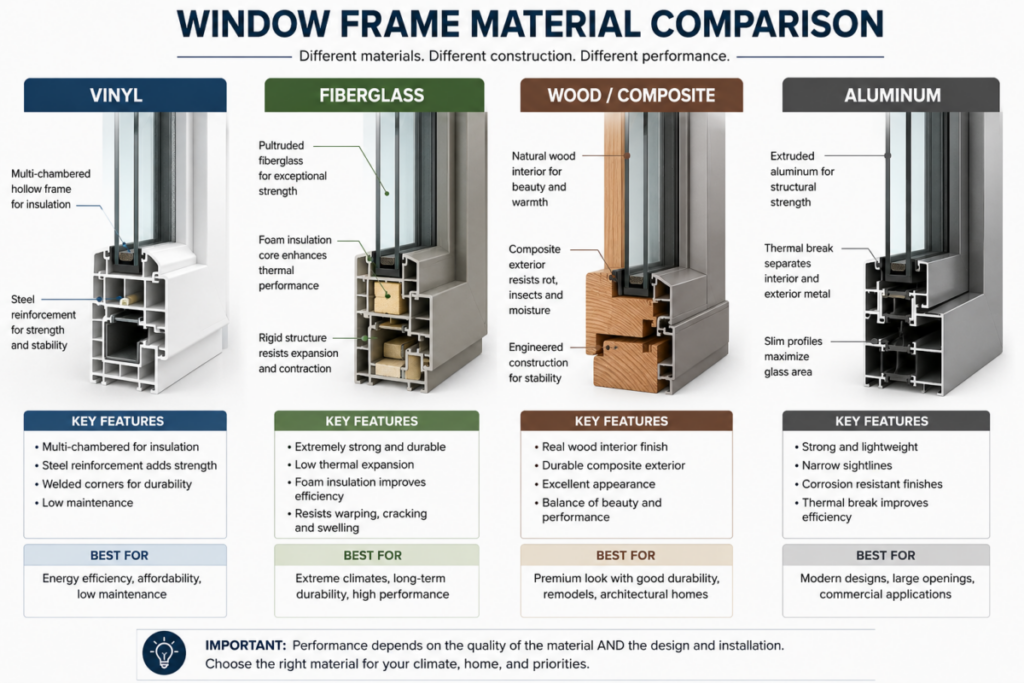
At a minimum, you should clearly understand:
- What frame material is being used?
(Vinyl, fiberglass, wood/composite, aluminum)
- How does that material behave in your climate?
(Expansion, durability, long-term stability)
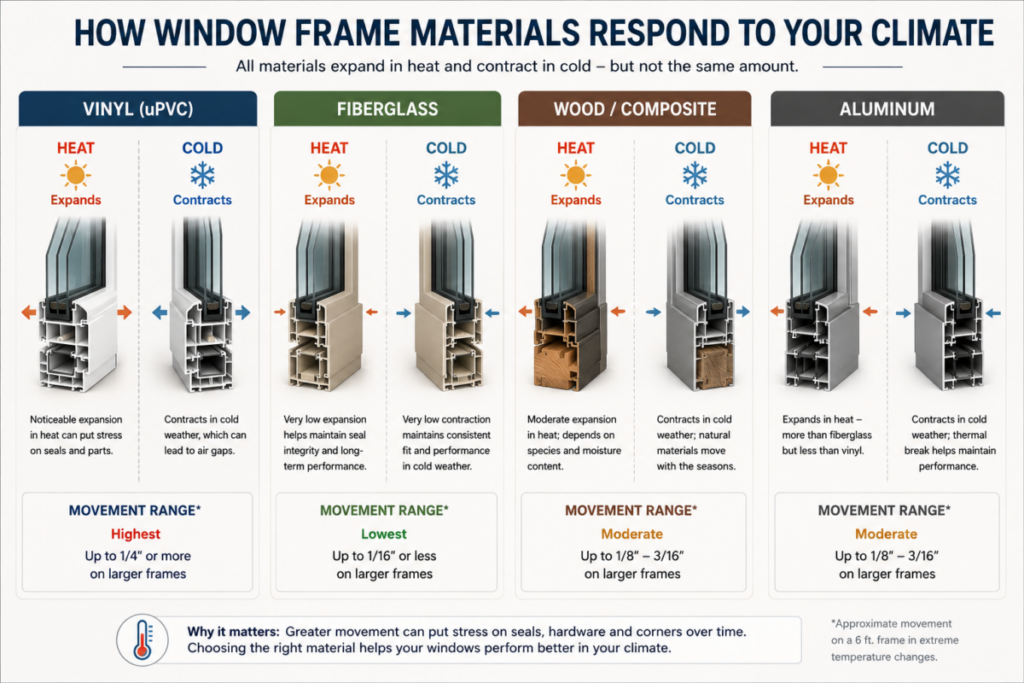
- What glass package is included?
- Double or triple pane
- Argon (or other gas) fill
- Glass thickness
- Spacer system type
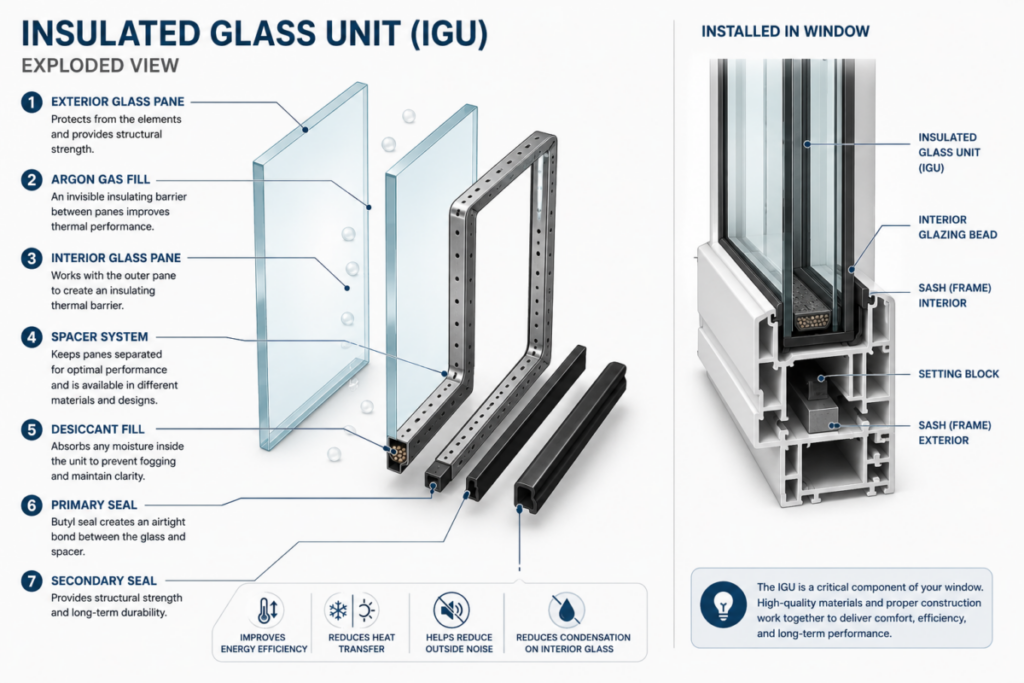
- How is the glass constructed and held in place?
(Encapsulated vs adhesive/tape + glass stop)
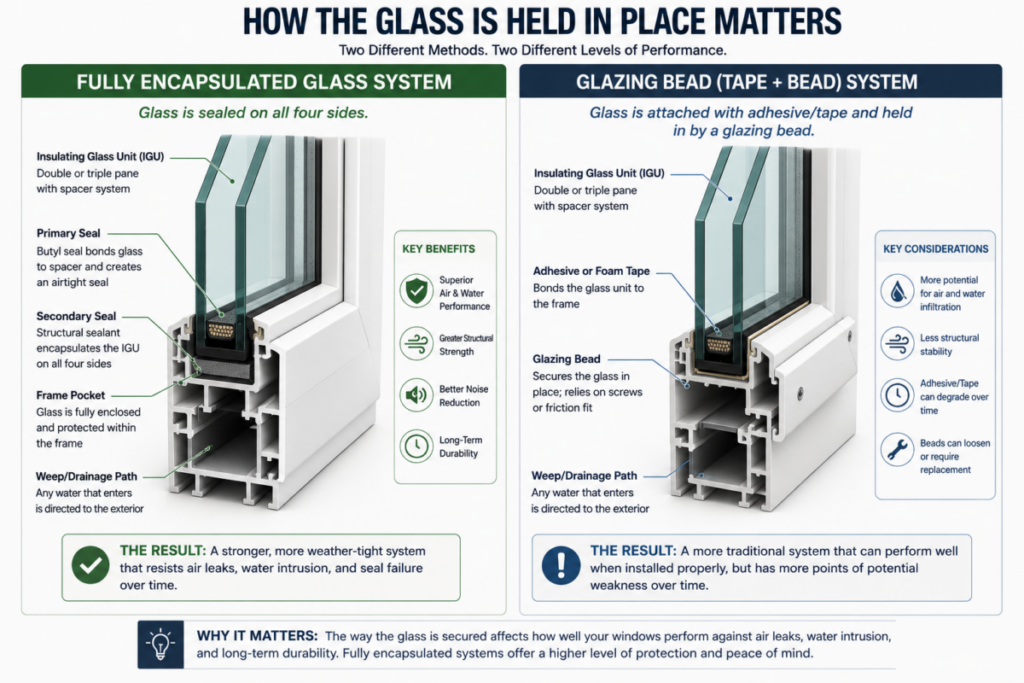
Why This Matters
If you don’t understand the product:
You’re relying on trust instead of clarity

2. INSTALLATION— How Is It Being Put Into Your Home?
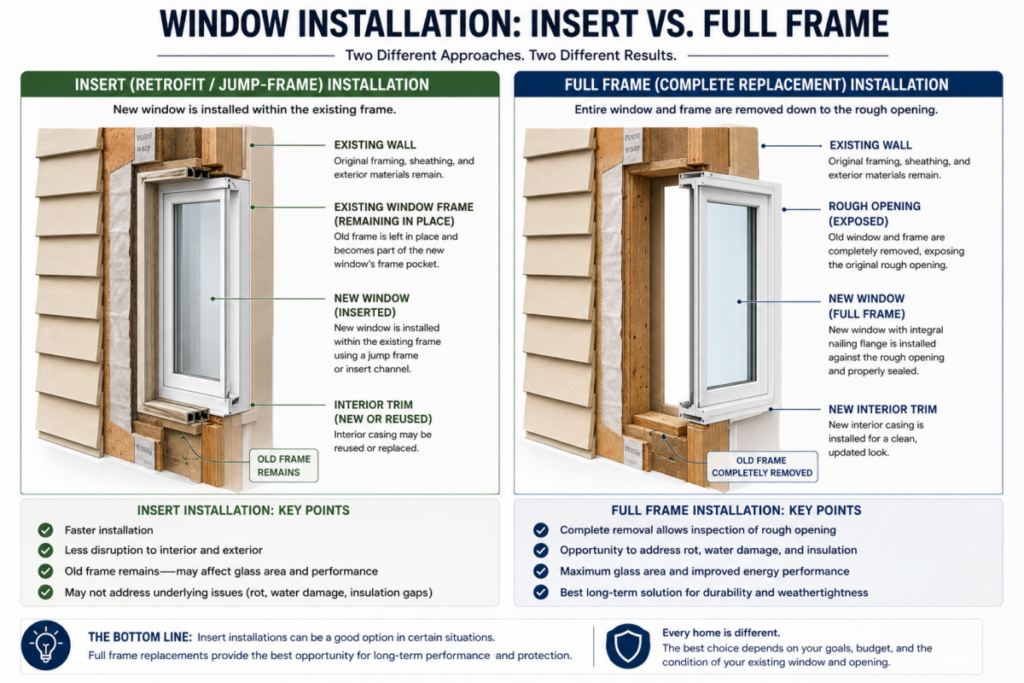
This is one of the most important sections.
You should know:
- Is this an insert (retro-fit, jump-frame) installation or full frame replacement?
- What happens to the existing frame?
(Removed or left in place)
- How is the opening prepared before installation?
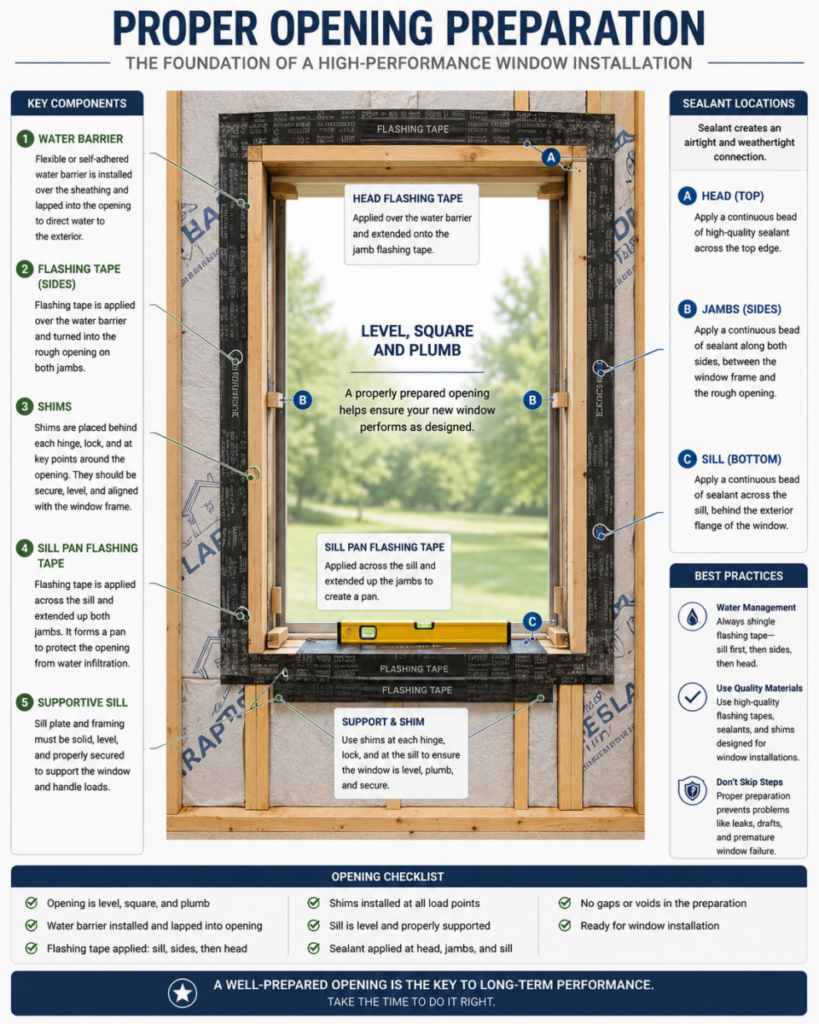
- Is a water barrier or flashing system included?
- How is the window sealed against air and moisture?
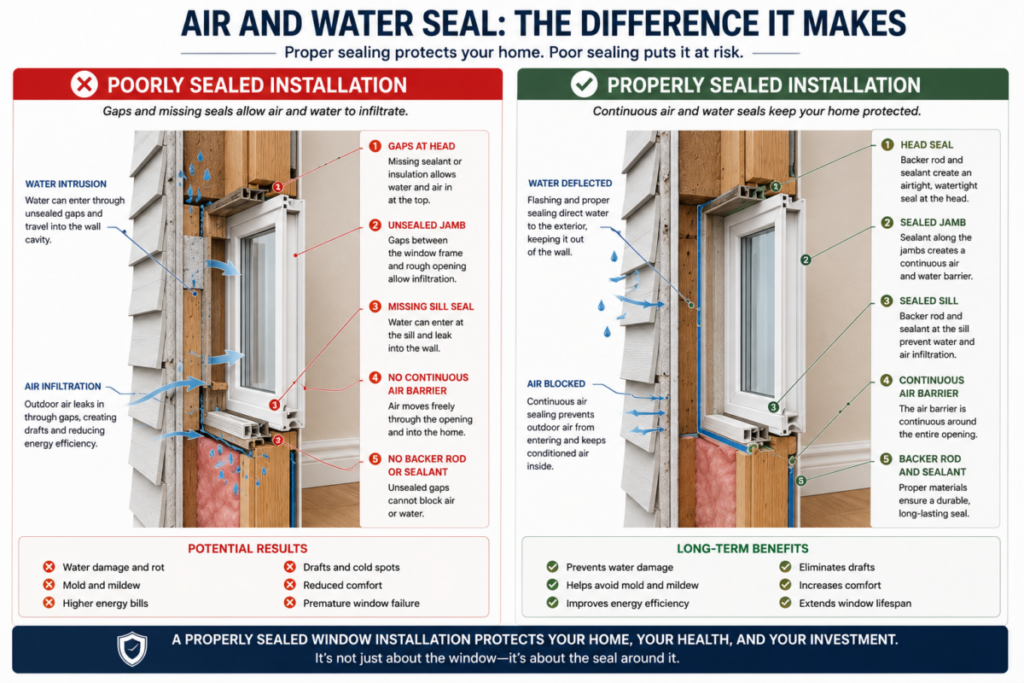
- How is the exterior finished?
(Stucco tie-in, trim work, sealing)
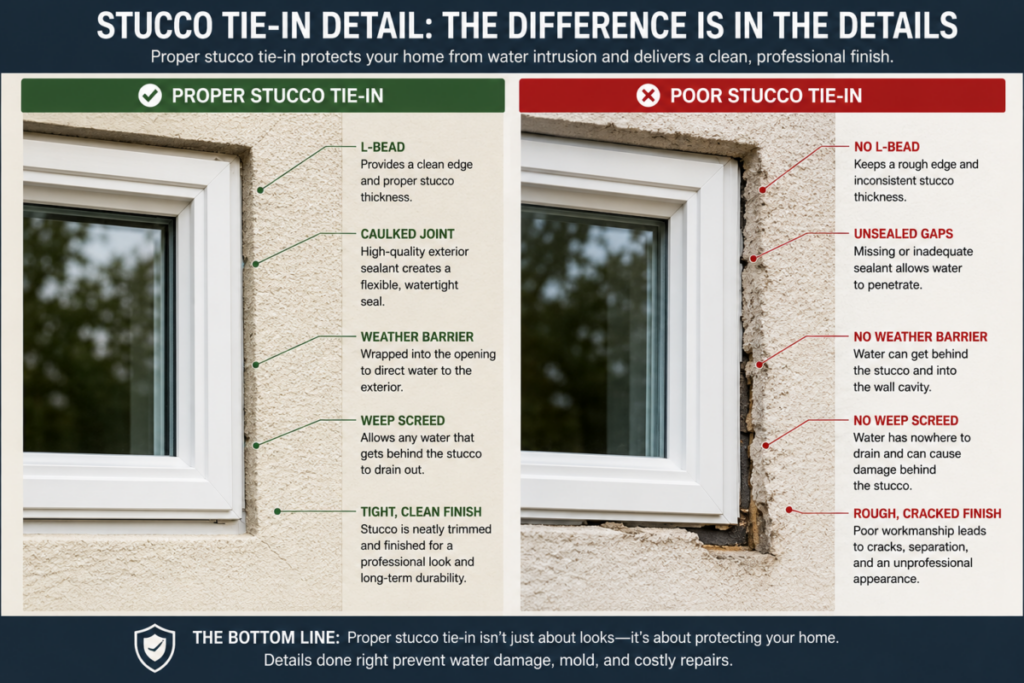
Why This Matters
The installation determines whether the window performs the way it should.
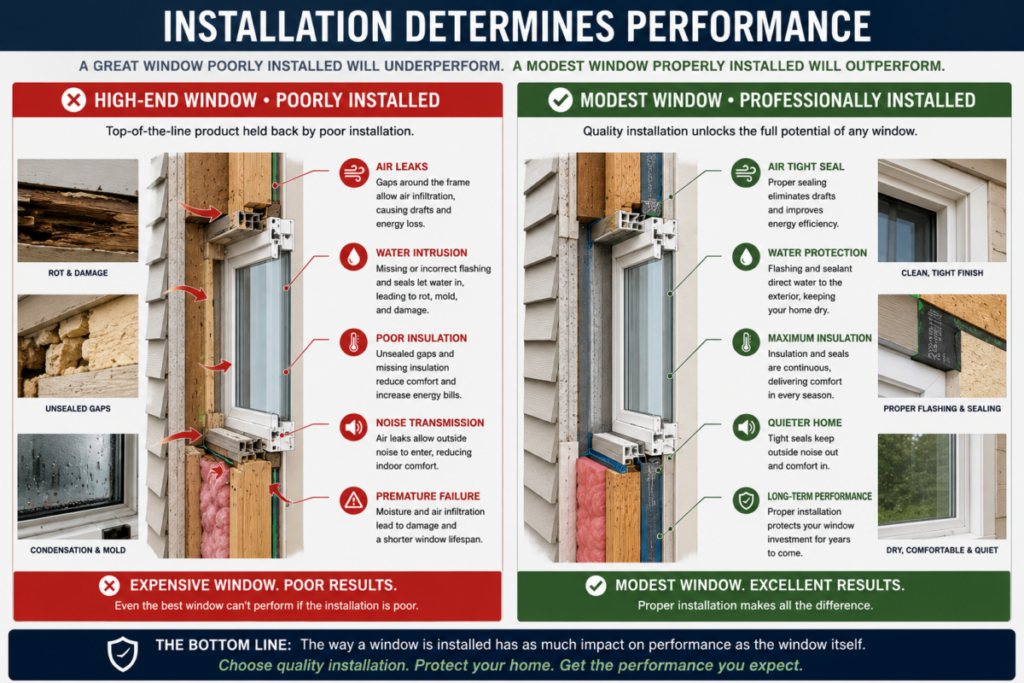
3. PRICING — What Are You Paying For?
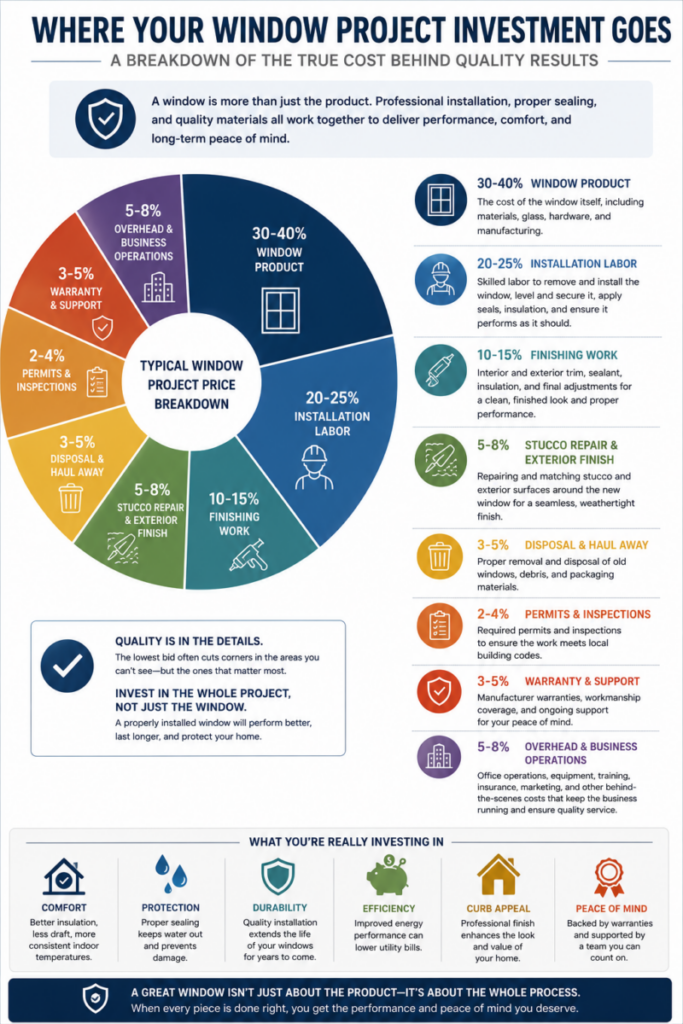
Before agreeing to a price, you should be able to answer:
- What is included in the total price?
- What is NOT included?
(repairs, finishing, unexpected issues)
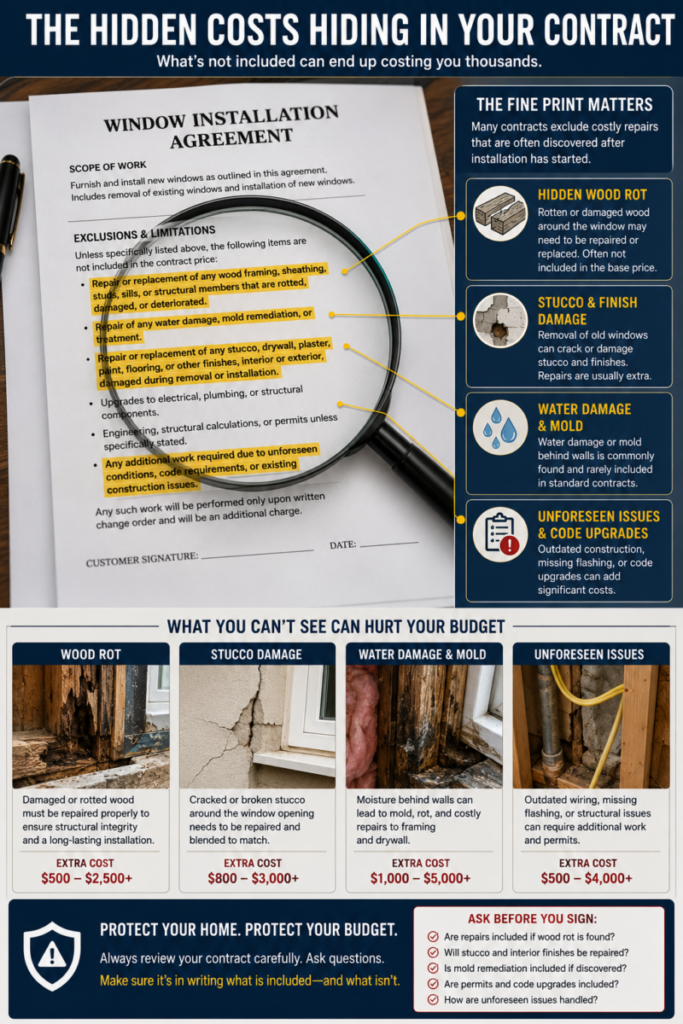
- Are there potential additional costs?
- Is the pricing stable—or dependent on signing immediately?
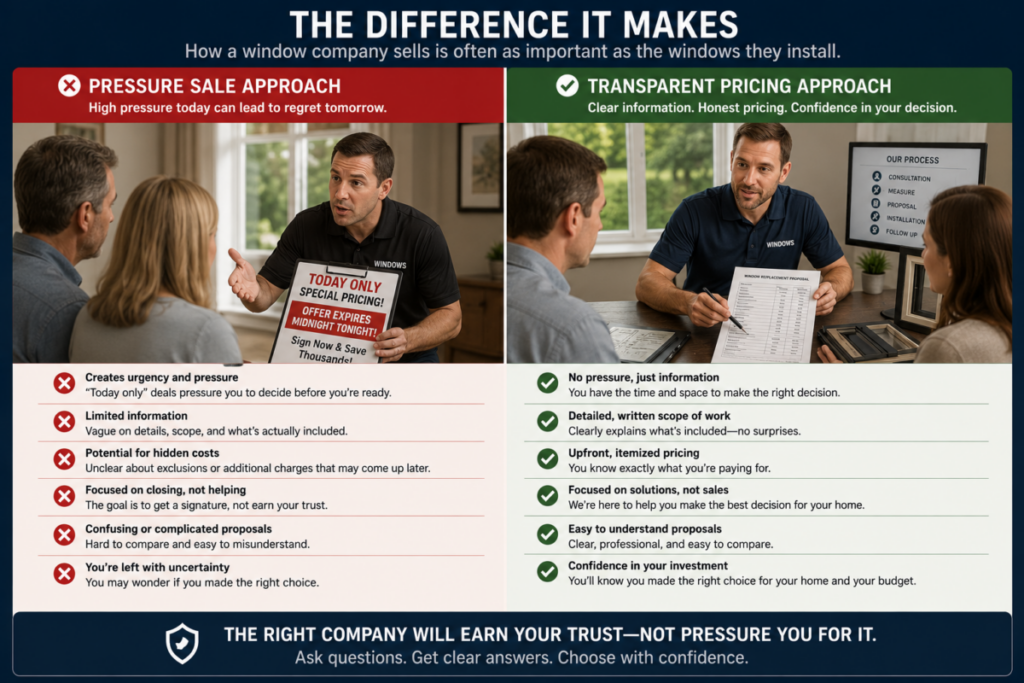
Why This Matters
You can’t evaluate price until you understand scope.
4. COMPANY — How Are You Being Treated?
This is often overlooked—but it matters.
Ask yourself:
- Are they explaining clearly—or avoiding details?
- Are your questions being answered directly?
- Is everything important written down?
- Do you feel informed—or pressured?
Why This Matters
The way the process feels is often a signal of how the project will go.
5. DECISION — Does This Actually Fit Your Situation?
Before signing, step back and ask:
- Does this solution match my home, climate, and needs?
- Does it align with how long I plan to stay?
- Am I paying for benefits I will actually experience?
- Do I clearly understand what I am buying?
The Most Important Question

If I had to explain this decision to someone else, could I do it clearly?
If not, something is still missing.
A Simple Way to Use This Checklist
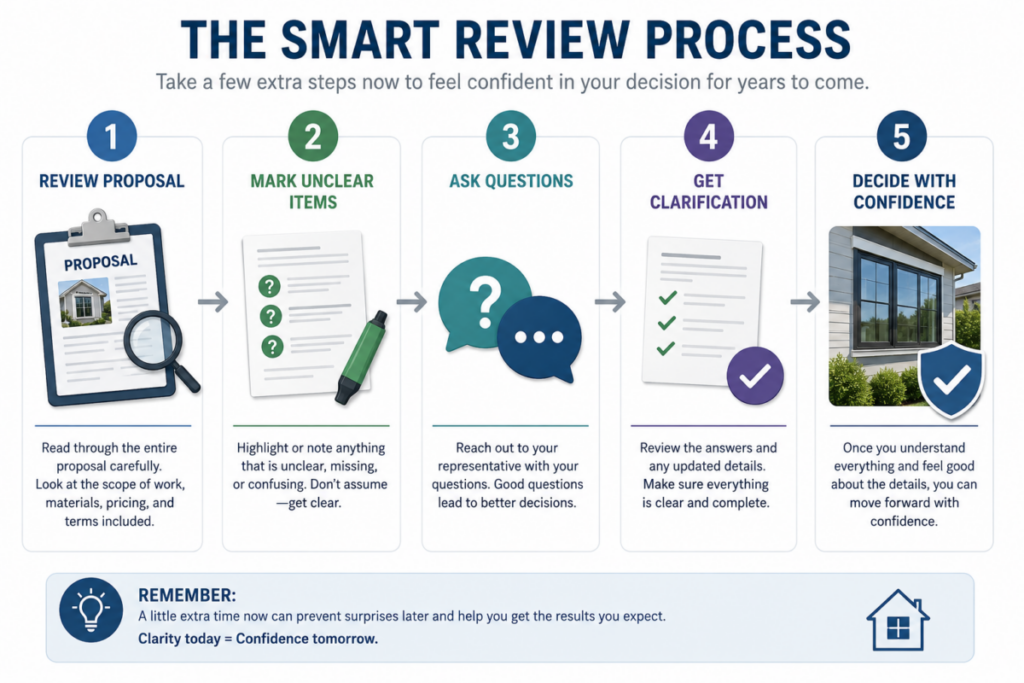
When reviewing a proposal:
- Go through each section slowly
- Mark anything that is unclear
- Ask for clarification before moving forward
This is not about being difficult.
It’s about making a well-informed decision.
The Final Pause (Do Not Skip This)

Before you sign anything, take a moment and ask yourself:
- Do I feel clear?
- Do I feel confident?
- Do I feel rushed?
If you feel rushed:

That is your signal to stop—not proceed.
The Bottom Line
This checklist is your safeguard.
If you use it correctly, it will help you:
- Avoid common mistakes
- Ask better questions
- Understand what you’re agreeing to
And most importantly:
Make a decision you won’t second-guess later

FINAL HOMEOWNER DECISION CHECKLIST
Replacement Windows: How to Avoid Overpaying and Making the Wrong Choice
HOW TO USE THIS CHECKLIST
This checklist is designed to be used AFTER you have narrowed your choices down to the final companies you are considering. Most homeowners make the mistake of focusing almost entirely on window brand names or advertised discounts while overlooking the details that determine whether the windows will actually perform well for the next 20–30 years.
A beautiful showroom sample does not guarantee:
- A quality installation
- Long-term glass seal durability
- Proper waterproofing
- Good warranty support
- Energy efficiency in real-world conditions
- Reduced noise
- Long-term structural stability
- Contractor accountability
The goal of this checklist is to help you evaluate the ENTIRE purchase:
- The window itself
- The glass system
- The frame material
- The installation method
- The contractor
- The warranty
- The total long-term ownership experience
You are not simply buying a window.
You are buying:
- A product
- An installation system
- A labor team
- A long-term service relationship
Print this checklist, or use the workbook and physically score each company side-by-side.
The company with the best sales presentation is often NOT the best long-term choice.
SECTION 1 — FRAME MATERIAL EVALUATION
| QUESTION | COMPANY A | COMPANY B | COMPANY C |
|---|---|---|---|
| What frame material is being used? | |||
| Does the material expand significantly in heat? | |||
| Is the frame designed for extreme desert temperatures? | |||
| Is structural reinforcement required inside the frame? | |||
| What is the expected lifespan of the frame material? | |||
| Will dark exterior colors increase expansion risk? | |||
| Is the frame known for warping, bowing, or seal stress? | |||
| Is fading or chalking common in Arizona sun exposure, or other areas with high heat? | |||
| Are corners mechanically fastened, welded, glued, or reinforced? | |||
| Does the material become brittle with age? | |||
| Would I still choose this material if price were equal? |
WARNING SIGNS
- Extremely thin frame walls
- Excessive frame flex when pressure is applied
- Large hollow vinyl chambers with minimal reinforcement
- Contractors avoiding discussion about thermal expansion
- Salespeople who only discuss U-factor and ignore structural durability
SECTION 2 — GLASS PACKAGE EVALUATION
| QUESTION | COMPANY A | COMPANY B | COMPANY C |
| Double-pane or triple-pane? | |||
| What Low-E coating is being used? | |||
| Is argon or krypton gas included? | |||
| What spacer system is used? | |||
| Is the spacer metal, foam, stainless, or composite? | |||
| How is the glass retained in the sash/frame? | |||
| Is the glass encapsulated or tape/glazing bead retained? | |||
| What is the actual glass thickness? | |||
| Is laminated glass available for sound reduction? | |||
| Is there documentation for SHGC and U-factor ratings? | |||
| What is the expected seal failure rate after 15–20 years? | |||
| Is condensation resistance discussed honestly? |
WARNING SIGNS
- Salespeople unable to explain spacer systems
- No discussion of glass retention methods
- Very thin glass packages
- Heavy reliance on marketing terminology instead of engineering explanation
- No explanation of how thermal movement affects seals over time
SECTION 3 — INSTALLATION METHOD EVALUATION
| QUESTION | COMPANY A | COMPANY B | COMPANY C |
| Full-frame replacement or insert installation? | |||
| Will the old frame remain inside the wall? | |||
| Will stucco or exterior cladding be properly addressed? | |||
| Is waterproofing discussed in detail? | |||
| Will damaged wood be repaired if found? | |||
| Is insulation around the new frame included? | |||
| Will interior trim work be required? | |||
| Will exterior sealants be color matched? | |||
| Is a permit required and included? | |||
| How long is the installation expected to last? | |||
| Who performs the actual labor — employees or subcontractors? | |||
| Is debris haul-away included? |
WARNING SIGNS
- “We just slide the new window inside the old frame.”
- Contractor dismisses waterproofing concerns
- No mention of flashing or drainage management
- No discussion about hidden rot or structural repairs
- Unrealistically fast installation timelines
- Installer cannot clearly explain the process step-by-step
SECTION 4 — CONTRACTOR EVALUATION
| QUESTION | COMPANY A | COMPANY B | COMPANY C |
| How many years has the company been operating? | |||
| Are they licensed, bonded, and insured? | |||
| Are they using trained employees or subcontractors? | |||
| Who services warranty claims? | |||
| Is there a dedicated service department? | |||
| Are online reviews consistent over time? | |||
| Are complaints related to installation or communication? | |||
| Did the salesperson rely heavily on pressure tactics? | |||
| Was pricing transparent and itemized? | |||
| Did they thoroughly inspect the home? | |||
| Did they measure carefully? | |||
| Did they explain WHY their system is different? | |||
| Would I trust this company if the price were identical? |
WARNING SIGNS
- “Today only” pricing pressure
- Refusal to leave written documentation
- Extremely large discount percentages
- Vague answers regarding labor crews
- No discussion of long-term service support
- Reviews mentioning communication problems after installation
SECTION 5 — WARRANTY EVALUATION
| QUESTION | COMPANY A | COMPANY B | COMPANY C |
| Is the manufacturer warranty transferable? | |||
| Is glass breakage included? | |||
| Is labor included or only parts? | |||
| Is seal failure fully covered? | |||
| Is coverage prorated after a certain number of years? | |||
| Who pays for installation labor on warranty claims? | |||
| Are exterior finishes covered against fading? | |||
| Is accidental damage excluded? | |||
| Are screens and hardware covered? | |||
| What voids the warranty? | |||
| Does the installer provide a separate workmanship warranty? | |||
| Is there a clear written process for claims? |
WARNING SIGNS
- “Limited Lifetime Warranty” with excessive exclusions
- Parts-only coverage after a few years
- Labor excluded entirely
- Difficult claim procedures
- Warranty only valid for original owner
- Vague workmanship warranty language
SECTION 6 — ENERGY EFFICIENCY & COMFORT
| QUESTION | COMPANY A | COMPANY B | COMPANY C |
| Will this reduce solar heat gain? | |||
| Will interior comfort likely improve? | |||
| Will HVAC load likely decrease? | |||
| Is sound reduction discussed realistically? | |||
| Are room orientation and sun exposure considered? | |||
| Is condensation resistance discussed honestly? | |||
| Will darker rooms become noticeably dimmer? | |||
| Is there realistic discussion about actual savings? | |||
| Is the product optimized for Arizona conditions? |
WARNING SIGNS
- Unrealistic energy savings claims
- “This window pays for itself.”
- No discussion of orientation or glass selection
- Generic national sales presentation not tailored to climate
SECTION 7 — PRICING & VALUE ANALYSIS
| QUESTION | COMPANY A | COMPANY B | COMPANY C |
| Total project price | |||
| Number of windows/doors included | |||
| Full-frame or insert pricing? | |||
| Financing terms explained clearly? | |||
| Are permits included? | |||
| Are hidden charges possible? | |||
| Is exterior repair work included? | |||
| Is interior repair work included? | |||
| Is disposal included? | |||
| Is this price based on quality or sales tactics? | |||
| Would this still feel like a good value in 10 years? |
WARNING SIGNS
- Massive discounts from artificially inflated starting prices
- Pressure to finance immediately
- “Manager approval” sales tactics
- Very low pricing without detailed scope explanation
- Extremely high pricing without technical justification
SECTION 8 — FINAL DECISION SCORECARD
Rate each category from 1–10.
| CATEGORY | COMPANY A | COMPANY B | COMPANY C |
| Frame material confidence | |||
| Glass package quality | |||
| Installation method confidence | |||
| Contractor trustworthiness | |||
| Warranty confidence | |||
| Energy efficiency confidence | |||
| Long-term durability confidence | |||
| Noise reduction confidence | |||
| Overall value | |||
| Overall confidence level | |||
| TOTAL SCORE |
FINAL QUESTIONS BEFORE SIGNING
Ask Yourself:
- Am I buying based on pressure or logic?
- Did this company educate me or simply sell me?
- Do I fully understand the installation process?
- Do I understand what is NOT covered under warranty?
- Do I trust the company to service problems years later?
- Is this product appropriate for my climate?
- Did I compare installation quality as carefully as product quality?
- Would I still choose this company without the discount deadline?
- If all companies were the same price, who would I choose?
- Am I solving long-term problems or simply buying a sales presentation?
MOST IMPORTANT TAKEAWAY
The best replacement window project is usually NOT:
- The cheapest
- The most advertised
- The company offering the biggest discount
- The company with the most aggressive salesperson
The best project is usually the one that combines:
- A structurally stable frame
- A durable glass system
- A proper installation method
- Realistic warranties
- A trustworthy contractor
- Long-term service support
A great installation with a good window is usually far better than a poor installation with a premium window.
Most homeowners will only replace their windows once.
Take your time.
Compare carefully.
Evaluate the entire system — not just the sales presentation.